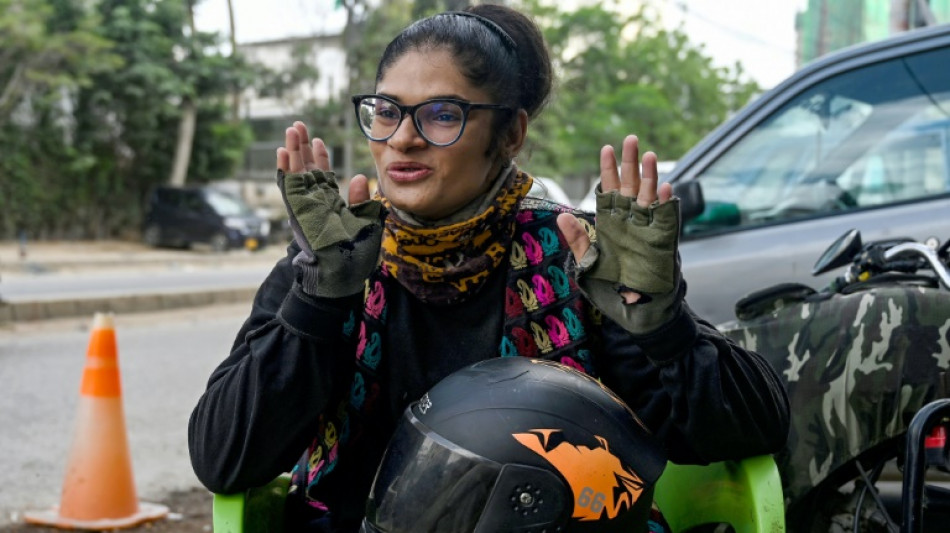
Women ride Pakistan's economic crisis into the workplace / Photo: © AFP

 Cambodia no 'safe haven' for cyberscams, PM says
 North Korea weightlifter sets three world records for Asian Games gold
 A Full Moon for Every Child: STARTRADER's STARCARES Brings Support to SOS Children's Village Ho Chi Minh City

 Meta leans into AI, smart glasses amid privacy pushback

 Battered Duerer masterpiece up for five-year revamp
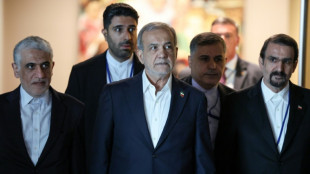
 Trump met with Venezuela's interim leader at UN

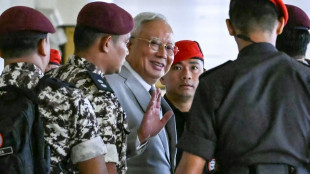 Malaysia furore after Najib wins conditional house arrest

 Italy hope for new dawn under Mancini

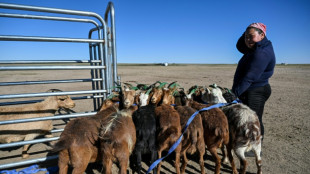 Mongolian herders enlist new tech against harsher, drier climate

 Tata turmoil shines light on India succession woes

 World Cup 'not enough' as Spain begin next chapter

 Meta acts against 3.7 mn scammers' accounts with Singapore police help

 Australia PM says draft social media rules about taking back control

 Voting opens in Alaska's annual Fat Bear Week

 MLS coach axed for telling female ref 'It's a man's game'

 US refuses to give Sudan's de facto leader visa for UN

 Man City hold Bayern to start Women's Champions League, Arsenal win late

 Trump threatens Iran with 'hell' but reveals fresh talks

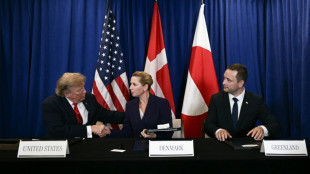 Trump signs security deal with Greenland, Denmark at UN

 Trump threatens Iran with 'hell' but unveils fresh talks

 Chile's Atacama Desert blossoms with life after El Nino rains

 Sri Lanka hands 220-year jail terms to 15 convicted of Easter bombings

 Typhoon Dujuan leaves 7 dead in Japan from landslides, flooding: media

 Ganna and Borghini lead Italy to mixed relay gold at cycling worlds

 Drug cocktail killed former child star Hayden Panettiere: coroner

Amina Sohail veers through heavy traffic to pick up her next passenger –- the sight of a woman riding a motorcycle drawing stares in Pakistan's megacity of Karachi.
The 28-year-old is the first woman in her family to enter the workforce, a pattern emerging in urban households coming under increasing financial pressure in Pakistan.
"I don't focus on people, I don't speak to anyone or respond to the hooting, I do my work," said Sohail, who joined a local ride-hailing service at the start of the year, transporting women through the dusty back streets of the city.
"Before, we would be hungry, now we get to eat at least two to three meals a day," she added.
The South Asian nation is locked in a cycle of political and economic crises, dependent on IMF bailouts and loans from friendly countries to service its debt.
Prolonged inflation has forced up the price of basic groceries such as tomatoes by 100 per cent. Electricity and gas bills have risen by 300 per cent compared to July last year, according to official data.
Sohail used to help her mother with cooking, cleaning and looking after her younger siblings, until her father, the family's sole earner, fell sick.
"The atmosphere in the house was stressful," she said, with the family dependent on other relatives for money. "That's when I thought I must work."
"My vision has changed. I will work openly like any man, no matter what anyone thinks."
- 'Get her married' -
Pakistan was the first Muslim nation to be led by a woman prime minister in the 1980s, women CEOs grace power lists in Forbes magazine, and they now make up the ranks of the police and military.
However, much of Pakistani society operates under a traditional code which requires women to have permission from their family to work outside of the home.
According to the United Nations, just 21 percent of women participate in Pakistan's work force, most of them in the informal sector and almost half in rural areas working in the fields.
"I am the first girl in the family to work, from both my paternal and maternal side," said Hina Saleem, a 24-year-old telephone operator at a leather factory in Korangi, Karachi's largest industrial area.
The move, supported by her mother after her father died, was met with resistance from her extended family.
Her younger brother was warned that working could lead to socially unacceptable behaviour, such as finding a husband of her choice.
"My uncles said 'get her married'," she told AFP. "There was lots of pressure on my mother."
At the changeover of shifts outside the leather factory, workers arrive in painted buses decorated with chinking bells, with a handful of women stepping out amid the crowd of men.
Nineteen-year-old Anum Shahzadi, who works in the same factory inputting data, was encouraged by her parents to enter the workforce after completing high school, unlike generations before her.
"What is the point of education if a girl can't be independent," said Shahzadi, who now contributes to the household alongside her brother.
Bushra Khaliq, executive director for Women In Struggle for Empowerment (WISE) which advocates for political and economic rights for women, said that Pakistan was "witnessing a shift" among urban middle class women.
"Up until this point, they had been told by society that taking care of their homes and marriage were the ultimate objective," she told AFP.
"But an economic crunch and any social and economic crises bring with them a lot of opportunities."
- 'We are companions' -
Farzana Augustine, from Pakistan's minority Christian community, earned her first salary last year at the age of 43, after her husband lost his job during the Covid-19 pandemic.
"My wife had to take over," Augustine Saddique explained to AFP.
"But it is nothing to be sad about, we are companions and are running our house together."
The sprawling port metropolis of Karachi, officially home to 20 million people but likely many millions more, is the business centre of Pakistan.
It pulls in migrants and entrepreneurs from across the country with the promise of employment and often acts as a bellwether for social change.
Nineteen-year-old Zahra Afzal moved to Karachi to live with her uncle four years ago, after the death of her parents, leaving her small village in central-eastern Pakistan to work as a childminder.
"If Zahra was taken by other relatives, she would have been married off by now," her uncle Kamran Aziz told AFP, from their typical one room home where bedding is folded away in the morning and cooking is done on the balcony.
"My wife and I decided we would go against the grain and raise our girls to survive in the world before settling them down."
Afzal beams that she is now an example for her sister and cousin: "My mind has become fresh."
D.Schaer--VB