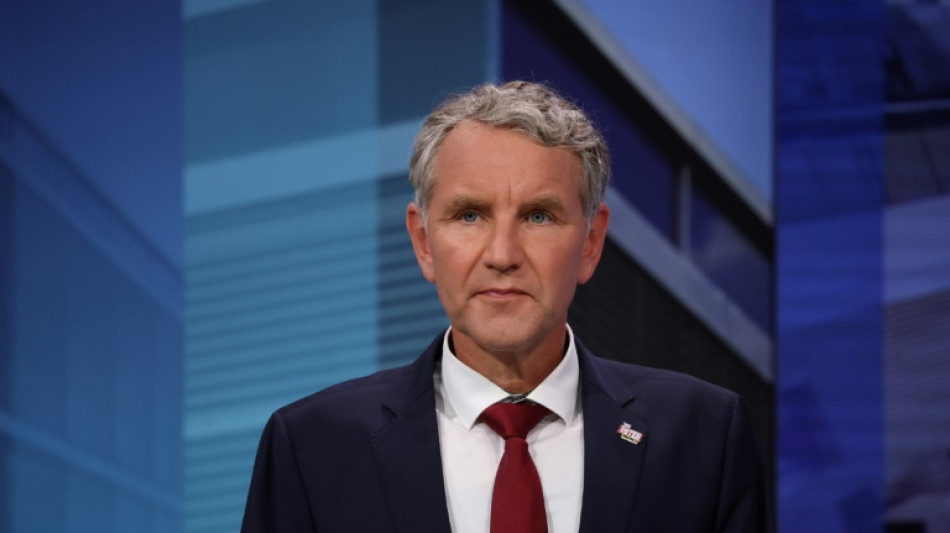
Scholz urges German parties to isolate far right / Photo: © AFP

 Swiss voters expected to shun stricter neutrality
 Rapper-turned-PM faces first big test after Nepal disaster

 Tuchel seeks tonic to England World Cup 'scar' in Spain showdown

 'Helps me cope': Catholic baptisms rise among French youth

 Colombians in Santa Marta stay inside after violence wracks the city

 Iran airlines cancel flights as US sanctions hit
 Meta launches camera-free AI glasses amid privacy pushback
 Australian PM says OpenAI hacked government health website

 Xi arrives in US to personal Trump welcome
 Morocco elects new parliament amid social frustration, youth discontent
 Scheffler and Burns to face Im and Lee in Presidents Cup opener
 Crushing wins for Lyon and Barca in women's Champions League
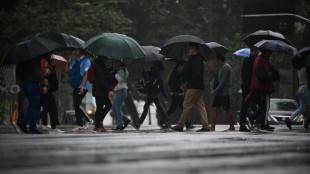 Rio breaks record for rainiest September amid powerful El Nino
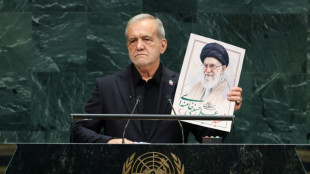
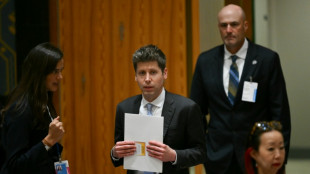 At UN, tech chiefs urge caution in AI development
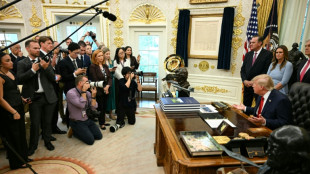
 Russian strikes kill seven in Ukraine, Zelensky vows winter campaign
 Venezuelan shot by ICE needs urgent medical care, mother tells AFP
 Zelensky says Putin using fighters from 47 countries in Ukraine war
 Klopp calls on Germany to 'rise above ourselves' as new era begins

 Russian strikes kill seven in Ukraine as Russia vows no 'pause' to war

 ArcPoint Expands Globally with Institutional Intelligence Platform for Modern Investors
 Ronaldo focussing on 'present' ahead of Wales test

 Outgoing UN chief makes final climate push at New York summit
 Grief and pain flow at hearing for Canadian suicide poison vendor

 Ireland boss Hallgrimsson says timing of Israel remarks 'not clever'
 Weinstein resentenced to 15 years in prison for 2006 sex assault
German Chancellor Olaf Scholz on Monday urged parties to avoid collaborating with the far right, after the AfD made record gains in two regional polls and his own coalition suffered a heavy defeat a year before a general election.
In the former East German state of Thuringia, the anti-immigrant, anti-Islam AfD became the first far-right party to win a regional election since World War II, taking around 33 percent of the vote on Sunday.
The AfD was headed for a close second place in neighbouring Saxony.
Germany's topselling Bild daily described the outcome as "a political earthquake".
Scholz, whose deeply unpopular three-party coalition received a slapdown in both states, called the results "bitter" and "worrying".
"The AfD is damaging Germany. It is weakening the economy, dividing society and ruining our country's reputation," he said.
"All democratic parties are now called upon to form stable governments without right-wing extremists," he said in a message on Facebook.
Coalition governments are the norm in Germany at federal and state level, and mainstream parties have always ruled out collaboration with the far right.
But AfD co-leader Alice Weidel said she believed the "undemocratic firewall" was untenable given the party's electoral success, while fellow leader Tino Chrupalla said there would be "no politics without the AfD".
- 'Reasonable government' -
The conservative CDU, the only centrist party to perform strongly on Sunday, was quick to dismiss the idea of teaming up with the AfD.
"Voters know that we do not form coalitions with the AfD," said Carsten Linnemann, the general secretary of the conservative CDU.
The CDU only narrowly edged out the AfD with 32 percent of the vote in Saxony, and came second in Thuringia.
The conservatives still hold hopes of leading the next government in Thuringia, with their lead candidate Mario Voigt appealing for a "reasonable government" in a coalition led by the CDU.
The AfD's controversial local leader, Bjoern Hoecke, meanwhile declared that his party was the "people's party in Thuringia".
"We need change and change will only come with the AfD," he said, hailing the "historic result".
Hoecke has often caused outrage with his outspoken statements and was fined twice this year for deliberately using a banned Nazi slogan.
Sahra Wagenknecht, who heads the far-left BSW, said her party "cannot work together" with Hoecke and has long ruled out a coalition with the AfD.
BSW, formed earlier this year as a breakaway from the ex-communist Linke party, secured vote shares in the teens in both regional polls and is seen as a key building block in any coalition.
BSW however has serious differences with the more established parties, complicating negotiations, including a dovish stance towards Russia and opposition to the planned stationing of US missiles in Germany.
- 'Alarming' -
Political divisions and the complicated electoral maths mean "forming a government will be difficult" after the two regional elections, said Marianne Kneuer, a professor of politics at the Dresden University of Technology.
The election result was also a "big slap for the entire government and Olaf Scholz", Kneuer said, as voters showed their discontent with the deeply unpopular three-party coalition in Berlin.
Scholz's Social Democrats recorded meek results, scoring around seven percent in Saxony and falling to six percent in Thuringia.
The chancellor's partners in a fractious coalition -- the liberal FDP and the Greens -- struggled even more.
The FDP fell below the five-percent threshold for seats in both elections, while in Saxony the Greens only scraped in.
The results were "nothing to celebrate", Social Democrats party chair Lars Klingbeil said, adding that the party had to be "better".
The run up to the elections was dominated by a bitter debate over immigration stirred up by a suspected Islamist knife attack a few days before the vote.
Opposition parties, including the AfD and the CDU, seized on the deadly stabbing in the western city of Solingen to criticise the government for its supposedly lax border regime.
The government has sought to respond to the alarm by announcing stricter knife controls and rules for migrants in Germany illegally.
W.Huber--VB