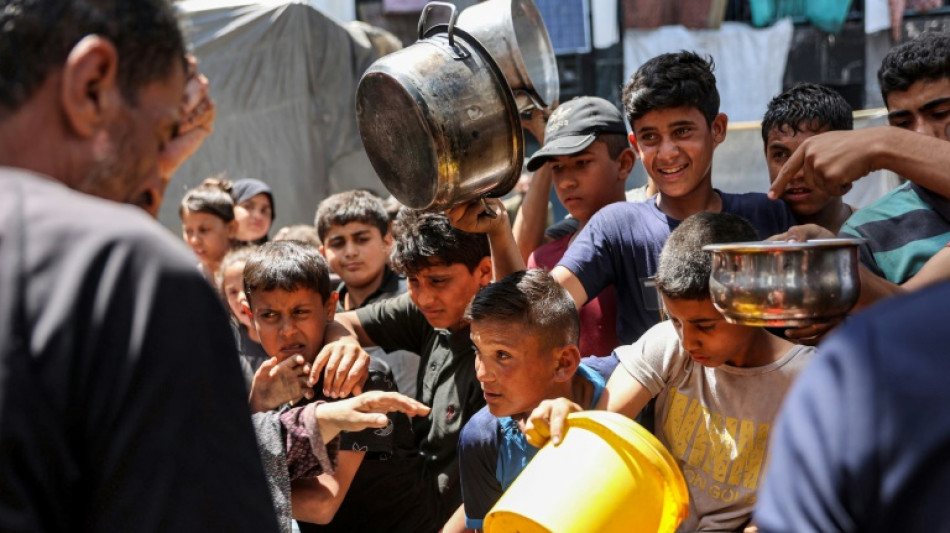
Leisure 'forgotten': Gaza war drives children to work / Photo: © AFP/File

 Dominican Republic calls for Haiti force to be strengthened
 Dolly Parton's nephew ordered to stay away from estate staff, properties

 Early exit for Philippine darling Eala at Singapore Open

 Hurricane Polo triggers huge waves in coastal Mexican city

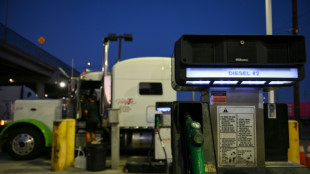 What happens if the US bans diesel exports

 Macklemore hits back with 'Free Palestine Tour' after Sheeran split
 Met Opera to give New Yorkers free tickets in affordability push

 Top ECB official to resign to take up IMF role

 Xi and Trump call for peace in lavish White House state visit

 Five up-and-coming players looking to make mark in Nations League

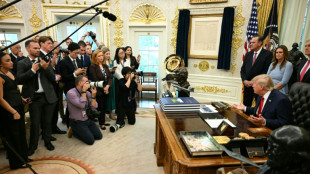 CNN, MS NOW, Politico request court hearing after White House access denied

 Eviction of pensioner puts Spain housing crisis in spotlight

 CNN, MS NOW, Politico say reporters still barred from White House
 Udinese sign ex-Real Madrid defender Alaba on free transfer

 Trump welcomes Xi to Washington with lavish praise

 Kane relishing chance to become England's most-capped player

 Average EU diesel price hits record 2.23 euros a litre: AFP analysis

 Whitetip Investments Marks 10 Years of Regulation, Transparency & Responsible Trading

 Pakistan blocks roads around capital ahead of planned pro-Khan protest

 Stocks fall, oil prices rise as global bonds under pressure

 Mancini's Italy facing battle to 'win back' dispirited fans

 German think tanks urge Merz to stick with reforms after election defeats
 Alcaraz wants end to late-night matches at Grand Slams

 EU battle over how to define 'Made in Europe'

 Eight killed in wave of Russian strikes on Ukraine

Some crush rocks into gravel, others sell cups of coffee: Palestinian children in Gaza are working to support their families across the war-torn territory, where the World Bank says nearly everyone is now poor.
Every morning at 7:00 am, Ahmad ventures out into the ruins of Khan Yunis in southern Gaza, picking through the rubble produced by steady Israeli bombardment.
"We gather debris from destroyed houses, then crush the stones and sell a bucket of gravel for one shekel (around 0.25 euros)," the 12-year-old said, his face tanned by the sun, his hands scratched and cut and his clothes covered in dust.
His customers, he said, are grieving families who use the gravel to erect fragile steles above the graves of their loved ones, many of them buried hastily.
"At the end of the day, we have earned two or three shekels each, which is not even enough for a packet of biscuits," he said.
"There are so many things we dream of but can no longer afford."
The war in Gaza began with Hamas's unprecedented October 7 attack on southern Israel which resulted in the deaths of 1,199 people, most of them civilians, according to an AFP tally based on Israeli official figures.
Israel's retaliatory military campaign has killed at least 40,476 people in Gaza, according to the Hamas-run territory's health ministry, which does not break down civilian and militant deaths.
The UN rights office says most of the dead are women and children.
"Nearly every Gazan is currently poor," the World Bank said in a report released in May.
- 'Barefoot through the rubble' -
Child labour is not a new phenomenon in Gaza, where the United Nations says two-thirds of the population lived in poverty and 45 percent of the workforce was unemployed before the war.
Roughly half of Gaza's population is under 18, and while Palestinian law officially prohibits people under 15 from working, children could regularly be found working in the agriculture and construction sectors before October 7.
The widespread wartime destruction as well as the constant displacement of Gazans trying to stay ahead of Israeli strikes and evacuation orders has made that kind of steady work hard to find.
Khamis, 16, and his younger brother, Sami, 13, instead spend their days walking through potholed streets and displacement camps trying to sell cartons of juice.
"From walking barefoot through the rubble, my brother got an infected leg from a piece of shrapnel," Khamis told AFP.
"He had a fever, spots all over, and we have no medicine to treat him."
Aid workers have repeatedly sounded the alarm about a health system that was struggling before the war and is now unable to cope with an influx of wounded and victims of growing child malnutrition.
- Money gone 'in a minute' -
The paltry sums Khamis and Sami manage to earn do little to defray the costs of survival.
The family spent 300 shekels (around 73 euros) on a donkey-drawn cart when they first fled their home, and later spent 400 shekels on a tent.
At this point the family has relocated nearly 10 times and struggles to afford "a kilo of tomatoes for 25 shekels", Khamis said.
Moatassem, for his part, said he sometimes manages to earn "30 shekels in a day" by selling coffee and dried fruit that he sets out on cardboard on the roadside.
"I spend hours in the sun to collect this money, and we spend it in a minute," the 13-year-old said.
"And some days I only earn 10 shekels while I shout all day to attract customers," he added.
That's a drop in the ocean for daily expenses in a territory where prices for goods like cooking gas and gasoline are soaring.
In these conditions, "we only think about our basic needs, we have forgotten what leisure is, spending for pleasure," Moatassem said.
"I would like to go home and get back to my old life."
R.Braegger--VB