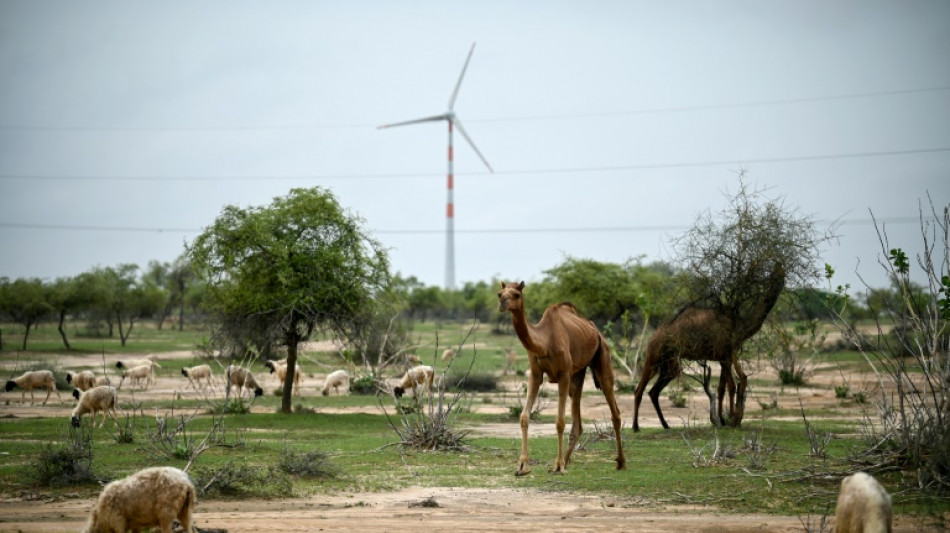
India's green energy wind drive hits desert herders hard / Photo: © AFP

 Wellalage and Mendis star as Sri Lanka level England ODI series

 Guyana urges Venezuela at UN to respect ICJ's ruling on Essequibo region

 Argentina coach says Messi deserves to go out on own terms

 Xi sets red lines for Trump despite lavish White House welcome

 Cowboys, Ravens happy with footing for first Rio NFL clash

 Starbucks to close 250 more cafes in North America

 French actress Marina Vlady dies at 88

 CNN, MS NOW, Politico allowed back in White House after judge's order

 Morocco's ruling coalition dominates low-turnout parliament election

 Napoli hoping to build new stadium, says owner

 What's behind the Pakistani strikes on Afghanistan?
 Hundreds protest for return of Nobel peace laureate Machado to Venezuela

 Aubameyang to miss two months for Deportivo after knee surgery

 Newsom says Trump presidency 'as we know it' ends in November

 Stocks fall as oil prices rise and bonds back under pressure

 Russell leads Mercedes 1-2 in Azerbaijan GP practice

 Ukrainian kills priest, wounds four at Polish abbey

 Sri Lanka captain Mendis hits century in 321-6 against England

 Oscar-winner Cotillard fears being moved by AI actor

 Agassi demands proper break for exhausted tennis stars

 Seixas 'crushes' teammates in training to draw Pogacar comparisons

 Trump welcomes Xi to White House, touting agreement on AI

 Stocks fall, oil prices rise as global bonds back under pressure

 UK man died putting women, children first in Mozambique jihadist siege: coroner

 Russell leads Mercedes 1-2 at Azerbaijan GP practice

Whirring wind turbines in India's Thar desert supply critical green energy for the world's most populous nation, but those living in their shadows say it comes at their expense.
It illustrates the hard balance faced as India, the third-largest greenhouse gas emitter, scrambles to boost its non-fossil fuel capacity to stem the rising impacts of climate change.
"The big companies have come here and built the windmills, but they're useless to us," said 65-year-old livestock herder Nena Ram, describing an age-old farming system upended by the giant turbines.
The country is suffering increasing devastation from heatwaves, floods and droughts, events that climate scientists say are exacerbated by rising global temperatures.
But those from areas used for renewable energy production say their needs have been sacrificed for the greater good.
In western Rajasthan state, where most of the Thar desert lies, that includes the loss of grazing lands and damage to sacred groves called "orans".
The desert oases, protected by the community for centuries, collect water critical for their livestock-based economy of camels, cattle and goats.
But herders say heavy construction trucks damage the water sources, reducing grasslands and further drying the land.
What farmers like Ram contribute to greenhouse gases is very far from the fume-belching giants of India's coal-hungry heavy industry.
He is struggling from a brutal one-two punch.
First he was hit by the consequences of climate change. Then he was knocked by mitigation efforts to combat them.
- 'Paying the price' -
The deserts around Jaisalmer district in Rajasthan are dotted with hundreds of turbines, one of India's largest onshore wind farms.
Rajasthan is capable of providing five gigawatts (GW) of wind power to the grid, according to government figures.
Many turbines are owned by Indian conglomerates, including the Adani Group and Suzlon.
The companies say they are supporting India's national drive to transition to renewable power while supporting communities impacted by the construction.
Suzlon says it provides "sustainable development to the villages around its wind farms", including health, education and livestock support projects.
Adani says it is "deeply committed" to the community, supporting schools and clean water programmes.
But farmers complain bitterly that the turbines were built on community grazing land.
Milk production has also slumped.
"The farmers are paying the price," said Jitendra Kumar, who works in a local health clinic.
"Their land was taken away. Windmills occupy the land meant for cattle grazing".
- 'Lives in darkness' -
Power lines criss-cross the desert around Jaisalmer, a district home to about 670,000 people, according to the last census
But it suffers from frequent power cuts, sometimes for days at a stretch.
Residents say power is channelled to feed surging demand in industrial centres and big cities.
"We are leading our lives in darkness," local environmental activist Sumer Singh Bhati said.
"We have power for barely two hours a day... We are desperate for light."
Power cuts are unbearable during summer. Temperatures sometimes sizzle at 50 degrees Celsius (122 Fahrenheit).
India this year baked in its longest heatwave on record, according to government weather experts.
They warn steadily more oppressive temperatures will be seen increasingly in the future.
India aims to boost non-fossil fuel power capacity to 500 GW by 2030 and is committed to achieving a net-zero-emissions economy by 2070 -- two decades after most of the industrialised West.
Renewable energy plants are being built at breakneck speed, rising from 76 GW to 203 GW in the past decade, according to government figures. Around a quarter of that is from the wind.
But reaching the 500 GW renewable target requires expansion on a vast scale.
- 'How will we survive?' -
Such statistics mean little to villagers living near the towering turbines, slamming them as an "incursion of the white structures".
Environmental activists say that while outsiders see the desert as a dead zone, they are areas rich in biodiversity.
Locally revered species, such as the critically endangered Great Indian Bustard, are facing extinction.
The once common giant brown-and-white birds fly into the mesh of overhead power lines.
Parth Jagani, an environmental activist in Jaisalmer, said numbers had plummeted in the past 25 years -- with just 150 left nationally.
"Once the windmills and the high-tension wires were installed, their mortality increased," Jagani said.
In 2021, the Supreme Court ordered power lines to be put underground in key bird breeding zones.
But the government petitioned and overturned the decision, arguing it would hinder renewable energy targets.
Villagers have set up a memorial for the bird, a statue of a lone bustard.
"If our birds and animals are taken away, what will we do?" said Ram, smoothing his sweeping grey moustache.
"How will we survive?"
M.Betschart--VB