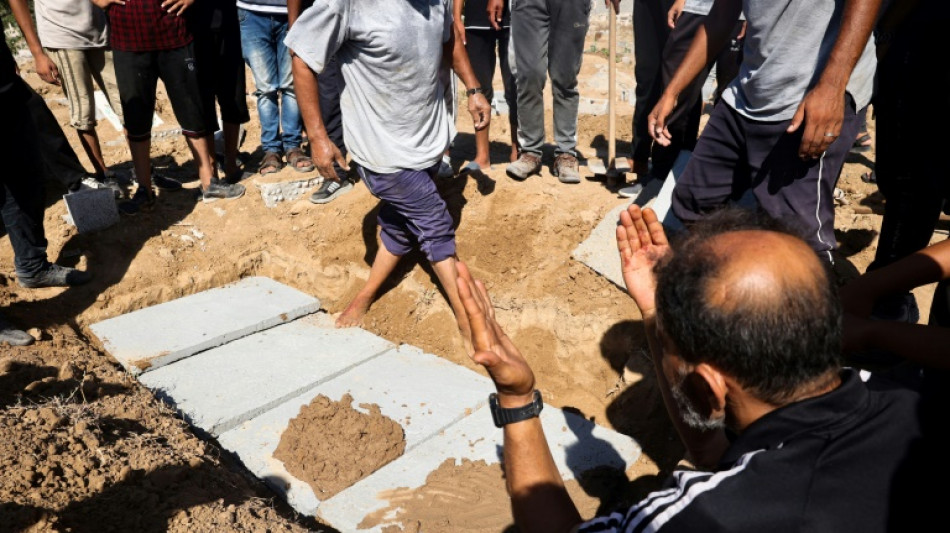
Gazans lose tens of thousands in war, but have few chances to mourn / Photo: © AFP/File

 Assefa seeks 'better than my best' at Berlin marathon

 US court refuses to overturn Pentagon ban on Anthropic

 Verstappen and Norris blame slow cars as Mercedes tops qualifying

 Crowds cheer pope in Paris after AI 'paradise of machines' warning

 Teen swimmer makes Games history as Thai, Chinese sprinters win gold
 Man City found guilty of 114 Premier League charges - reports

 Concerns over 'missing' UK explorer Ranulph Fiennes

 Suspected Paris killer of Argentine rugby star begs forgiveness
 Oil prices fall on cautious hopes for US-Iran progress

 Noskova, Muchova take Czech Republic into BJK Cup final

 Thai sprinter Puripol breaks own Asian Games record to win 100m gold
 Russell takes pole for Azerbaijan GP, Antonelli crashes out

 Williams boss hails Chadwick as F1 inspiration for women
 World No.1 Sinner delays return with China Open withdrawal

 South Lebanon children return to school destroyed by Israel strike

 Jewish group urges Berlin far-left vote winners to tackle antisemitism

 European stock markets climb as oil prices drop

 Trump accuser E. Jean Carroll finally has her damages

 Germany's Havertz, Musiala ruled out of Greece match with injury

 Ireland's Gaza stance spills from Eurovision into football
 Welcome aboard the Costa Serena, the Asian Games floating hotel

 Asian markets mixed after recent oil surge
 Cash for nature protection: hotelier's offer to Principe islanders
 US miner KoBold bets on AI to gain edge in DR Congo mineral hunt
 Internet disrupted in Ethiopia as conflict rages
Once a day, Umm Omar picks up the phone and calls her late husband, humouring their four-year-old daughter who does not understand yet her father was killed early in the Gaza war.
Little Ella "wants us to call him, to tell him about her day", said Umm Omar, who has fled with her three children to Al-Mawasi, a coastal area teeming with mostly displaced Palestinians in the southern Gaza Strip.
More than 40,000 people have been killed in Gaza since war between Israel and Palestinian militants broke out on October 7, the Hamas-run territory's health ministry said Thursday.
It was triggered by Hamas's attack on southern Israel that day that resulted in the deaths of 1,198 people, according to an AFP tally based on official Israeli figures.
Umm Omar told AFP she did not understand "how the months have gone by" since her husband, Ibrahim al-Shanbari, was killed in an Israeli strike on northern Gaza.
When he died, Umm Omar said she lost everything "in a fraction of a second", but there was little time to bury him properly, grieve or process the loss of the "kind" man that he was.
There was no funeral procession or "any of the usual mourning (rituals) because it's wartime", Umm Omar added.
"It was very difficult to say goodbye... because the martyrs were buried very quickly," she said, with fighting raging across the besieged territory.
To help Ella, "I ended up pretending" her father was still alive, said Umm Omar.
Still, according to her, others had it worse, "those who have lost an entire family, those who have not been able to say goodbye, or those who find their children in pieces".
With more than 1.5 percent of Gaza's 2.4 million population killed during the war, many people have lost loved ones.
The smell of death is everywhere, but under constant bombardment, shelling and battles, Gazans often have little time -- or place that is not in ruins -- to process their grief.
- 'Death has replaced life' -
Some victims bled to death before reaching hospitals, many of which had gone out of service due to the fighting or facing severe shortages amid an Israeli siege imposed early on in the war.
Others were crushed under their toppled homes, their bodies eventually retrieved from the rubble of bombed-out neighbourhoods. Some are still missing, feared buried under the ruins.
To Mustafa al-Khatib, 56, who has lost several relatives, "death has replaced life."
The incessant violence has rendered many cemeteries inaccessible, often forcing Gazans to dig makeshift graves with whatever tools they can find, Khatib told AFP.
And "there are no stones or cement to make a concrete covering for the grave either", he said.
The hasty interment of Khatib's uncle in a hospital yard has left him with a "heavy heart", he said.
His sister was laid to rest at a long abandoned cemetery, which Khatib said was later bombed.
In central Gaza's Al-Maghazi refugee camp, a woman placed her hand on the ground outside a school used a displacement shelter: this is where she said her daughter was buried after dying in her arms, fatally wounded in a blast.
With nearly all Gazans displaced at least once by the war, and often far from home, they have resorted to burying family members on any available patch of land, in the street, or sometimes on football fields.
Many do not know when they may be able to return to their burial spots or even find them again.
- Longing for a final embrace -
In the nearly 10 months since the war began, AFP correspondents have witnessed mass burials and bodies put in the ground in blood-stained blankets.
Some were wrapped in plastic sheets, marked with a number rather than a name, either because the bodies were unrecognisable or because no relatives had come to claim them.
Across the ravaged territory, which had already suffered for years under a crippling Israeli-led blockade and past cycles of violence, hasty burials are now conducted daily in the midst of fighting, evacuation orders and hazardous journeys to find food, water and medical care.
Khatib said he had "grown accustomed" to the often chaotic and fleeting farewells before friends and family return to their daily task of survival.
Some never had the chance to say goodbye.
Gazans interviewed by AFP have struggled or were outright unable to express their grief and loss. Many said they await their own death to rejoin relatives.
For more than six months, Ali Khalil has known that his 32-year-old son Mohammed was killed in the bombing of his home in the Al-Shati refugee camp, on the outskirts of Gaza City.
But he had fled for safety with his grandchildren to the coastal territory's south when he heard the news.
"What hurts me the most is not having been able to bury my son, not having hugged him and not having said goodbye to him," said the grieving 54-year-old man.
"I wonder if his body remained intact or if it was in pieces. I have no idea."
D.Schlegel--VB