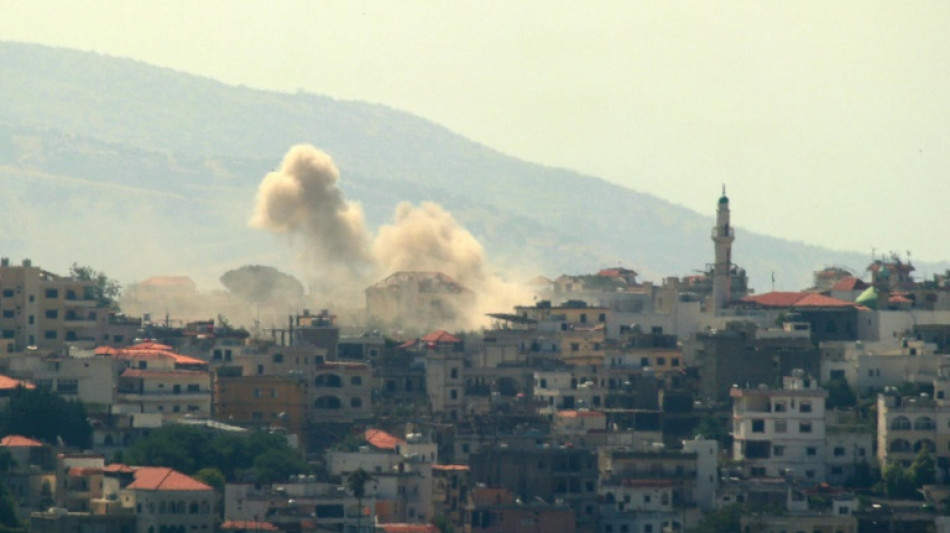
Lebanese on edge amid fears of all-out Israel-Hezbollah war / Photo: © AFP

 Japanese 11-year-old wins Asian Games eSports gold

 TikTok agrees to teen limits in US settlement following Meta

 Venezuela's oil cradle pins hopes on US energy deals

 US, China buy time with trade truce as pressure builds

 'Leo, Leo': Young Catholics give pope rockstar welcome in France

 Lula bans sports betting days ahead of Brazil's election

 Guatemala ensures survival of vulnerable 'fossil' fish
 Mancini finds positives in Italy loss, accepts fans' jeers
 Alcaraz helps Europe into Laver Cup lead

 Six missing after building collapses in historic Athens district

 Mbappe scores but suffers knee injury as Zidane gets debut France win

 Mancini's Italy return spoiled by Belgium defeat

 Rodri confident in Man City innocence despite reported charges

 Jay-Z rape accuser says she made 'false accusations'

 Senegal draw first match under Vieira and Nigeria survive scare
 Trump, Xi end summit long on pomp, but short on progress

 Russia not preparing for conflict with Europe, Putin says
 Trump's photo of Xi greeting carries signs of AI
 Six missing after building blast in historic Athens district

 Millions in US northeast brace for powerful storm

 Assefa seeks 'better than my best' at Berlin marathon

 US court refuses to overturn Pentagon ban on Anthropic

 Verstappen and Norris blame slow cars as Mercedes tops qualifying

 Crowds cheer pope in Paris after AI 'paradise of machines' warning

 Teen swimmer makes Games history as Thai, Chinese sprinters win gold
Fears of a major escalation between Israel and Hezbollah have left many Lebanese on edge, exacerbating mental health problems and reviving traumas of past conflicts in the war-weary country.
One 29-year-old woman, who lives near the southern city of Sidon, said she dreaded the thunderous, explosive boom of Israeli jets regularly breaking the sound barrier.
"I feel the house will fall down on top of me... Sometimes I freeze... or start crying," said the woman, a contract worker for a non-governmental organisation.
She was 11 years old when Israel and Lebanese militant group Hezbollah went to war in the summer of 2006, and said bombs fell near her house.
"Sometimes, unconsciously, you remember it," said the woman, requesting anonymity in a country where mental health issues are often stigmatised.
"These sounds give you flashbacks -- sometimes you feel you're back at that time," she said.
Since Hamas's October 7 attack on Israel sparked the Gaza war, Hezbollah has traded near daily cross-border fire with the Israeli army in support the Palestinian militant group, sending tensions soaring.
Lebanon has been on a knife's edge since a strike on Beirut's southern suburbs last week killed Hezbollah's top military commander, just hours before the assassination, blamed on Israel, of Hamas's political leader Ismail Haniyeh in Tehran.
Iran and Hezbollah have vowed revenge, amid fears that retaliatory attacks could spiral into all-out war, with airlines suspending flights to Lebanon and countries imploring foreign nationals to leave.
- Panic attacks -
"I already had been suffering from anxiety and depression... but my mental health has deteriorated" since October, said the woman, who can no longer afford therapy because her work has slowed due to the hostilities.
"You feel afraid for the future", she said.
Before the 2006 Israel-Hezbollah war, Lebanon endured a gruelling 1975-1990 civil conflict in which Israel invaded the south and in 1982 besieged Beirut.
The current cross-border violence has killed more than 560 people in Lebanon, most of them fighters but also including at least 116 civilians, according to an AFP tally.
On the Israeli side, including in the annexed Golan Heights, 22 soldiers and 26 civilians have been killed, according to army figures.
Laila Farhood, professor of psychiatry and mental health at the American University of Beirut, said "cumulative trauma" has left many Lebanese with stress, anxiety, depression and post-traumatic stress disorder.
"Individuals transmit their anxieties to their children as cross-generational trauma," she told AFP.
"What is happening now triggers previous traumas," causing some people to have panic attacks, said Farhood, who specialises in war trauma and its impact on Lebanese civilians.
On Tuesday, Israeli jets broke the sound barrier over central Beirut, causing intense sonic booms that rattled windows and nerves, just two days after the anniversary of a catastrophic blast at Beirut's port in 2020.
"I had my first panic attack," said Charbel Chaaya, 23, who studies law in France and is living with his family near Beirut.
"I couldn't breathe, my legs felt numb... in that very first moment, you don't know what the sound is -- just like what happened on August 4," he said.
- 'Uncertainty' -
Layal Hamze from Embrace, a non-profit organisation that runs a mental health centre and suicide prevention hotline, said people in Lebanon now are "more susceptible to any sound".
"Baseline, the adrenaline is already high. It's a stressful situation," said Hamze, a clinical psychologist.
"It's not only the Beirut blast," Hamze added.
"The natural or automatic response" is to be frightened, she said, and while "maybe the older generation... are a bit more used to" such sounds, they could trigger "the collective trauma".
Some on social media have urged people to stop letting off fireworks -- a ubiquitous practice for celebrations -- while humorous skits making light of difficulties like flight cancellations have also circulated.
With coping mechanisms varying greatly, some people are "going partying", while others "are reaching out to the community more", which helps them feel they are not alone, Hamze said.
Dancer Andrea Fahed, 28, whose flat was damaged in the port blast, said she panicked when she heard this week's sonic booms.
She said she felt "lucky" to be a dancer, because with her community "we laugh together, we move together... you let go of a lot of things".
But she said the "uncertainty" was a constant struggle, and now leaves her windows open, fearing another blast could shatter everything.
"Anything can happen," Fahed said.
"If it's happening with that intensity in Gaza, why wouldn't it come here?"
G.Schmid--VB