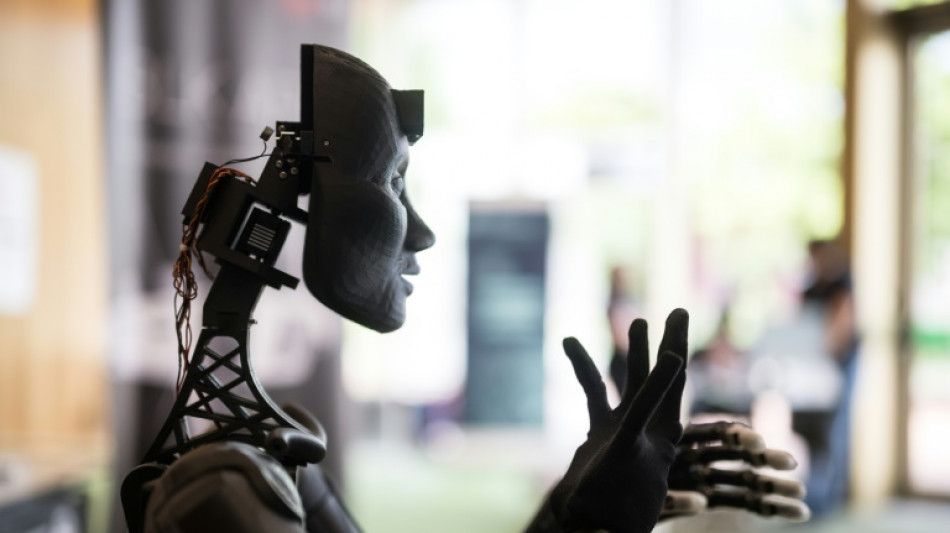
In world first, EU's sweeping AI law enters into force / Photo: © AFP/File

 How young is too young as child prodigies win big at Asian Games

 UK Labour party meets buoyed by Burnham but eager for concrete plans

 Thousands protest ahead of Mexican president's report on missing students

 Bangkok floods force thousands into shelters

 AI startup urges optimism from Europe despite safety fears

 'Godlike, invincible': Japan hails 11-year-old Games history-maker

 Nepal's hydropower ambitions face climate reality check
 Power cuts, rubble: millions come home to find Sudan's capital unlivable

 Internationals keep Presidents Cup lead with late fightbacks

 Tuchel to 'keep pushing' England to reach Spain's level

 Alcaraz saves match points to keep Europe ahead in Laver Cup

 Spain success driven by hunger to improve, says De La Fuente

 Lyon collapse at Stade Francais to suffer first Top 14 loss

 Oyarzabal and Spain sink England again as Modric shines for Croatia

 Housing protesters camp in central Madrid after mass demonstration

 Louise Trotter expands her palette at Bottega Veneta
 Pope prays at Lourdes after huge Paris mass

 USA trims International lead after Presidents Cup four-balls

 Russia accuses Europe of blocking Ukraine talks, as strikes drag on

 'He said hello': Families pray with pope on Paris avenue

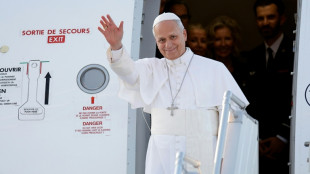 Pope celebrates giant Paris mass, flies to Lourdes

 Thousands march in Madrid over eviction of 87-year-old woman

 England women back to winning ways with last-gasp defeat of New Zealand

 Trump rejects Iran proposal for deal to reopen Hormuz

 England's Cox says injured Buttler leaves 'big shoes to fill'

The European Union's landmark law on artificial intelligence came into force on Thursday, which Brussels vows will drive innovation while protecting citizens' rights.
The EU earlier this year adopted the world's first sweeping rules to govern AI, especially powerful systems like OpenAI's ChatGPT after difficult and tense negotiations.
Although the rules were first proposed in 2021, they took on greater urgency when ChatGPT burst onto the scene in 2022, showing generative AI's human-like ability to churn out eloquent text within seconds.
Other examples of generative AI include Dall-E and Midjourney, which can generate images in nearly any style with a simple input in everyday language.
"With our artificial intelligence act, we create new guardrails not only to protect people and their interests, but also to give business and innovators clear rules and certainty," European Commission President Ursula von der Leyen said.
Companies will have to comply by 2026 but rules covering AI models like ChatGPT will apply 12 months after the law enters into force.
Strict bans on using AI for predictive policing based on profiling and systems that use biometric information to infer an individual's race, religion or sexual orientation will apply six months after the law enters into force.
The law known as the "AI Act" takes a risk-based approach: if a system is high-risk, a company has a stricter set of obligations to fulfil to protect citizens' rights.
The higher the risk to Europeans' health or rights, for example, the greater the companies' requirements to protect individuals from harms.
"The geographic scope of the AI Act is very broad, so organisations with any connections to the EU in their business or customer base will need an AI governance programme in place to identify and comply with their obligations," said Marcus Evans, partner at law firm Norton Rose Fulbright.
Companies in violation of the rules on banned practices or data obligations face fines of up to seven percent of worldwide annual revenue.
The EU in May established an "AI Office" of tech experts, lawyers and economists under the new law to ensure compliance.
P.Staeheli--VB