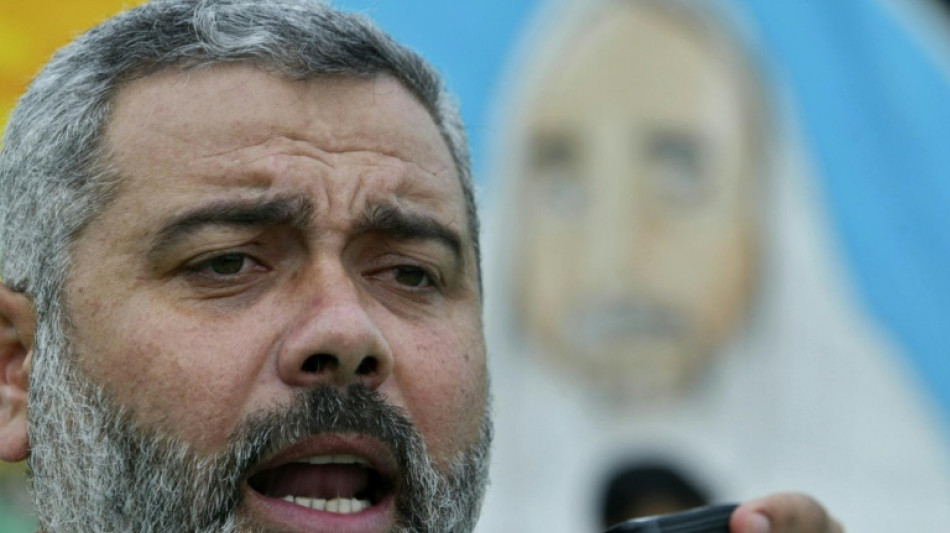
Hamas says leader killed in Israel strike in Iran / Photo: © AFP

 AVEVA and PETROJET Sign MoU for Digital Twin Projects in Egypt

 Daily Horoscope November 20, 2026: Astrological Predictions for All Signs

 Desire Under the Elms review - a horror show that bruises more than it moves

 Saudi PIF Retains Top Sovereign Wealth Fund Brand Title for Third Year

 Phoenix Weekend Guide: Sangria Socials, Pie Markets, and New Brunch Spots

 Trent Perry’s Late Heroics Lift No. 7 UCLA Past Cal State Fullerton

 2027 Hyundai Elantra Review: Brutalist Design and Expanded Dimensions
Hamas said Wednesday its political leader, Ismail Haniyeh, was killed in an Israeli strike in Iran, where he had been attending the inauguration of the country's new president.
Haniyeh's killing came after Israel on Tuesday struck a Hezbollah stronghold in southern Beirut, killing a senior commander of the Iran-backed group it said was responsible for a weekend rocket attack on the Israel-annexed Golan Heights.
"Brother, leader, mujahid Ismail Haniyeh, the head of the movement, died in a Zionist strike on his headquarters in Tehran after he participated in the inauguration of the new (Iranian) president," the Palestinian militant group said in a statement.
Iran's Revolutionary Guards also announced the death, saying Haniyeh's residence in Tehran was "hit" and he was killed along with a bodyguard.
"The residence of Ismail Haniyeh, head of the political office of Hamas Islamic Resistance, was hit in Tehran, and as a result of this incident, him and one of his bodyguards were martyred," said a statement by the Islamic Revolutionary Guard Corps's Sepah news website.
The Guards said the cause of the incident was not immediately clear but it was "being investigated."
Haniyeh had travelled to Tehran to attend Tuesday's swearing-in ceremony of Iranian President Masoud Pezeshkian.
The Israeli army declined to comment on foreign media reports.
- 'Axis of resistance' -
Israeli Prime Minister Benyamin Netanyahu has vowed to destroy Hamas and bring back all hostages taken during the October 7 attack, which sparked the war in the Gaza Strip.
The attack launched by Hamas on southern Israel resulted in the deaths of 1,197 people, mostly civilians, according to an AFP tally based on official Israeli figures.
Militants also seized 251 hostages, 111 of whom are still held captive in Gaza, including 39 the military says are dead.
Israel's retaliatory military campaign in Gaza has killed at least 39,400 people, according to the health ministry in the Hamas-run territory, which does not provide details on civilian and militant deaths.
Regional tensions have soared since the start of the Israel-Hamas war in October, drawing in Iran-backed militant groups in Syria, Lebanon, Iraq and Yemen.
Haniyeh was elected head of the Hamas political bureau in 2017 to succeed Khaled Meshaal.
He was already a well-known figure having become Palestinian prime minister in 2006 following an upset victory by Hamas in that year's parliamentary election.
Considered a pragmatist, Haniyeh lived in exile and split his time between Turkey and Qatar.
He had travelled on diplomatic missions to Iran and Turkey during the war, meeting both the Turkish and Iranian presidents.
Haniyeh was said to maintain good relations with the heads of the various Palestinian factions, including rivals to Hamas.
He joined Hamas in 1987 when the militant group was founded amid the outbreak of the first Palestinian intifada, or uprising, against Israeli occupation, which lasted until 1993.
Hamas is part of the "axis of resistance", Tehran-aligned groups such Hezbollah in Lebanon and the Huthis in Yemen arrayed against arch-foe Israel.
Iran has made support for the Palestinian cause a centrepiece of its foreign policy since the 1979 Islamic revolution.
It has hailed Hamas's October 7 attack on Israel but denied any involvement.
R.Fischer--VB