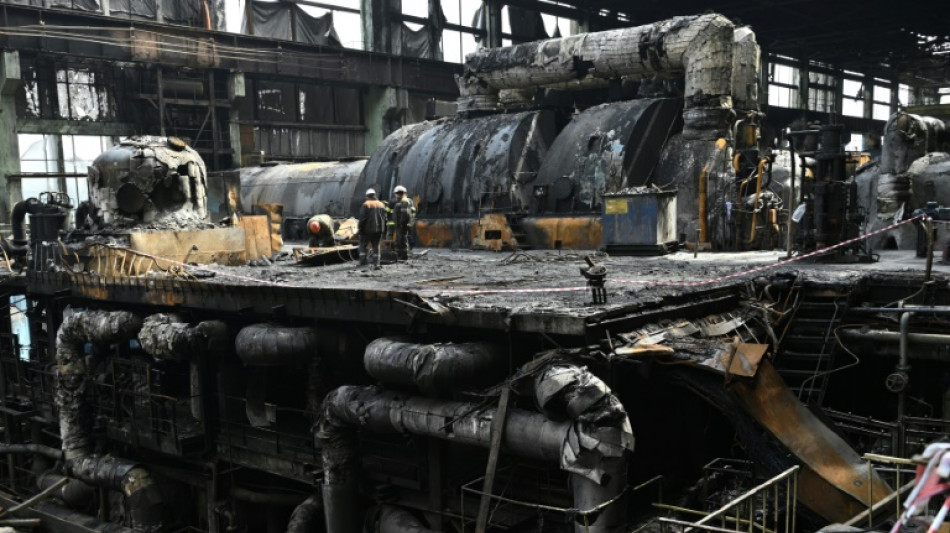
Ukraine relies on friends as Russia strikes power grid / Photo: © AFP

 Japan win marathon penalty shootout to set up South Korea gold-medal clash

 Djokovic grinds out opening-round win at China Open
 Northern Ireland police probe blockade of disputed parade

 UK PM Burnham reopens divisive debate on rejoining EU

 Man City future in doubt after guilty verdict
 'Do something,' begs Iranian woman after death sentence over protests

 China extends 52-year unbeaten record as Games organisers say sorry
 In Manchester, people say City scandal is 'shame for football'

 Stocks lacklustre as inflation data weighs on sentiment
 Israel-bound plane rerouted, pilots wounded in reported fight

 Truth commission on Sweden's Sami people seeks redress

 Energy costs spark inflation surges in France, Italy

 South Korea break China hearts to reach Asian Games football final
 Eala storms into Asian Games semi-finals to thrill adoring fans

 Turkey freezes ex-minister's assets as fund crisis grows
 What we know about the North Korean POW dispute

 Most equities rise after oil price plunge, US data in focus

 Polar oceans transformed as warming melts ice habitats: research

 Lost shark becomes viral star in South Korea

 Dangote to launch $16bn refinery in Kenya

 North Korean leader 'extremely obese': Seoul spy agency

 Yankees and pope-backed White Sox start MLB playoffs with wins

 Malaysia's ex-PM Mahathir in hospital for observation

 'No limits': Marathon world record holder Sawe chasing history

 Countdown begins to biggest-ever Rugby World Cup

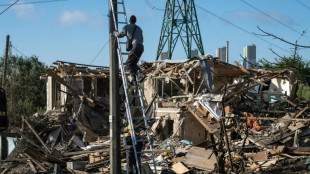
With Russian attacks on energy infrastructure causing power cuts, Ukraine is depending on its central and eastern European neighbours to keep the lights on.
Ukraine in recent weeks has resorted to consumption restrictions and rolling blackouts after Russian forces stepped up attacks on the country's power stations and transmission lines.
But thankfully, Ukraine got connected to the European power grid literally hours before the invasion started in February 2022 after preparing for the move since 2017.
It was initially planned as a brief test of autonomous operation, which required it to disconnect from the Russian grid, but it never reconnected as Russian forces invaded.
Instead, it joined the western network at record speed, which then-EU energy commissioner Kadri Simson hailed as "a year's work in two weeks".
Ukraine's electricity imports from neighbours Hungary, Moldova, Poland, Romania and Slovakia have been growing steadily for months as Russian attacks on its power system have intensified.
In June, the imports amounted to 858.3 gigawatt-hours (GWh), a growth of 91 percent over May, said the Kyiv-based consultancy ExPro.
Hungary topped the June imports with almost 42 percent of the total amount.
Slovak grid operator SEPS told AFP it had raised power exports to Ukraine from 2.6 GWh in full-year 2023 to almost 40 GWh in January-May this year.
On the other hand, both countries have refused to provide military aid to Ukraine as they foster friendly ties with Russia.
The imports based on bilateral agreements have enabled Ukraine to limit power cuts to certain hours of the day.
Meanwhile, Ukraine's domestic production is shrinking. The Green Deal Ukraine think tank has said the country produced 96,800 gigawatt-hours (GWh) of power in 2023, down from 103,800 GWh in 2022.
In 2021, before the invasion, Ukraine produced almost 158,000 GWh, according to the International Energy Agency.
- 'Eroding' defence -
The US-based Center for European Policy Analysis (CEPA) quoted analyst Maciej Bukowski as saying the dwindling supply was "eroding Ukraine's defensive capabilities and directly threatening its security".
"Essential infrastructure is crippled, which reduces civilian and economic resilience," he said.
Ukrainian President Volodymyr Zelensky said in June that Russia targeted the sector "to influence and subjugate nations".
Russia denies its forces target civilian infrastructure, but its defence ministry has claimed retaliatory attacks on energy sites that it says support the Ukrainian military.
Ukraine also receives substantial financial aid and energy equipment from allies worldwide.
Germany has provided over $450 million since February 2022 to boost its energy sector, finance infrastructure repairs and switch greener energy.
German development agency GIZ provides consultancy on savings and resilience, and sends over equipment and material.
"More than half a million people in Ukraine benefit from this," a GIZ spokeswoman told AFP.
- 'Europe's problem' -
The Czech Republic has shipped dozens of cogeneration units producing electricity and heat from gas.
The container-sized units helping schools, hospitals, shopping centres and households are mobile and therefore difficult to target with rockets.
The supply was financed by international institutions including US Aid, which has provided almost $1 billion to Ukraine's energy sector since the invasion began.
Austria's climate protection ministry runs a fund worth millions of euros to help Ukraine rebuild its energy system and buy equipment such as generators.
Bulgaria is in talks with Ukraine to sell two Russian-made nuclear reactors at a discount to help it renew its energy infrastructure.
Other European countries including the Netherlands, Poland and Sweden have also shipped equipment to Ukraine, while Norway has provided substantial financial support.
The World Bank put the damage to Ukraine's energy sector at $12 billion late last year, long before Russia stepped up its attacks on infrastructure this past spring.
"Russian bombs falling on Ukrainian power plants and pipelines is Europe's problem too, and in various regards," said the analyst Bukowski.
"Priorities must be set straight: without stable energy, Ukraine will not sustain itself."
burs-frj/dt/gv
R.Kloeti--VB