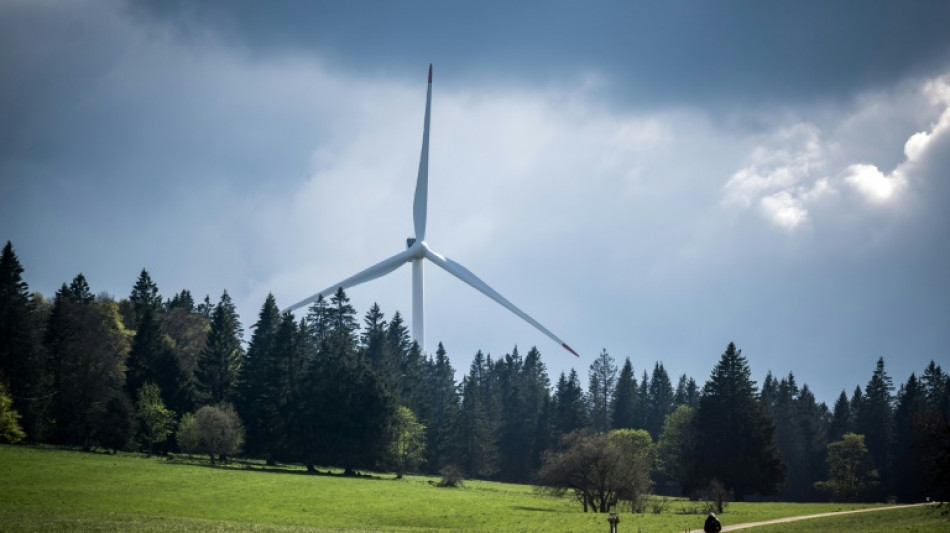
Swiss renewable energy battle moves to the ballots / Photo: © AFP/File

 Leaders visit Pacific atoll at frontline of climate change

 Yemen's Houthis claim striking Riyadh airport, other Saudi sites

 Best-selling British author Jeffrey Archer dies aged 86

 Military plane crash kills 32 in Nigeria

 Olise powers France to win over Belgium in Nations League

 High-flying Blazy turns to birdlife at Chanel

 Riyadh's allies pledge troops as Yemen, Saudi Arabia attack Houthis

 Clashes erupt outside Kosovo parliament over war crimes court

 Milan's Saelemaekers suffers ankle setback, faces lengthy spell out

 Rubio arrives in Iceland to push for greater US presence in Arctic

 Putin allows Italy's UniCredit to sell part of Russian business

 Djokovic into China Open final as Medvedev out for hitting fan with ball

 ICC unseals arrest warrants for Taliban education ministers

 Modric hopes fans back Croatia against Spain after England shame

 Bolsonaro rides right-wing surge into Brazil's election runoff

 Turkey blocks X account of British reporter

 Ukraine says using AI robot guns to shoot down new Russian drones

 At Oct 7 memorial, Netanyahu says will be no Hamas rule in Gaza

 Ukraine blames Russia for deadly sinking of Turkish ship in Black Sea

 UN rights council slams Taliban's 'oppression' of women

 Norway eyes partial ban of smart glasses

 Two dead after ship catches fire, sinks in Black Sea

 Spain's PM calls snap election after housing bill defeat

 STARCARES Equips Seven Foster Homes for Children and Young People in Tanzania

 Alleged Indian leader of neo-Nazi child abuse ring goes on trial in Paris

Switzerland's largest wind farm, sitting astride the ridge of the Jura mountains by the French border, consists of only 16 turbines -- tiny compared to those of other European countries.
The wealthy Alpine country has said it wants to rapidly accelerate the development of renewable energy sources as it strives to meet its target of carbon neutrality by 2050.
Authorities want to use a new climate bill approved last year to boost wind and solar power's current miniscule contribution to Switzerland's energy mix.
But that plan could hit a snag: the bill is being challenged by a national referendum on Sunday, potentially blocking its implementation next January.
While most environmental organisations back the law and its ambitions, a few smaller groups secured enough signatures to trigger a referendum under Switzerland's direct democracy system, amid fears it will fast-track large-scale energy projects and cause "unnecessary destruction of landscapes".
Switzerland's largest party, the hard right Swiss People's Party (SVP), has also backed the vote, warning that implementing the law could threaten Swiss energy security.
"It is not with renewable energy produced on mountaintops in the Jura that we will manage to guarantee supply security," Yvan Pahud, an SVP parliamentarian, told AFP.
The SVP supports more nuclear power instead.
- Sacrificing nature? -
Pierre-Alain Bruchez, who instigated the referendum, balked at the idea of installing large numbers of solar panels high up in pristine mountain landscapes.
The retired economist said he launched his battle after learning with "horror" of the Grengiols-Solar project, aimed at installing around 230,000 solar panels in the mountainous Wallis canton, at an altitude of 2,500 metres.
"We must not sacrifice nature on the altar of climate change," he told AFP.
Vera Weber, president of the Franz Weber Foundation for Nature and Animal Protection, which also called for the referendum, agreed.
"This law weakens the protection of nature in Switzerland," she told AFP.
Despite such arguments, overturning the law could prove difficult.
Sunday's vote will take place less than two months after Switzerland became the first country ever to be condemned by an international court for not doing enough against climate change.
The verdict by the European Court of Human Rights appears to have jolted the Swiss public, with 73 percent of voters polled recently saying they backed the law.
- More positives than negatives -
The bill is aimed at rapidly increasing hydro, wind and solar production, and it clears the way for a simplified approval process for large-scale projects.
As for solar power, the main aim would be to install panels on building roofs and facades.
The Swiss government, which supports the law, has acknowledged that court appeals against renewable energy projects "will probably be less likely to succeed than before".
However, it stresses that large installations in "biotopes of national importance" and in migratory bird reserves will remain banned, albeit with some exceptions.
WWF, which is among several environmental groups that support the law, highlighted that the bill calls for "over 80 percent of planned renewable energy development to go through solar on existing buildings".
WWF expert Patrick Hofstetter added that "effective measures against electricity waste are finally being introduced".
"From our point of view, the benefits of the project clearly outweigh" the negatives, he said.
- Overcoming fossil fuel dependence -
Greenpeace's Swiss chapter said the law could help Switzerland "overcome its dependence on fossil fuels like oil and gas, which often come from bellicose states".
Jaqueline de Quattro, a parliamentarian with the Liberal party, agreed.
Switzerland, she pointed out, spends eight billion Swiss francs ($8.9 billion) a year "on undemocratic fossil imports like Russian gas, or oil from Arab countries".
Given how reliant the Swiss are on the comforts energy brings, she told AFP, "we must also accept from time to time to see a wind turbine on the horizon".
W.Huber--VB