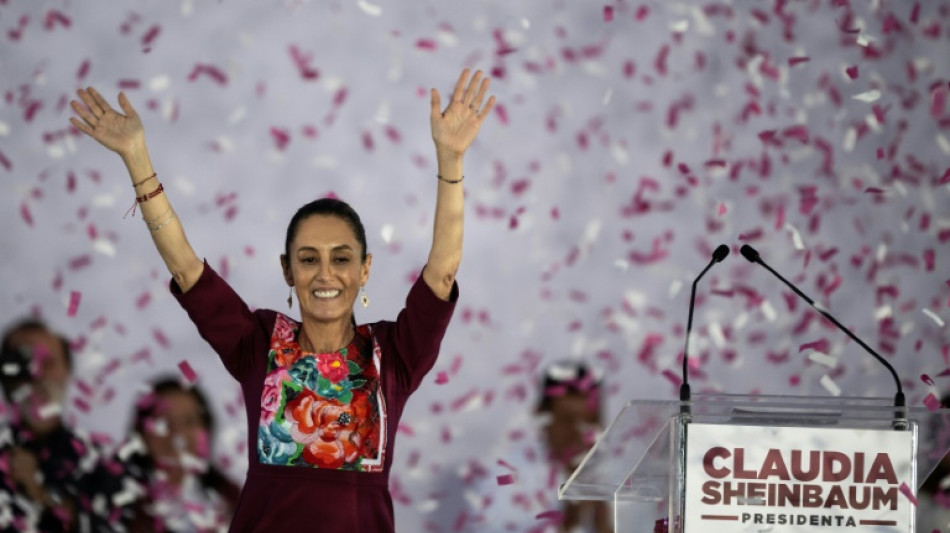
What's behind Claudia Sheinbaum's election victory? / Photo: © AFP/File

 Kenya reports first-ever Ebola death
 Tennis world No.1 Sinner's season over due to knee injury

 Yemen's Houthis claim attack on Riyadh airport, deny losing territory

 7-Eleven exits India amid mounting competition

 The alleged murder by US marine on Okinawa: five things to know

 End of an era as Messi prepares to hang up Argentina boots

 Superstar duo headline strong New Zealand squad for Rugby League World Cup

 South Korea warns of possible AI use in banking hacks

 EU vows AI rules will protect Europeans. Will they?

 Myanmar leader to visit Malaysia after migrant returns begin

 Germany's AfD poised to preside over state assembly for first time
 Australia's opposition vows 'largest cut to immigration' in country's history

 Ready, set, snooze: Sleep-deprived Japanese compete for best-rested

 Falcons thump Saints 45-24 as New Orleans marks Katrina anniversary

 Tuvalu govt adviser says Australia overstepped in pre-COP visit

 Asian stocks mixed despite tech-led Wall St record

 Tens of thousands expected in Paris for high school protests

 AI borrowing binge rattles US markets

 Young Canadians sue government over alleged climate failures

 White Sox down Guardians to take 2-0 series lead

 NHL record-breaker Ovechkin says current season will be his last

 France roar back in Nations League as Italy beat Turkey
 Messi readies for final farewell in Argentina send-off

 Esposito seals Italy win over Turkey in Nations League

 Russia downplays plague reports as Trump offers US help

Former Mexico City mayor Claudia Sheinbaum became the first woman to be elected president of the Latin American nation on Monday.
In October, the 61-year-old will replace President Andres Manuel Lopez Obrador, who enjoys an approval rating of more than 60 percent, largely thanks to his social programs for poorer Mexicans.
Here are some of the keys to Sheinbaum's victory, according to analysts.
- Intelligence, experience -
Sheinbaum is a pragmatic scientist by training who had several crises thrown at her as both a local politician and Mexico City mayor, including a devastating earthquake, the Covid-19 pandemic and a deadly metro accident.
Supporters and critics alike recognize her intelligence and commitment to the left-wing ideals at the center of Lopez Obrador's reform agenda.
Sheinbaum's popularity "can in part be attributed to her intelligence and sharpness, her commitment to popular issues such as renewable energy and education, and her experience in leading Mexico City's government," said Michael Shifter, an expert at the Inter-American Dialogue think tank in Washington.
- Loyalty to Lopez Obrador -
Sheinbaum repeatedly told voters that she would follow the same path as Lopez Obrador, an anti-establishment leftist who won a landslide victory in 2018 in a country fed up with corruption, crime and poverty.
"It was an easy-to-understand, strong message that, through repetition and discipline, really managed to get through," said academic Carlos Bravo Regidor.
Sheinbaum also benefited from the extensive network of the ruling Morena party, as well as the support of state machinery.
Since decades of dominance by the Institutional Revolutionary Party ended in 2000, "Morena has probably become the most successful party model at the national level," said Gustavo Urbina, an academic at the College of Mexico.
But it is premature to talk about a new era of hegemony, experts said.
Founded in 2014, Morena is still a young party whose strength has been largely based on loyalty to Lopez Obrador, widely known by his initials AMLO.
"The president continues to fulfill a symbolic, moral and decision-making role that is fundamental," Urbina said.
While Sheinbaum won an internal party poll to represent Morena, she was always seen as the outgoing president's favorite.
"AMLO supporters trust his judgement and have rallied around his handpicked successor," Shifter said.
- Unpopular opposition -
The unpopularity of the traditional Mexican parties -- the centrist PRI, the right-wing PAN and the leftist PRD -- was a major disadvantage for the main opposition candidate, Xochitl Galvez.
"They have a very bad reputation," Bravo Regidor said.
"That was a burden that greatly hindered Xochitl's potential," he added.
In contrast, Morena, of which Lopez Obrador and Sheinbaum are co-founders, is seen more positively by voters as "relatively new and different," Bravo Regidor said.
The opposition's "big mistake" was not paying attention to the "real, current and genuine discontent" of many Mexicans, said writer and analyst Jorge Zepeda Patterson.
Instead, Lopez Obrador's opponents sought to underline problems such as violence or difficulties accessing healthcare.
Faced with such an approach, "people will say, 'maybe, but at least they're trying,' while the traditional parties don't even try," Zepeda Patterson said.
R.Flueckiger--VB