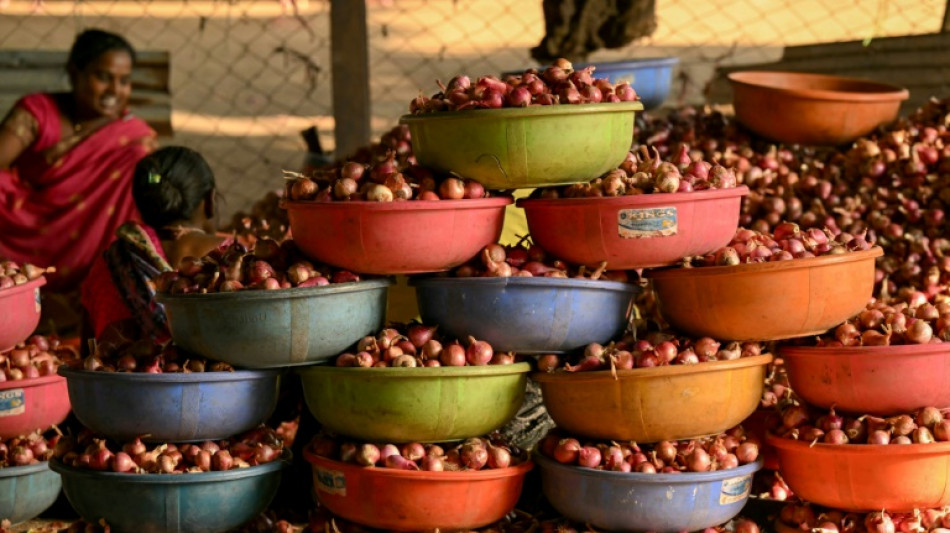
India's onion farmers cry foul at politicians' price recipe / Photo: © AFP

 Ronaldo opens door for Portugal return, apologises for walkout

 'Nobody seems to care': Russian city shrugs off plague reports

 Hundreds arrested in French school protests as Macron summons ministers

 WADA seeks tough anti-doping stance from Kenya

 German ex-spy chief arrested for suspected espionage, treason

 Furyk vows US will 'do more' to end Ryder Cup losing streak

 Iyer hits ton as India hammer West Indies in T20 opener

 Mandhana named India women's team captain after Kaur quits

 'The sound keeps coming back': children maimed in Ethiopia's Tigray clashes

 Paris Women's Fashion Week: the key trends

 i-payout Introduces a New Approach to Payments, Closing the Beneficiary Information Gap

 New Generation of Crypto Miners Released by ASICID

 New investor forecasts LIV Golf teams could be worth $100 mn each

 Shakira, Pique return to court over children visit arrangements

 Nobel physics prize hails 'ghostly messengers' from space

 France's Mistral unveils latest model in sovereign AI push

 Stocks climb as oil prices retreat

 Vstock Transfer Names Securities Industry Veteran Erica Goodstein General Counsel and Chief Compliance Officer

 Four Indonesian seamen return home after Somali pirate ordeal

 Crisis-striken Haiti postpones elections

 Germany arrests ex-spy chief on suspicion of giving secrets to foreign powers

 Djokovic wins China Open after de Minaur retires
 IMF warns cost-of-living shocks cause 'lasting deterioration' in affordability

 Alcaraz wins Japan Open for first title since injury return
 'We're working to keep football clean', Turkish minister says

Almost every Indian meal requires an onion -- one of the cooking essentials along with sugar and lentils that sweet-talking politicians use to curry favour with their voters by lowering costs.
But their policies to cut prices by slapping export bans on some goods including on onions and sugar, or by allowing duty-free imports of lentils, has made the key voting demographic of farmers furious.
They say the politicians' decisions flood the markets, and that the savings shoppers make are at their expense.
"The governments talk a lot about us," said onion farmer Kanha Vishnu Gulave. "But their actions only hurt us -- to keep the easily agitated city people happy by keeping our produce cheap."
Gulave, 28, comes from India's onion-producing heartland of Nashik district in Maharashtra state, which produces some 40 percent of onions nationwide.
He felt cheated when prices crashed after a sudden export ban in December.
"We dread elections," said Bharat Dighole, onion producers' association president for Maharashtra. "The most unwise interventions come around polls."
After the ban, prices dropped to sometimes less than a third, Dighole said.
That sparked dozens of small-scale protests in Maharashtra.
- Onion barometer -
At the same time, production expenses have more than doubled since 2017, Dighole added.
But the slump in wholesale prices meant that was not passed on to the consumer -- or voter, from the politicians' viewpoint.
They paid the same for their onions as they had done for years.
"All polls are fought in the name of farmers, but the government policy clearly favours the consumers," said Dighole.
India will vote on Saturday in the seventh and final phase of a general election, stretched over six weeks to ease the logistical burden of polls in the world's most populous country.
Two-thirds of India's 1.4 billion people draw their livelihood from agriculture, accounting for nearly a fifth of the country's gross domestic product.
In India, onions can be a barometer of a government's popularity.
Runaway prices have triggered mass protests and toppled governments in the past.
In 1998, the Bharatiya Janata Party (BJP) of Narendra Modi -- at the time a local politician -- lost control of the capital Delhi in state elections.
The defeat was widely blamed on voter anger at high onion prices.
While Prime Minister Modi is expected to sweep a third term in the ongoing national elections, the BJP has been out of power in the capital's state legislature ever since.
- 'Nothing but rhetoric' -
Days before voting began in the onion belt of Nashik, Modi's government lifted the export ban.
But analysts called that a political ploy.
"The opening up of the onion market is nothing but rhetoric," said economist Ashok Gulati, from the Indian Council for Research on International Economic Relations.
Gulati said restrictions remained -- including a minimum export price and 40 percent duty -- and made exports unviable, leaving farmers teary-eyed.
"Our best hope is to not sell for a loss," 30-year-old farmer Akshay Tarle told AFP at an onion auction, where lines of trailers piled high with the vegetable waited.
"When I leave home in the morning I don't even know if I'll be able to sell my produce at the right price," added another farmer, Vikas Babaji Tushare.
"My family ask me to buy things on my way back home, but there are days I don't even have the money," the 36-year-old added.
"I don't even know what to tell my children."
- Finger on the pulse -
Gulati warned export bans and unchecked imports of other products such as lentils -- a key staple and protein source for many -- were distorting markets and hurting producers.
India's import of pulses jumped to a six-year-high of around $3.75 billion in 2023-24, according to commerce figures cited by Indian media.
"Duty-free import of pulses... would dent the progress made in domestic production," Gulati said.
But some hope for change.
"People at the top fear that if onion prices rise, governments will fall," said Jagannath Bhimaji Kute, 58, vice-president of a wholesale onion market in Nashik.
"Whoever comes to power next will have to address our issues."
Kute urged Indians to "think about the farmers", questioning why people swallowed rising prices on fuel and cooking oil, but not food.
"Why must what we produce remain cheap, when everything else is getting more expensive?" he said.
K.Hofmann--VB