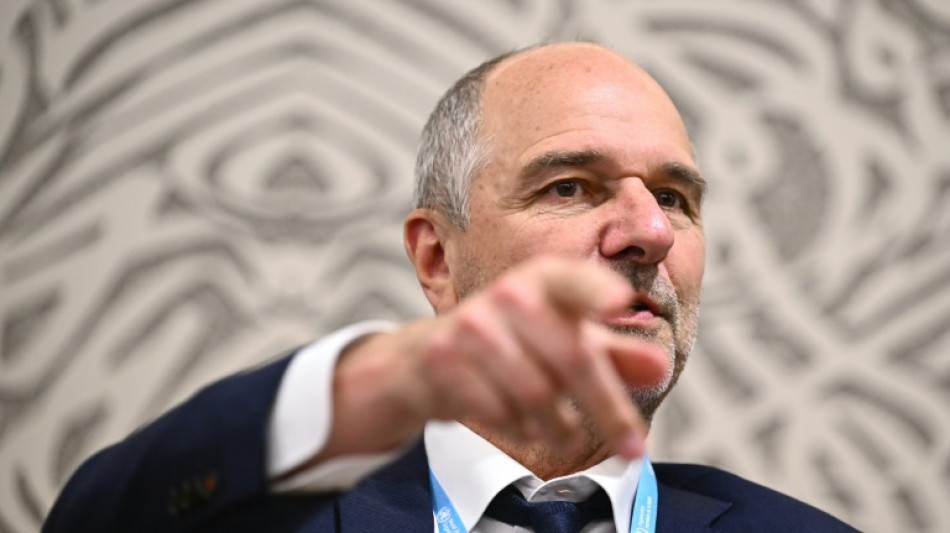
Israel's Rafah incursion taking dire health toll: WHO / Photo: © AFP

 N. Korea's Kim pledges 'invariable support' in Putin birthday letter
 OGRD Alliance Advances PLPC Multi-Asset Platform Following APHELAR Milestone, Expanding Licensing and Strategic Capital Frameworks

 Emotion, tears as Messi prepares for Argentina farewell

 Kane eyes Ronaldo record after matching England cap mark

 Spain fight back to beat Croatia, Kane adds to record for England

 Merino double helps Spain beat Croatia, reach Nations League quarters

 US stocks hit fresh records as oil stabilizes on rising supplies

 As Messi bows out, Argentines say 'thank you'

 Ronaldo opens door for Portugal return, apologises for walkout

 'Nobody seems to care': Russian city shrugs off plague reports

 Hundreds arrested in French school protests as Macron summons ministers

 WADA seeks tough anti-doping stance from Kenya

 German ex-spy chief arrested for suspected espionage, treason

 Furyk vows US will 'do more' to end Ryder Cup losing streak

 Iyer hits ton as India hammer West Indies in T20 opener

 Mandhana named India women's team captain after Kaur quits

 'The sound keeps coming back': children maimed in Ethiopia's Tigray clashes

 Paris Women's Fashion Week: the key trends

 i-payout Introduces a New Approach to Payments, Closing the Beneficiary Information Gap

 New Generation of Crypto Miners Released by ASICID

 New investor forecasts LIV Golf teams could be worth $100 mn each

 Shakira, Pique return to court over children visit arrangements

 Nobel physics prize hails 'ghostly messengers' from space

 France's Mistral unveils latest model in sovereign AI push
 Stocks climb as oil prices retreat

Israel's military offensive in Rafah is already taking a dire health toll in southern Gaza, and if it continues, "substantial" increases in deaths can be expected, a top WHO official warned Tuesday.
Since Israel launched its long-threatened Rafah incursion in early May, access to healthcare in Gaza's southernmost city has been devastated, said Rik Peeperkorn, the World Health Organization's representative in the Palestinian territories.
Speaking to AFP and Reuters in a joint interview in Geneva, he pointed to the around one million people on the move since the incursion, which has left two of Rafah's three hospitals completely disfunctional.
Al-Najar, Rafah's most important hospital, which had been servicing 700 dialysis patients from all over the Palestinian territory, has shut down, as has the Kuwaiti hospital.
And the Emirati maternity and paediatric hospital was now "barely functional", Peeperkorn said, pointing out that it could no longer accept new patients.
"If the incursion would continue, we would lose that last hospital in Rafah," he warned.
That would mean that around 1.9 million people in southern Gaza will basically be fully dependent on a string of field hospitals along the coast.
It would still be possible to be referred to the Al Aqsa hospital in the middle part of Gaza, and Peeperkorn pointed out that WHO had helped revive two recently defunct hospitals in Khan Yunis, also in central Gaza.
- 'A band-aid' -
But while that might sound like "a contingency plan", he stressed that "if there will be a full incursion (in Rafah)... this contingency plan is like a band-aid".
"It will not prevent what we expect: substantial additional mortality and morbidity."
Already, WHO and other aid organisations are struggling to keep humanitarian operations running, as bringing fuel and other aid into the Palestinian territory has been significantly hampered by the closure and disruption of two key crossings.
"There are currently 60 WHO trucks (in Egypt) waiting to get into Gaza," Peeperkorn said, adding that only three trucks with medical supplies had crossed in since May 7.
And even when medical and other aid makes it into Gaza, it remains "very challenging" to transport and deliver the goods both in the south and to the north, he said.
The Gaza war began after Hamas fighters attacked southern Israel on October 7, resulting in the deaths of more than 1,170 people, mostly civilians, according to an AFP tally based on Israeli official figures.
Palestinian militants also took 252 hostages, 121 of whom remain in Gaza, including 37 the Israeli army says are dead.
Israel's relentless military retaliation has killed at least 36,096 people in Gaza, mostly civilians, according to the Hamas-run territory's health ministry.
- 'Very concerned' -
The United Nations has long warned of looming famine, especially in the north of besieged Gaza.
And since the Rafah incursion, Peeperkorn said he was becoming increasingly worried about malnutrition in the south.
He said that during a mission to the north in April he had been somewhat relieved to see signs that access to food might be improving slightly.
"There was more food on the market, it was a bit more diverse," he said.
And while the hospitals he visited then were still full of severely malnourished children -- "two-year-olds weighing only four kilos" -- he said he had been hopeful that the situation might be on "a better trajectory".
But now, with the impact of the Rafah incursion already taking a heavy toll on access to aid and healthcare, he said that "we fear that instead of (being) on the right trajectory with regard to malnutrition, we will see very quickly a reverse again".
"We are very concerned."
Asked if he feared more people could eventually die from otherwise non-life-threatening injuries and disease or malnutrition-linked causes, than from the fighting itself, he said: "I would really hope... that this is not going to happen".
K.Sutter--VB