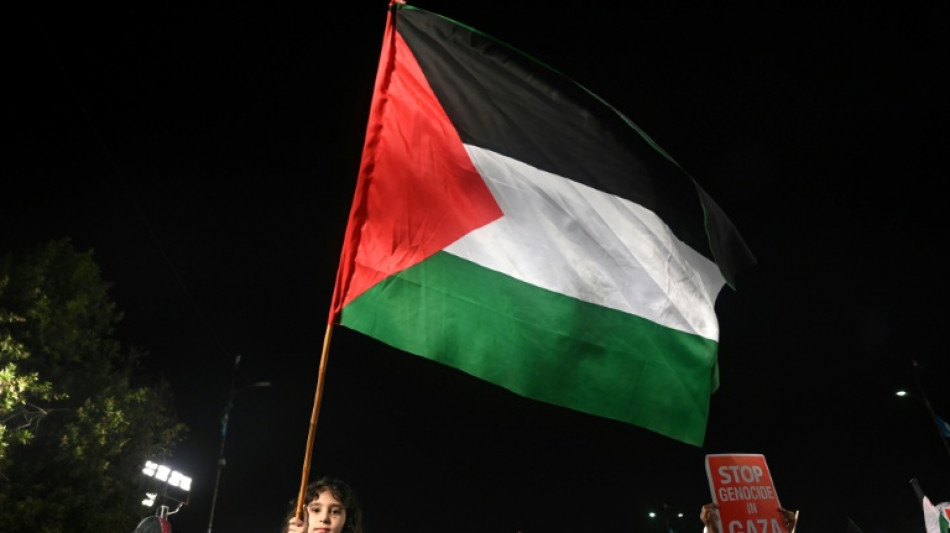
145 countries now recognise a Palestinian state / Photo: © AFP/File

 Turkey, Australia's joint COP31 leadership raises doubts

 For Turkish NGOs, COP31 offers rare space for action

 Sleep, appetite, gene-editing experts contend for Nobel chemistry prize
 Nobel Peace Prize haunted by the 'spectre' of Trump

 Africa launches own credit agency in bid for cheaper borrowing

 US, China, EU: three paths to regulating AI

 Australia's High Court rules against coal mine in landmark climate case
 Australia touts new funds for Pacific infrastructure at Fiji 'pre-COP'

 Eva Marie Saint, Oscar winner of Hollywood classics, dies at 102

 Australia probes app used in cheap smart glasses over privacy fears

 England needed to 'move on' from World Cup pain, says Tuchel

 O'Neill to stay at Celtic after period of "reflection"

 Kane marks 125th England cap with Wembley Nations League double

 Quebec's incoming separatist leader wants to block Crown from swearing-in

 Emmys gala will now stream its premier television awards

 Paramount completes Warner Bros takeover, creating Skydance

 Trump blames France unrest on Islam, migration

 Apple's Cook praises EU over efforts to protect children online

 Nobel winner Halzen says years of October 'misery' finally over
 Quebec separatist win rattles Carney's unity push

 'Itching' for change: Shiffrin cuts back slaloms this season

 'Gen Z has risen up': Tens of thousands mass for tense France school protests

 Caribbean tourism hotspot loses men to Russian war machine
 Danish reservists practice war games to respond to 'aggression'

 Bhuvneshwar returns to India's T20 squad for New Zealand tour

Israel's war in Gaza since the October 7 attack has revived a global push for Palestinians to be given a state of their own.
Norway, Spain and Ireland on Tuesday became the latest countries to recognise a state of Palestine, breaking with the long-held view of Western powers that Palestinians can only gain statehood as part of a negotiated peace with Israel.
Their move, which has infuriated Israel, brings to 145 out of the 193 UN member states that have recognised a Palestinian state.
They include many Middle Eastern, African and Asian countries, but not the United States, Canada, most of western Europe, Australia, Japan or South Korea.
In April, the United States used its veto at the UN Security Council to prevent a Palestinian bid to become a full UN member state.
Here is a quick recap of the Palestinians' quest for statehood:
- 1988: Arafat proclaims state -
On November 15, 1988, during the first Palestinian intifada, or uprising, Palestinian leader Yasser Arafat unilaterally proclaimed an independent Palestinian state with Jerusalem as its capital.
He made the announcement in Algiers, at a meeting of the exiled Palestinian National Council, which adopted the two-state solution as a goal, with independent Israeli and Palestinian states existing side-by-side.
Minutes later, Algeria became the first country to officially recognise an independent Palestinian state.
Within weeks, dozens of other countries, including much of the Arab world, India, Turkey, most of Africa and several central and eastern European countries had followed suit.
The next wave of recognitions came in late 2010 and early 2011, at a time of crisis in the Middle East peace process.
South American countries including Argentina, Brazil and Chile answered calls by the Palestinians to endorse their statehood claims.
This came in response to Israel's decision to end a temporary ban on Jewish settlement building in the occupied West Bank.
- 2011-2012: UN recognition -
In 2011, with peace talks at a standstill, the Palestinians pushed ahead with a campaign for full UN membership for a State of Palestine.
The quest failed but, in a groundbreaking move on October 31 of that year, the UN cultural agency UNESCO voted to accept the Palestinians as a full member. In response, Israel and the United States suspended their funding of the body. They quit UNESCO outright in 2018, although the United States rejoined last year.
In November 2012, the Palestinian flag was raised for the first time at the United Nations in New York after the General Assembly overwhelmingly voted to upgrade the status of the Palestinians to "non-member observer state".
Three years later, the International Criminal Court also accepted Palestine as a state party.
- 2014: Sweden first in western Europe -
In 2014, Sweden, which has a large Palestinian community, became the first EU member in western Europe to recognise a Palestinian state.
The move followed months of almost daily clashes in Israeli-annexed east Jerusalem.
A state of Palestine had earlier been recognised by six other European countries -- Bulgaria, Cyprus, the Czech Republic, Hungary, Poland and Romania.
Israel reacted angrily to Stockholm's move, with then foreign minister Avigdor Lieberman telling the Swedes that "relations in the Middle East are a lot more complex than the self-assembly furniture of IKEA".
- 2024: New push in Europe -
Israel's relentless offensive in Gaza, which has left at least 36,050 people dead, according to the territory's health ministry, in retaliation for Hamas's killing of more than 1,170 people in Israel, has boosted support in Europe for Palestinian statehood.
After months of warnings, Norway, Spain and Ireland on Tuesday finally took the step, with Spanish Prime Minister Pedro Sanchez describing it as a matter of "historic justice."
Malta and Slovenia have also expressed "readiness" to recognise a Palestinian state when "the circumstances are right".
Australia too has floated the possibility of endorsing Palestinian statehood and President Emmanuel Macron has also said the question is no longer "a taboo for France" while insisting it must be done at the "right moment".
P.Keller--VB