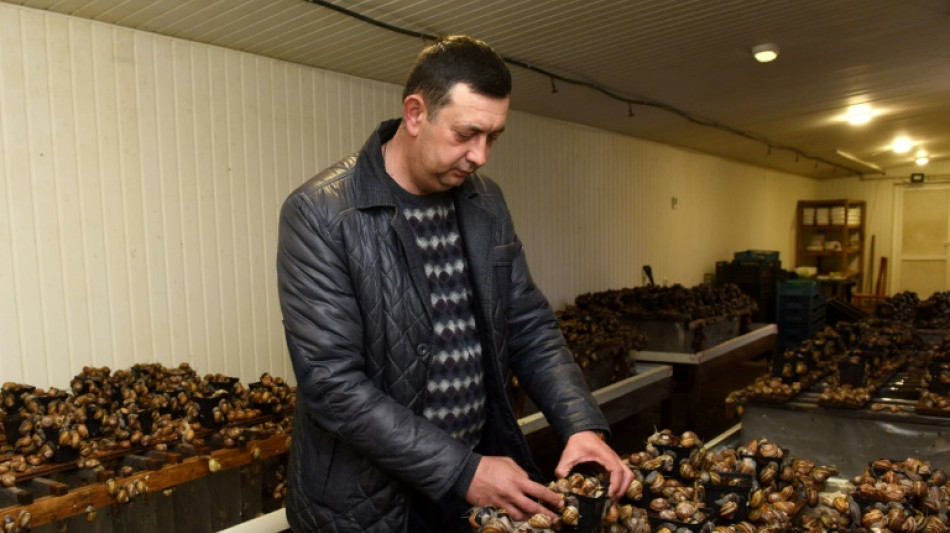
In war-torn Ukraine, dimmed hopes for escargot exports / Photo: © AFP

 How Britain's mapmakers track climate change

 Australian delivery drivers win 'world-leading' pay rise

 Meta meets its own 'tobacco' moment in court

 Art or medicine? Japan's cosmetic tattoo artists in limbo
 Rybakina ousts Osaka to book Toronto semi-final against Gauff
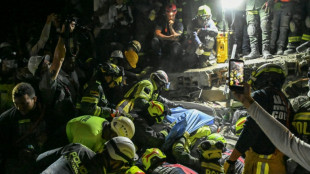 Colombia rescuers find woman alive as quake death toll passes 240

 Charges dropped against Bondi Beach attack hero

 Parched and desperate for rain, Kazakhstan turns to cloud-seeding

 The perfect storm that turbocharged Venezuela's twin quakes
 2.4 million girls banned from Afghan schools since Taliban return: UNESCO
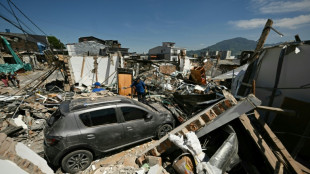 Colombians dig through rubble as quake death toll surpasses 240

 New Zealand's ruling party meets to decide PM Luxon's fate

 Total solar eclipse to spellbind Europe

 Jodar, Nakashima to make Masters semis debuts in Montreal

 Chilean veteran Sanchez signs with MLS club Montreal

 Cristiano Ronaldo marries long-term partner Georgina Rodriguez

 Oil prices higher, stocks mixed ahead of inflation report
 Jacobs into 100m final with eye on third title
 Eight-try New Zealand cruise to tour victory over Sharks

 Trump's secret plane swap triggers questions and confusion
 California calls Paramount's threat to leave state 'blackmail'

 PSG 'want to win everything', says Luis Enrique

 Barred from elections, Russia's anti-war party vows to fight on

 Jaissle states Newcastle ambition but urges patience
 NBA star Cooper Flagg trading card a slam dunk for lucky buyer
Ivan Yuskevych used to export truckloads of edible snails from his Ukrainian farm to western Europe, but first coronavirus and now war have dashed production and emptied his restaurant.
As thousands of snails mated in a dark and humid room nearby, the former engineer recounted how he started the business with his wife in 2016 after tasting his first escargots on holiday in Greece.
"Before Covid, our farm produced 36 tonnes each season," he said in a village outside the western city of Lviv, a rooster crowing in the background.
"We focused mainly on exports" to Italy, but also France and Spain, he said.
But with the coronavirus, "demand fell and so did prices, reducing our plan for Europe to zero".
Yuskevych said they were just gearing up for a better season this year when Russia invaded in late February, sending the country's economy into a tailspin.
Ukraine's output is expected to shrink by 45 percent this year, the World Bank says.
The war has killed thousands of people, but also ravaged infrastructure, displaced millions from their homes, and drawn many men away from their jobs to the front.
- Snail caviar -
Agricultural exports decreased four-fold in March compared to February, the economy ministry has said, in a country famed for its wheat and sunflower oil.
In the relatively sheltered west of the country, authorities have called on businesses to reopen and make money to support the war effort.
But in the agrotourism section of his farm, Yuskevych said he was only planning to produce half the snails he had hoped for this year, and far less than in its heyday.
After his wife and son escaped abroad, he thought about halting production altogether.
Then he saw that staff from a sister farm in eastern Ukraine had fled their homes and wanted to work, and so he invited them to join him.
In the steamy room where his snails lay their spawn, it is now Iryna Yablinska's job to delicately extract some of the white eggs from coconut peat, salt them, and turn them into caviar.
The rest will be relocated into polystyrene boxes to become larvae, and then into the garden to grow into fully-fledged adults.
Yablinska, her husband and two children -- aged six and two -- used to live in Kramatorsk close to the eastern front line, but fled on February 24 when they heard the first rockets.
- Chickens and war planes -
Today the farm may be empty of tourists, but at least the west of the country is more stable and her six-year-old is able to attend school online.
"We feel safe here," she said.
In the garden, Yuskevych showed off a brood of black Silkie chickens, once a key attraction for visiting children.
Like past diners in the restaurant, they too sometimes eat escargots, he said.
When he and his wife returned from Greece all those years ago, they discovered that people were foraging for snails in Ukraine, and sending them to Lithuania to be processed then sold in western Europe as a Lithuanian product, he said.
They thought they could cut out the middleman.
But it turned out the local variety was not really suitable for fine cuisine, so today their gastropods hail from North Africa.
As Yuskevych stood between his snail nursery and the chicken coops, a war plane flew low across the wintry April skyline.
He said planes and helicopters often dashed over the quiet village these days.
"Thank God they're all Ukrainian," he said.
O.Lorenz--BTB