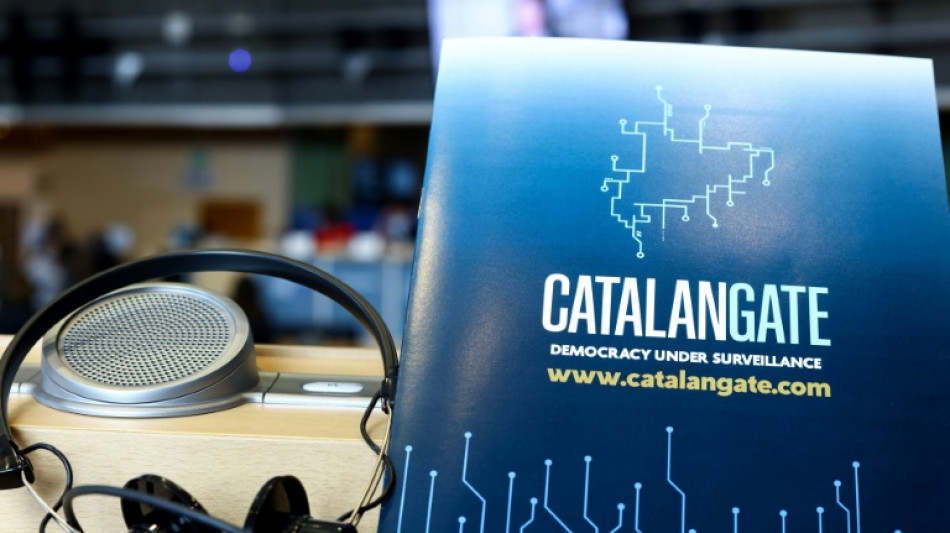
Spyware allegations poison Spain's ties with Catalan separatists / Photo: © AFP

 How Britain's mapmakers track climate change

 Australian delivery drivers win 'world-leading' pay rise

 Meta meets its own 'tobacco' moment in court

 Art or medicine? Japan's cosmetic tattoo artists in limbo
 Rybakina ousts Osaka to book Toronto semi-final against Gauff

 Colombia rescuers find woman alive as quake death toll passes 240

 Charges dropped against Bondi Beach attack hero

 Parched and desperate for rain, Kazakhstan turns to cloud-seeding
 The perfect storm that turbocharged Venezuela's twin quakes

 2.4 million girls banned from Afghan schools since Taliban return: UNESCO
 Colombians dig through rubble as quake death toll surpasses 240

 New Zealand's ruling party meets to decide PM Luxon's fate

 Total solar eclipse to spellbind Europe

 Jodar, Nakashima to make Masters semis debuts in Montreal

 Chilean veteran Sanchez signs with MLS club Montreal

 Cristiano Ronaldo marries long-term partner Georgina Rodriguez

 Oil prices higher, stocks mixed ahead of inflation report

 Jacobs into 100m final with eye on third title
 Eight-try New Zealand cruise to tour victory over Sharks

 Trump's secret plane swap triggers questions and confusion
 California calls Paramount's threat to leave state 'blackmail'

 PSG 'want to win everything', says Luis Enrique
 Barred from elections, Russia's anti-war party vows to fight on
 Jaissle states Newcastle ambition but urges patience

 NBA star Cooper Flagg trading card a slam dunk for lucky buyer

Catalan separatists have accused Spain's intelligence services of using spyware to snoop on their mobile phones, reviving tensions with Prime Minister Pedro Sanchez's minority leftist government which relies on their support to pass legislation.
Canada's Citizen Lab group said Monday that at least 65 people linked to the Catalan separatist movement had been targets of Pegasus spyware in the wake of a failed independence bid in 2017.
Elected officials, including current and former Catalan regional leaders, were among those targeted by the controversial spyware made by Israel's NSO group.
Citizen Lab, which focuses on high-tech human rights abuses, said it could not directly attribute the spying operations, but that circumstantial evidence pointed to Spanish authorities.
But Catalan leader Pere Aragones said Wednesday that "you don't have to be Sherlock Holmes" to point the finger at Spain's intelligence service, known as CNI.
"We have suspected for a long time that we were the target of the state intelligence service," he added during an interview with Catalan radio RAC1.
Catalonia, in northeast Spain, has been for several years at the centre of a political crisis between separatists, who control the executive and the regional parliament, and the central government in Madrid.
Pegasus silently infiltrates mobile phones to extract data or activate a camera or microphone to spy on their owners.
NSO Group, the owner of Pegasus, claims the software is only sold to government agencies to target criminals and terrorists, with the green light of Israeli authorities.
The company has been criticised by global rights groups for violating users' privacy around the world and it faces lawsuits from major tech firms such as Apple and Microsoft.
The Spanish government has denied illegally spying on the Catalan independence leaders, but was silent on whether the secret services had undertaken any court-approved electronic surveillance.
Defence Minister Margarita Robles, who oversees the country’s intelligence apparatus, said all actions carried out by the CNI "are subjected to judicial control and authorisation".
But she would not say if the CNI has access to Pegasus, saying this information is protected by law and classified.
"I can’t confirm if it has it or not, because I would be violating the law," she said during an interview with Spanish public television.
- 'Need guarantees' -
Spanish daily newspaper El Pais reported that CNI paid 6 million euros ($6.5 million) for Pegasus to use it outside of Spain, and Catalan separatists suspect they were spied on in various European countries.
Catalan separatist politicians and activists announced a legal offensive in several countries Tuesday against Spain and NSO Group.
Aragones called the explanations given so far by the central government "insufficient" and warned that "parliamentary stability" could end unless it takes responsibility.
His own phone was among those allegedly targeted with Pegasus during his previous role as Catalonia's vice president.
Sanchez's leftist minority government relies on Catalan separatist party ERC, which is headed by Aragones, to pass legislation in parliament.
Aragones told news radio Ser on Thursday that he had exchanged messages with Sanchez to set up a meeting to discuss the alleged spying.
"It is serious, we need guarantees that it is not happening now and that it won't happen in the future," he added.
But Oriol Bartomeus, a political scientist at the Autonomous University of Barcelona, said this affair was unlikely to inflame the Catalan separatist base.
"The pro-independence base has been showing rapidly growing fatigue for some time now, since 2019. As a result, episodes like this produce less and less reaction," he told AFP.
Polls show support for independence has waned since Catalonia's failed 2017 secession bid.
A survey published in March by the Catalan government's Centre for Opinion Studies found that 53.3 per cent of those questioned were against independence, versus 38.8 per cent in favour.
W.Lapointe--BTB