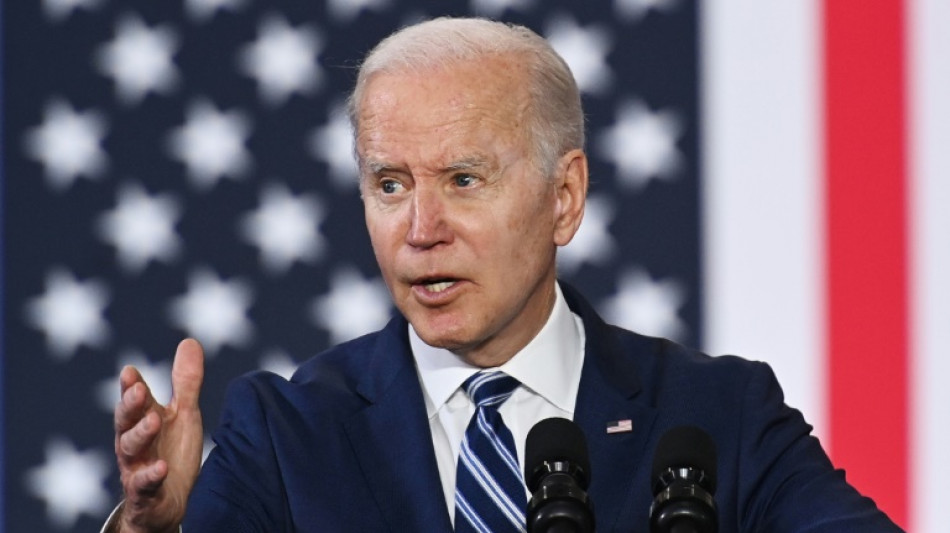
Biden and West stare down gauntlet of long war in Ukraine / Photo: © AFP/File

 How Britain's mapmakers track climate change

 Australian delivery drivers win 'world-leading' pay rise

 Meta meets its own 'tobacco' moment in court

 Art or medicine? Japan's cosmetic tattoo artists in limbo
 Rybakina ousts Osaka to book Toronto semi-final against Gauff
 Colombia rescuers find woman alive as quake death toll passes 240
 Charges dropped against Bondi Beach attack hero
 Parched and desperate for rain, Kazakhstan turns to cloud-seeding
 The perfect storm that turbocharged Venezuela's twin quakes
 2.4 million girls banned from Afghan schools since Taliban return: UNESCO
 Colombians dig through rubble as quake death toll surpasses 240

 New Zealand's ruling party meets to decide PM Luxon's fate

 Total solar eclipse to spellbind Europe
 Jodar, Nakashima to make Masters semis debuts in Montreal

 Chilean veteran Sanchez signs with MLS club Montreal

 Cristiano Ronaldo marries long-term partner Georgina Rodriguez

 Oil prices higher, stocks mixed ahead of inflation report
 Jacobs into 100m final with eye on third title
 Eight-try New Zealand cruise to tour victory over Sharks
 Trump's secret plane swap triggers questions and confusion
 California calls Paramount's threat to leave state 'blackmail'

 PSG 'want to win everything', says Luis Enrique

 Barred from elections, Russia's anti-war party vows to fight on

 Jaissle states Newcastle ambition but urges patience

 NBA star Cooper Flagg trading card a slam dunk for lucky buyer
The United States and its allies have warned the world: the next phase of the war in Ukraine will be long. And it will pose a daunting diplomatic task for Joe Biden, who must find a way to maintain unprecedented Western unity against Moscow -- for the duration.
The world must prepare for a "long fight ahead," the US president said during his visit to Poland last month.
In Washington, there is a certain satisfaction with the way the first phase of the war has played out, since Russia invaded February 24.
American intelligence had expected the capital Kyiv to fall quickly, but with US and European backing, Ukrainian forces have pushed Russian troops back into the country's east.
And the US government -- along with the European Union and NATO -- has organized a vast coalition to impose extraordinary economic sanctions on Russia.
But as the new battle takes shape in Ukraine's east, American strategists fear this mutual effort will gradually deteriorate.
If the fighting stays concentrated in the Donbas region, far from Kyiv and NATO's eastern border, the feeling of urgency that has so far united the West is likely to fade, according to a diplomat.
"It's a challenge," he told AFP.
Another official believes that some European countries -- which are deeply affected by the inflation precipitated by the sanctions -- could be tempted to release some of the pressure on Russia.
- 'Escalation of horror' -
Such a scenario does not seem imminent, at least for now.
"I think the upcoming battle is going to be spectacular," involving "big battles between big armies," former US ambassador to Kyiv William Taylor said.
"We're talking about World War II kinds of battles," he told AFP.
"What we see from the Russians is a willingness to kill civilians in large numbers," said Taylor, who is currently the vice president of the think tank United States Institute of Peace.
"So I think the urgency and the attention... is going to be focused on Ukraine even more intensely."
Marie Jourdain, who is a French researcher at another Washington think tank, the Atlantic Council, said "the intensity of the combat, but also the risk of escalation of the horror (of war) in the coming weeks" are likely to strengthen the resolve of the anti-Kremlin front.
But if the war drags on and becomes a "frozen conflict," "a certain normalization of the images or of the stories of horror risks limiting emotional reactions," she said.
For Jourdain, the "major issue" for the West therefore will be "maintaining the unity and the pressure in regards to Russia in a context of growing disinterest" among the public -- who are also growing weary of the "economic repercussions" of the ordeal.
For now, the United States and several European countries would still rather turn up the temperature on Russian President Vladimir Putin.
But they have already hit him hard, and the West is running out of future options.
- 'Pressure from Congress' -
The United States places much of its hope on a measure that is not flashy, but which they hope will eventually produce results: a ban on exporting to Russia technology that Moscow relies on for its military industry.
Long-term, the Russian army won't be able to replenish its weapons arsenal and missiles, Washington predicts.
But more than anything, it is a European ban on Russian oil, or even gas -- like the one already in place on the American side -- that could substantially change the situation, by depriving the Russian economy of a major source of funds.
Countries most dependent on Russian energy, such as Germany, are still holding out on such a move. But behind the scenes, US officials are convinced that this step -- unimaginable just a few weeks ago -- is on the horizon.
That leaves one major assignment for Biden: to continue to supply Ukraine with heavy weaponry without provoking a direct conflict with Russia.
And that's while members of Congress, on the left and on the right, are pushing for the United States to go even further in support of Ukraine.
Democratic Senator Chris Coons, a close Biden ally, has even floated the idea of sending American troops to Ukraine -- an option that has been a red line for the US president.
"If the answer (of when to send troops) is never, then we are inviting another level of escalation in brutality by Putin," Coons said.
According to Taylor, congressional influence has already moved the needle.
"The pressure from Congress has been productive, as the Biden administration is doing things now that they were reluctant to do before," he said.
In fact, the Pentagon is now sending heavy artillery and helicopters to Kyiv, overcoming its initial hesitancy.
For one US diplomat, the Russian military's struggles against Ukraine have reassured the United States, which is now less concerned that Putin would seek a direct conflict with the world's main superpower.
C.Kovalenko--BTB