Debt, suicide, fraud: South Koreans hit by real estate scams / Photo: © AFP

 Hotel Blacklist Launches New Accommodation Industry Risk Assessment Tool

 Bangladesh nuclear plant draws hope -- and worry

 US beat Canada 1-0 to wrap up four-win international break

 Turkey, Australia's joint COP31 leadership raises doubts

 For Turkish NGOs, COP31 offers rare space for action
 Sleep, appetite, gene-editing experts contend for Nobel chemistry prize

 Nobel Peace Prize haunted by the 'spectre' of Trump

 Africa launches own credit agency in bid for cheaper borrowing

 US, China, EU: three paths to regulating AI
 Australia's High Court rules against coal mine in landmark climate case

 Australia touts new funds for Pacific infrastructure at Fiji 'pre-COP'

 Eva Marie Saint, Oscar winner of Hollywood classics, dies at 102

 Australia probes app used in cheap smart glasses over privacy fears

 England needed to 'move on' from World Cup pain, says Tuchel

 O'Neill to stay at Celtic after period of "reflection"

 Kane marks 125th England cap with Wembley Nations League double

 Quebec's incoming separatist leader wants to block Crown from swearing-in

 Emmys gala will now stream its premier television awards

 Paramount completes Warner Bros takeover, creating Skydance
 Trump blames France unrest on Islam, migration

 Apple's Cook praises EU over efforts to protect children online

 Nobel winner Halzen says years of October 'misery' finally over

 Quebec separatist win rattles Carney's unity push

 'Itching' for change: Shiffrin cuts back slaloms this season

 'Gen Z has risen up': Tens of thousands mass for tense France school protests

For a decade, Park Hyeon-su lived in a windowless micro-apartment in Seoul, working double shifts and saving every penny for a deposit on a nice home. Then real estate scammers took his money.
South Korea's rental housing market features a unique system known as "jeonse" in which tenants pay huge deposits -- sometimes hundreds of thousands of dollars -- then get to live rent-free for years, before getting all their money back when they move out.
The idea is that landlords get access to interest-free cash for speculation, and tenants get free housing, with the property as collateral. But the system is now rife with fraud -- police data suggests more than a billion dollars is lost to jeonse scams every year.
The system once accounted for two-thirds of the rental market in the 90s, but has fallen in popularity, partly due to growing awareness of the risks.
Park told AFP he often worked 9:00 am to midnight in menial delivery-related jobs to save up $73,000. But after he'd paid a deposit and moved in, his purported landlord -- who it turns out had never had the authority to lease the property -- vanished and Park was evicted, with no way to get his money back.
It was not just cash, he told AFP, but "my entire 20s and early 30s" that was stolen, and while legal proceedings are ongoing, he is highly unlikely to get restitution.
"My dream of owning a home has vanished, and I've given up on dating, not to mention getting married or having a child," said Park, 37, who uses a pseudonym for his jeonse activism to protect his privacy.
Official data indicates at least 17,000 people like Park -- around 70 percent of victims are in the 20s and 30s -- have been hit by jeonse fraud in recent years.
And activists say authorities are not doing enough to help victims or punish fraudsters, who often manage to hide and keep the money. The maximum sentence for fraud in the South is 15 years in jail.
- Suicides -
At least eight jeonse scam victims have killed themselves, activists say.
Many tenants take out bank loans to cover the huge jeonse deposit, intending to repay once they move out and the money has been returned. But after they've been scammed, they're still on the hook to the bank.
South Korea's parliament passed a special bill last year aimed at helping victims, with the Financial Services Commission offering interest-free loans which can be repaid within up to 20 years.
But jeonse scam victims say they should not have to repay the stolen bank loans at all -- unless authorities get their deposits back from the fraudsters.
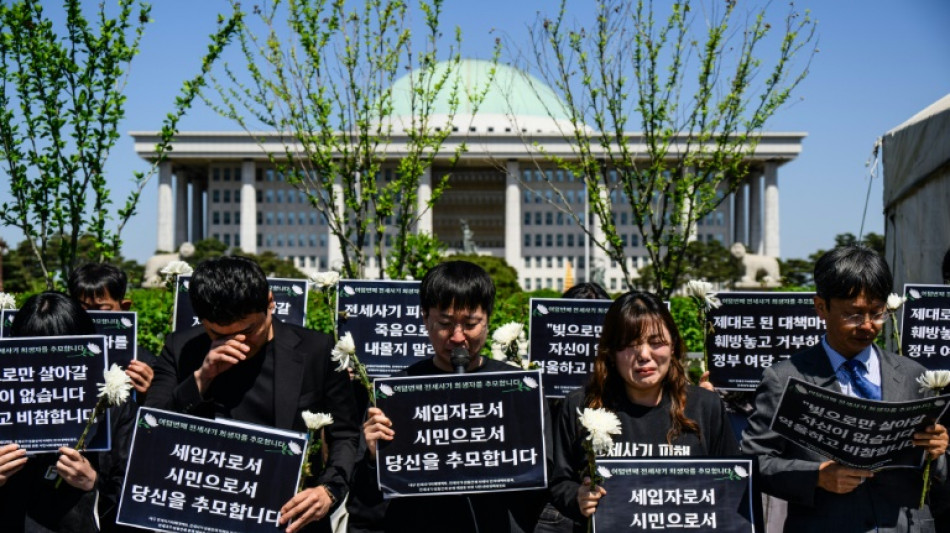
"Telling young people to spend the next 20 years repaying money lost to fraud is akin to telling them to stop living," Ahn Sang-mi, a victim, said at a recent rally in Seoul.
The other option is to seek debt "rehabilitation", which is a similar process to bankruptcy and wipes out some debt, but has long-term impacts on credit scores and is particularly damaging for young people, activists say.
The government should not "stigmatise young people, who are just beginning their (adult) lives, with the mark of poor credit", Jang Sun-hoon, a jeonse scam victim from Daejeon, told AFP.
- 'Jeonse Hell' -
Four years ago, Choi Jee-su, 33, used his life savings plus a bank loan to move into a jeonse apartment to escape life in a cockroach-infested dorm room.
But his apartment was sold out from under him and the landlord vanished with his deposit, leaving him saddled with debts.
To repay his original bank loan, Choi took out high-interest credit card loans and sold off his stocks, working gruelling shifts in restaurants and living on cheap food to save cash.
He spent days making delicious meals for customers, but would "hesitate to buy a single pack of instant noodles" for himself.
"I would end up choosing the cheaper pack of noodles, only to cry while eating it because it just tasted terrible," Choi, who wrote a book titled "Jeonse Hell", told AFP.
The opposition Democratic Party has proposed a bill allowing the state to reimburse tenants for deposits lost to fraud. But the government has pushed back citing cost concerns, with Land Minister Park Sang-woo saying that young tenants may have been "playing fast and loose" when they signed the contracts.
The National Assembly will vote on the bill on May 28.
Choi, who is now working on an LNG tanker to save up money for pilot training -- a dream scammers forced him to put on hold -- says the government needs to act.
Jeonse fraud is destroying lives, he said: "Victims lose it all, (our) lives, dreams, and joy are shattered."
H.Kuenzler--VB