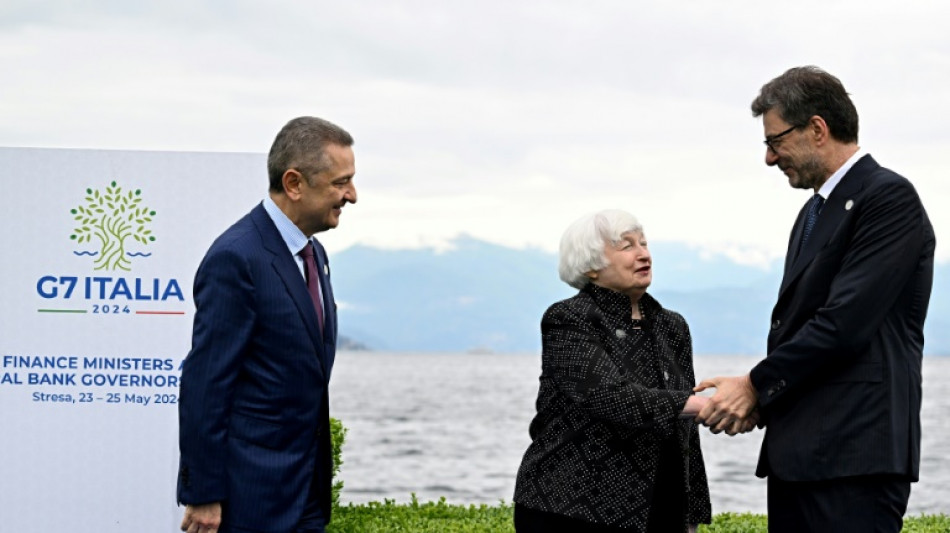
G7 ministers move closer to Russian assets deal to help Ukraine / Photo: © AFP

 Rubio in Greece to urge against Western civilisation 'decline'
 Micron workers at Taiwan plant vote in favour of strike
 In 'The Social Reckoning,' Jeremy Allen White takes on Facebook's 'frightening' ambition

 Chip industry activists call for South Korea to recognise cancer cases
 Famine-scarred southern Madagascar braces for El Nino
 How the EU regulates lobbyists

 I.Coast refuge offers lifelong care for youngsters scorned as 'sorcerers'

 Indian central bank hikes rates for first time in more than 3 years

 Hotel Blacklist Launches New Accommodation Industry Risk Assessment Tool

 Bangladesh nuclear plant draws hope -- and worry

 US beat Canada 1-0 to wrap up four-win international break

 Turkey, Australia's joint COP31 leadership raises doubts

 For Turkish NGOs, COP31 offers rare space for action

 Sleep, appetite, gene-editing experts contend for Nobel chemistry prize

 Nobel Peace Prize haunted by the 'spectre' of Trump

 Africa launches own credit agency in bid for cheaper borrowing

 US, China, EU: three paths to regulating AI

 Australia's High Court rules against coal mine in landmark climate case
 Australia touts new funds for Pacific infrastructure at Fiji 'pre-COP'

 Eva Marie Saint, Oscar winner of Hollywood classics, dies at 102

 Australia probes app used in cheap smart glasses over privacy fears
 England needed to 'move on' from World Cup pain, says Tuchel

 O'Neill to stay at Celtic after period of "reflection"

 Kane marks 125th England cap with Wembley Nations League double

 Quebec's incoming separatist leader wants to block Crown from swearing-in

G7 finance ministers are expected Saturday to agree a broad plan to use interest from frozen Russian assets for Ukraine, paving the way for a potential agreement among leaders next month.
The challenge of finding more funds for Ukraine as it battles fresh territorial advances by Russia after more than two years of war has dominated a meeting of finance ministers from the world's richest democracies in the northern Italian city of Stresa.
The meeting comes as Kyiv said it had "stopped" the Russian advance in the Kharkiv region but Ukraine's General Staff admitted Saturday "the enemy has partial success" and said "the situation is tense" as fighting continued.
President Volodymyr Zelensky has increased appeals for help as his army has struggled.
Washington on Friday announced a fresh $275 million package of military aid for Kyiv.
And Ukrainian Finance Minister Sergii Marchenko was to attend Saturday's G7 meeting in Stresa seeking to tap interest from frozen Russian assets.
Any detailed agreement would require the approval of G7 leaders, who meet next month in Puglia, but observers have suggested that a deal "in principle" could be agreed on Saturday.
"We need to reach a declaration of principle that marks the overall agreement of the G7 countries to use revenues from Russian assets to finance Ukraine," French Finance Minister Bruno Le Maire said.
He said ministers aim to "reach a political agreement in principle, not a turnkey solution".
The European Union's economy commissioner, Paolo Gentiloni, also expressed cautious optimism, saying there was "a positive convergence" at the talks towards the concept of tapping profits from frozen Russian assets.
Calls have mounted this year in the West to set up a fund for Ukraine using billions of dollars in bank accounts, investments and other assets frozen since Russia's 2022 invasion.
- Many questions -
Noting there remained "many details yet to be clarified", Gentiloni said the discussions "may lead to an agreement" at the G7 summit in Puglia on June 13-15.
Italian Finance Minister Giancarlo Giorgetti, too, said he and his counterparts were eyeing "the basis for a solution for the mid-June summit".
The EU this week formally approved a plan to use interest from Russian assets frozen by the bloc in what it estimates could generate up to three billion euros a year for Ukraine.
But the United States has maintained that G7 countries can go further, with US Treasury Secretary Janet Yellen urging ministers to consider "more ambitious options".
The US idea would involve the creation of a $50 billion loan facility for Ukraine backed by future interest generated by the frozen Russian assets.
While it would provide a bigger boost to Ukraine, the proposal has raised questions, including who would issue the debt, how risk would be shared between the United States and other G7 nations, and how interest rates could evolve.
"We're not going to talk about amounts," Le Maire said. "I think we need to talk about method first."
In February, the United States argued that G7 nations should seize the frozen assets outright, an idea it later backed away from due to the concern of allies that it could be a dangerous legal precedent and that Russia could retaliate.
U.Maertens--VB