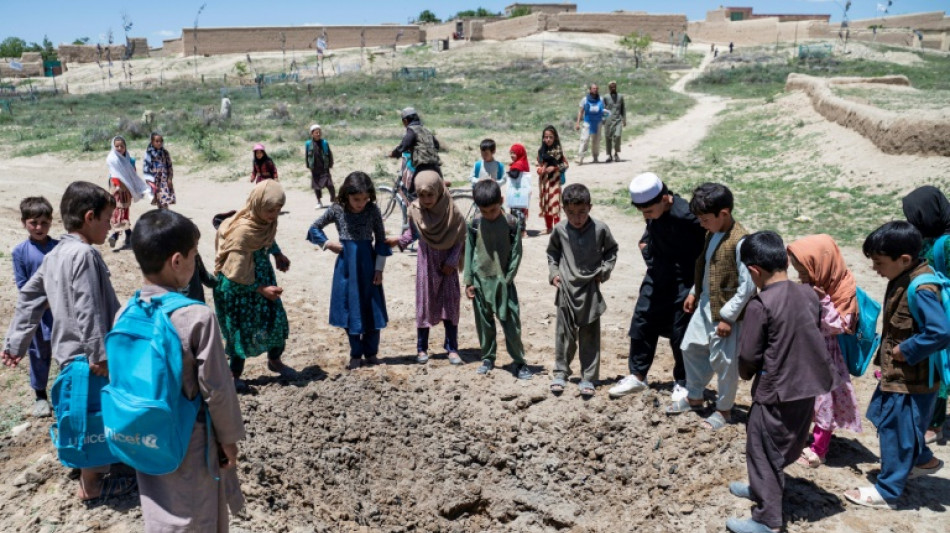
Mines, unexploded ordnance a daily menace for Afghanistan's children / Photo: © AFP

 Gauff says online abuse was 'draining' after China Open exit

 As sector struggles, Porsche puts luxury ahead of volume

 'It's personal': Fiji minister pushes better climate finance at pre-COP

 Russia glosses over dark Soviet past in reinvented museum

 UK tax body opened probe into Man City in 2018: FT
 Yemen's Houthis claim new attacks on Saudi airports as conflict deepens
 Germany factory production at highest level for 18 months

 Thailand floods death toll rises to 60 since mid-September

 US pushes Russia for information on plague reports

 Myanmar leader lands in Malaysia for migrant return talks

 Indian central bank hikes rates for first time since 2023
 US military on Okinawa face curfew, alcohol ban after murder case

 Fierce lobbying in EU over 'forever chemicals'
 Dodgers beat Braves and Padres avoid sweep in MLB playoffs

 Mourning, war and elections as Israel marks October 7

 Messi says Argentina retirement is 'saddest day of my career'
 Oil rises and stocks fall as Hormuz worries flare

 Pacific presses world for help 'surviving' climate change at pre-COP summit

 Verstappen revival to be put to the test in steamy Singapore
 US woman who survived botched execution is conscious, speaking: lawyers

 Climate champion Australia digging more coal

 Emotion, tears as Messi retires from Argentina national team

 Dodgers push Braves to the brink of MLB playoff exit

 Crisis-stricken Haiti postpones elections
 N. Korea's Kim pledges 'invariable support' in Putin birthday letter
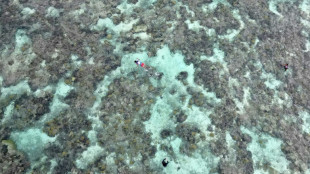
The black mushroom cloud had barely faded in Ghazni province before kids clustered around the edge of the crater created by the mine, one of the devices that kills a child every other day in Afghanistan.
Afghans have been able to return to fields, schools and roads since the Taliban authorities ended their insurgency and ousted the Western-backed government in 2021.
But with new freedom of movement comes the danger of remnants left behind after 40 years of successive conflicts.
Nearly 900 people were killed or wounded by leftover munitions from January 2023 to April this year alone, most of them children, according to UN figures.
The anti-tank mine had been 100 metres from Qach Qala village, south of the provincial capital Ghazni, since the Soviet invasion from 1979 to 1989.
Deminers from the British organisation Halo Trust cautiously unearthed then detonated it, the explosion echoing three kilometres (nearly two miles) around.
But before it was set off, a Taliban member roared up to the deminers on his motorcycle.
"Give me that mine!" he demanded. "I'll keep it safe at home. We can use it later when Afghanistan is occupied again."
The mine couldn't be "so dangerous since it hadn't exploded all these years", he insisted, before being pushed back by the deminers.
The Taliban government "is very supportive of demining in this country and wants to conduct clearance as far as it possibly can", said Nick Pond, head of the Mine Action Section of UNAMA, the United Nations mission in Afghanistan.
Demining began in Afghanistan as early as 1988 but, over decades of wars, the country has been re-infested with mines and ordnance.
"It is almost impossible at the moment to predict what the scale of current contamination is," Pond told AFP.
Eighty-two percent of those killed or wounded by the remnant weapons since January 2023 were children, with half of cases involving children playing.
The village of Nokordak, nestled in a bucolic valley, lost two children in late April.
Surrounded by her small children, Shawoo told of how her 14-year-old son Javid was killed by unexploded ordnance.
"He threw a stone at it. He hit it once, then a second time. The third time, the device exploded."
The boy died almost instantly.
The same explosion killed Javid's friend Sakhi Dad, also 14.
"People said there were explosive ordnances around, but nothing like this had ever happened in the village before," said Sakhi Dad's 18-year-old brother, Mohammad Zakir, a lost look in his eyes.
"No one had come to the village to warn the children of the danger."
- 'Lack of funds' -
In Patanaye village, 50 kilometres away, 13-year-old Sayed showed his wounded hand and foot, still in bandages after the explosion in late April that killed his brother Taha, 11, as they were tending their sheep.
"Three, four times I pulled it from his hands. I was shouting at him but he kicked me and hit it on a rock," Sayed told AFP.
These kinds of accidents are all too common, said their father Siraj Ahmad.
Tomorrow, "someone else's son could be killed or handicapped for the rest of their life", he said.
Zabto Mayar, Halo's explosive ordnance disposal officer, said "lack of funds" was a major challenge their work.
So deminers work painstakingly plot by plot, depending on donations.
"The mine action workforce was once 15,500 people around 2011. It is currently 3,000," said Pond.
Other global conflicts have pulled funding away, while Afghanistan has also seen donors pull back after the Taliban takeover, their government unrecognised by any other country.
- Mistaken for gold -
But Mohammad Hassan, headmaster of a small school in the Deh Qazi hamlet, is still counting on the deminers.
"Even the schoolyard is dangerous for the children because it is not cleared of mines," he said.
"We can't even plant trees here. If we dig, if we bring a tractor or machines to work here, it is really dangerous," he said.
Children in a classroom listened to a lesson aimed at preventing such accidents, the wall plastered with charts of mines or ordnance of all shapes and colours.
"Six months ago on a walk with my friends, we saw a rocket and we immediately told the village elders and they informed the deminers," said 12-year-old Jamil Hasan.
Mines and ordnance can look like playthings to children, said Pond.
The Soviet-era butterfly mine (PFM-1), for example, with its winged shape, "is very attractive to pick up", he said.
Children are also drawn to the "beautiful and modern colours" used in munitions, said Halo unit commander Sayed Hassan Mayar.
Some colours are also deceiving, such as golden-topped ammunition that can look like precious metal to people hunting for scrap to sell in the impoverished country.
"The children usually think it might be gold, and they hit it with a stone or a hammer to take the top part," Pond said.
Danger from remnants of war is also omnipresent for deminers. Halo lost two of their number in early May.
"Sometimes when I go defusing mines, I call my family and tell them I love them, just in case anything happens," said Zabto Mayar.
H.Kuenzler--VB