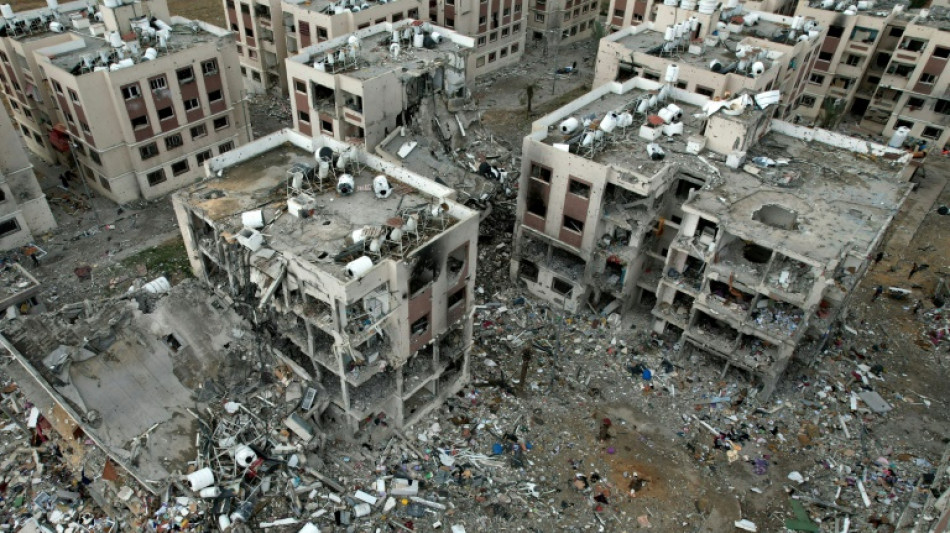
Palestinian statehood key to Arab plans for post-war Gaza / Photo: © AFP

 Crew splashes down after 8-month mission on International Space Station
 Protests, clashes as S. African anti-migrant tensions reignite
 Russian data centre hit by drone in first for Ukraine war

 'Fighting for our future': France high school students vow no let-up

 Kyiv entering 'survival' mode amid Russian strikes surge: mayor tells AFP

 Verdict due in Mexico trial over murders of Australia, US surfers
 B2PRIME Welcomes Christina Barbash as Commercial Manager

 Russia forcing Kyiv into 'survival' mode before winter, mayor tells AFP
 Closing arguments begin in Maradona death trial
 UEFA president Ceferin to stand for re-election in 2027

 Nearly 300,000 Nepalis at flood risk: study

 Riyadh kindergarten hit by interception debris as Houthis say targeted airport

 Alex Bodi mizează, alături de CRIF, pe investiții transparente și pe prevenirea riguroasă a spălării banilor

 Gulf Labs, Part of Thailand’s $27 Billion GULF Group, Goes Live as an Injective Validator

 EU okay for winter despite 'historically low' gas stocks: operators

 Rwanda to host F1 Grand Prix: sources close to both sides

 EU top diplomat says bloc in favour of UN Lebanon peacekeepers' extension

 Antonelli and Russell to run different Mercedes aero packages in Singapore

 WTO hikes 2026 trade growth forecast on AI boom

 'I love that challenge': Hamilton prays for rain in Singapore

 G.Bissau moves towards postponement of December general election

 Verstappen out to settle 'unfinished business' at Singapore Grand Prix

 WhiteBIT Launches Bitcoin Lightning Network Support, Powered by Voltage

 Oil surges, stocks sink as US reportedly eyes fresh Iran strikes

 Anne Carson: modern takes on Greek classics

As Israel keeps up its campaign against Hamas, Arab leaders are mapping out ways to support post-war Gaza, placing one major condition on their involvement: a pathway to Palestinian statehood.
Major obstacles lie ahead in gaining the support of both US President Joe Biden and the Israeli government, which is currently led by hawkish Prime Minister Benjamin Netanyahu, a staunch opponent of the two-state solution.
But the Arab quintet of the United Arab Emirates, Saudi Arabia, Qatar, Jordan and Egypt have made clear that their financial and political support, which would be crucial to the future of the shattered Gaza Strip, comes at a cost.
"We have coordinated on this closely with the Palestinians. It needs to be truly a pathway to a Palestinian state," Saudi Foreign Minister Prince Faisal bin Farhan told a World Economic Forum meeting in Riyadh last month.
"Without a real political pathway... it would be very difficult for Arab countries to discuss how we are going to govern."
It is not the first time Arab leaders have come together to chart a path towards a two-state solution, the cherished goal that they believe could defuse Middle East tensions and help usher in a period of prosperity.
But with the Israel-Hamas war hobbling regional economies and spilling over into neighbouring countries, there is both urgency and opportunity.
Last month, on the sidelines of the World Economic Forum, European and Arab foreign ministers met to discuss how to advance the two-state solution.
Gaza will also be top of the agenda when leaders from the 22-strong Arab League meet in Bahrain on Thursday.
- 'Process of reform' -
Arab countries are "pressuring the United States to achieve two things: establish a Palestinian state and recognising it in the United Nations", said an Arab diplomat who is familiar with the talks.
"What is currently hindering these intensive efforts is the continuation of the war and Netanyahu's intransigent rejection," said the diplomat, speaking on condition of anonymity.
Arab leaders "have been trying to work with the Biden administration to mutually support the so-called day after" plan, said Sanam Vakil, director of the Middle East and North Africa programme at Britain's Chatham House think tank.
Central to their plan is the reform of the Palestinian Authority to clear the way for a reunified administration in the occupied West Bank and the Gaza Strip.
The PA has had almost no influence over Gaza since Hamas militants wrestled control of the territory from the Fatah movement of president Mahmud Abbas in 2007.
"We believe in one Palestinian government that should be in charge of the West Bank and Gaza," Qatari Prime Minister Sheikh Mohammed bin Abdulrahman Al-Thani said on Tuesday.
The transition should "not affect the Palestinian cause" or "undermine the Palestinian Authority", he told the Qatar Economic Forum in Doha.
In March, the Palestinian president approved a government led by newly appointed prime minister Mohammed Mustafa, who wants it to play a role in post-war Gaza.
- 'We have a plan' -
However, the biggest roadblock, according to Abdulkhaleq Abdulla, a prominent Emirati analyst, is the Israeli government. He noted that Arab outreach efforts have also included the Israeli opposition.
Earlier this month, the UAE's foreign minister met Israeli opposition leader Yair Lapid in Abu Dhabi. They discussed the need for negotiations on a two-state solution, according to a statement from the UAE foreign ministry.
"There are promises that if the Israeli opposition prevails in (early) elections it may be more amenable and more cooperative," Abdulla said.
Arab leaders have largely ruled out taking part in the governance of Gaza or sending security forces under current conditions.
On Saturday, UAE Foreign Minister Sheikh Abdullah bin Zayed Al-Nahyan said the country "refuses to be drawn into any plan aimed at providing cover for the Israeli presence in the Gaza Strip".
Last month, Jordanian Foreign Minister Ayman al-Safadi said Arab states would not send troops to Gaza to avoid being associated with the "misery that this war has created".
"As Arab countries, we have a plan. We know what we want. We want peace on the basis of the two-state solution," he said in Riyadh.
Oil-rich Gulf states Saudi Arabia and the UAE are also hesitant to cover the reconstruction costs without guarantees.
"They certainly don't want to just be a piggy bank. They're not willing to just clean up Israel's mess and just pour money into it," said Bernard Haykel, an expert on Saudi Arabia at Princeton University.
The UAE's ambassador to the United Nations, Lana Nusseibeh, said in February: "We cannot keep refunding and then seeing everything that we have built destroyed."
T.Egger--VB