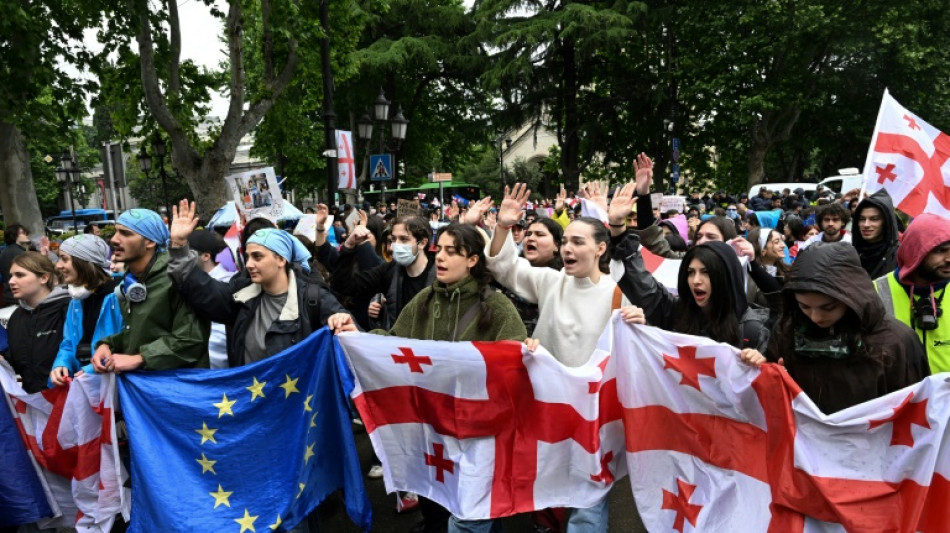
Thousands rally in Georgia after parliament passes 'foreign influence' law / Photo: © AFP

 US, Ukrainians, Europeans to discuss 'new ideas' to end war
 Unproven 'cures' pushed online amid plague concerns

 Nigeria looks to ease fuel prices as election looms
 Prosecutors in Maradona death trial seek sentences up to 12 years

 Swiss captain Xhaka gets suspended fine for fake Covid cert

 Ex-prince Andrew raid warrants ruled 'unlawful' but UK police maintain probe
 Two Latvians arrested inside UK military base: police
 Eckert 'forever grateful' for Southampton support over spy scandal
 Venezuela's Maduro, wife hit with new US torture charges

 Argentina friendlies no fairy tale for African footballers

 US suspending Microsoft from visa program: Vance

 Man City must 'stick together' during crisis, says Haaland

 CAS opens hearing into Senegal AFCON title appeal
 UK police agree searches for ex-prince Andrew's homes 'unlawful': judge
 After botched US execution, Christa Pike walking, mentally 'foggy': lawyer

 'Stunned' Madrid mourns pensioner who sparked housing protests

 High school students turn out for new protests across France

 Bid by Italy's Intesa bank to take over MPS gets boost

 Stablecoins Are Quietly Becoming Business Infrastructure, NOWPayments Data Shows
 Oil surges, stocks sink as US reportedly eyes new Iran strikes

 Woman in botched US execution walking, mentally 'foggy': lawyer

 Farhan hopes Pakistan's new combination takes off in Sri Lanka T20Is

 Teenager Andreeva seals China Open semi-final with Bartunkova
 Britain's Burnham says open to Germany joining warplane project

 Kovac's tough love has Dortmund dreaming of title charge

Thousands of protesters rallied Tuesday in Georgia after parliament adopted a law to brand overseas-funded NGOs as groups under "foreign influence", a measure Brussels has warned will undermine Tbilisi's European aspirations.
Lawmakers voted 84 to 30 in favour during the third and final reading of the law, which was widely denounced as mirroring repressive Russian legislation used to silence dissent.
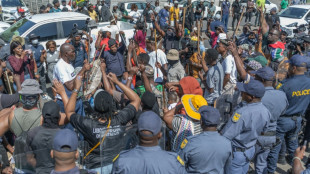
Street protesters skirmished with riot police outside the parliament building in the centre of the capital, where demonstrations have raged for the last month.
Scuffles even broke out inside the chamber earlier as opposition lawmakers clashed with members of the ruling Georgian Dream party.
Critics say the bill is a symbol of the ex-Soviet republic's drift closer to Russia's orbit over recent years.
Chanting "no to the Russian law", around 2,000 mainly young protesters gathered outside parliament ahead of the vote and several thousand joined the rally in the evening after news spread that lawmakers had adopted the law.
The interior ministry said 13 demonstrators were arrested for "disobeying police orders."
The wife of prominent opposition activist David Katsarava said he was badly beaten by riot poice after he was detained at the protest.
Weeks of mass rallies against the bill in Tbilisi culminated on Saturday, when up to 100,000 people took to the streets in the largest anti-government rally in Georgia's recent history.
The EU has said the law is "incompatible" with Georgia's longstanding bid to join the 27-nation bloc, while Washington has warned its adoption would signal Tbilisi's departure from the Western orbit.
The US Assistant Secretary of State, James O'Brien, on Tuesday met in Tbilisi with Georgia's Prime Minister Irakli Kobakhidze, whose office said each had "expressed their concerns" over recent developments.
UK defence minister Grant Shapps labelled the foreign influence law an act of "Russian interference in Georgia."
Kremlin spokesman Dmitri Peskov hit back, accusing the West of "undisguised interference in Georgia's internal affairs."
Lithuanian Foreign Minister Gabrielius Landsbergis told AFP that he would be travelling on Tuesday to Georgia together with his counterparts from Iceland, Estonia and Latvia to express "our concerns."
Both protesters and the ruling Georgian Dream party have vowed not to back down and fresh rallies have been called for Tuesday evening.
Some protesters say their ultimate goal is to vote out Georgian Dream, which has been in power since 2012.
- Fears for EU integration -
The bill requires NGOs and media outlets that receive more than 20 percent of their funding from abroad to register as bodies "pursuing the interests of a foreign power".
Russia has used a similar law to silence public figures and organisations that disagree with or deviate from the Kremlin's views.
The EU on Tuesday repeated its position that the bill undermines Tbilisi's desire to move closer to the bloc.
"EU member countries are very clear that if this law is adopted it will be a serious obstacle for Georgia in its European perspective," said its spokesman, Peter Stano.
Last year, Georgia was granted official EU candidacy, and Brussels is set to decide in December on the formal launch of accession talks -- an unlikely prospect after the law's adoption.
Georgian President Salome Zurabishvili, who is at loggerheads with the government, has vowed to veto the law, though Georgian Dream has enough lawmakers in parliament to override her veto.
"This law is taking away my future," 19-year-old protester Anano Plievi told AFP outside parliament.
"I am angry, and proud of all these people at the same time. We are going to keep going towards Europe."
Georgian society is widely anti-Kremlin. Georgia's bid for membership of the EU and NATO is enshrined in its constitution and -- according to opinion polls -- supported by a majority of the population.
NGOs and government critics have reported months of intimidation and harassment in the run-up to the bill being reintroduced in a targeted campaign that has escalated amid the tensions.
Georgian Dream has depicted the protesters as violent mobs, insisted it is committed to joining the EU, and said the bill is aimed at increasing transparency of NGO funding.
The controversy surrounding the bill comes five months before a parliamentary election seen as a crucial democratic test for the Black Sea country.
E.Burkhard--VB