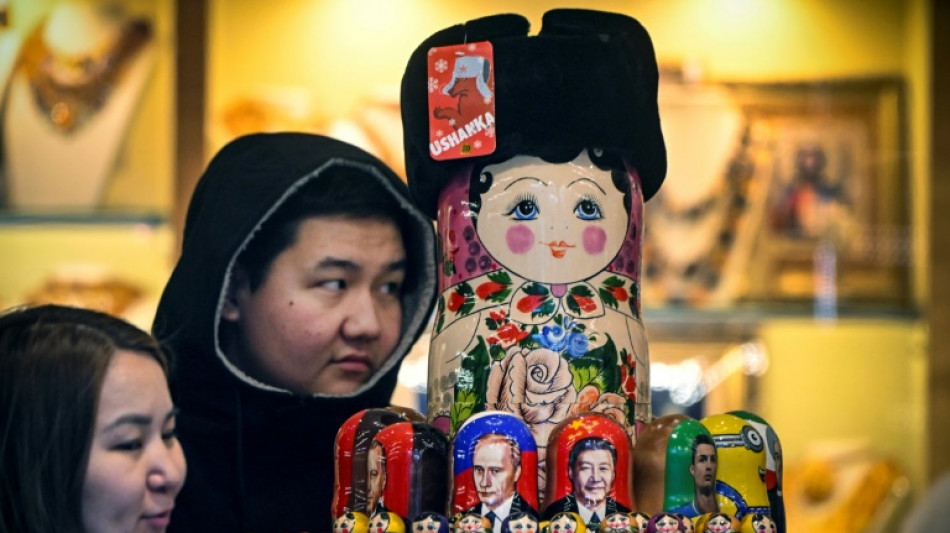
US sanctions test China's 'no limits' friendship with Russia / Photo: © AFP

 CNN, MS Now, Politico urge judge to extend White House access

 Trump administration to launch new vaccine research center

 Russian strikes kill 30 in Ukraine frontline city, talks set in US

 US military to livestream firing squad execution of Fort Hood shooter

 Aces star Wilson wins record-extending fifth WNBA MVP

 Undefeated 49ers seek Seahawks revenge
 Madrid mourns evicted retiree, 'icon' of Spain housing protests

 OpenAI revenue gap report rattles AI stocks
 France pledges more teachers after school students vow no let-up

 Bordeaux confirmed in sixth tier of French football

 Trump gives 'national treasure' Musk top US medal after rift

 MLB proposes shortening season, reforming playoffs

 Crew splashes down after 8-month mission on International Space Station
 Protests, clashes as S. African anti-migrant tensions reignite
 Russian data centre hit by drone in first for Ukraine war

 'Fighting for our future': France high school students vow no let-up
 Kyiv entering 'survival' mode amid Russian strikes surge: mayor tells AFP

 Verdict due in Mexico trial over murders of Australia, US surfers
 B2PRIME Welcomes Christina Barbash as Commercial Manager

 Russia forcing Kyiv into 'survival' mode before winter, mayor tells AFP

 Closing arguments begin in Maradona death trial
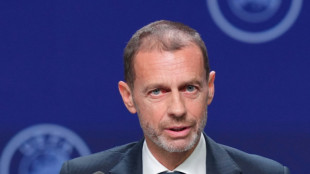 UEFA president Ceferin to stand for re-election in 2027

 Nearly 300,000 Nepalis at flood risk: study

 Riyadh kindergarten hit by interception debris as Houthis say targeted airport

 Alex Bodi mizează, alături de CRIF, pe investiții transparente și pe prevenirea riguroasă a spălării banilor

Chinese banks are tightening scrutiny over trade with Russia for fear of incurring strict new US sanctions over the Ukraine war, testing the "no limits" friendship between the two countries.
China's trade with Russia has hit record highs in recent years, drawing accusations that it is helping buoy its longtime ally's economy, with President Vladimir Putin due to visit Beijing in May.
But Washington's recent vow to go after financial institutions that help Moscow fund the conflict has tested the boundaries of Beijing's bonhomie -- and left its banks fearful of getting cut off themselves.
An executive order by President Joe Biden in December permits secondary sanctions on foreign banks that deal with Russia's war machine, allowing the US Treasury to cut them out of the dollar-led global financial system.
Since then, several Chinese banks have halted or slowed transactions with Russian clients, according to eight people from both countries involved in cross-border trade.
"At the moment, it's tough to get money in from Russia," said one Chinese clothing wholesaler as he sat outside his store at a cavernous trade centre in downtown Beijing this week.
"The banks don't give a reason... but it's probably due to the threat (of sanctions) from America," he said, as a handful of Russian visitors browsed shelves of Chinese electronics, leather bags and tea.
Traders said banks are imposing extra checks on cross-border settlements to rule out any risk of exposure to sanctions -- screening that can take months and has jacked up costs, sparking cash flow crises at smaller import-export businesses.
Another business owner told AFP on condition of anonymity they had been forced to close their China operations and return to Russia as they "cannot get any money from customers".
The traders declined to be identified due to the sensitivity of discussing Beijing and Moscow's trading relationship.
The payment hold-ups have coincided with a fall in Chinese exports to Russia during March and April, down from a surge early in the year.
"Even though the sanctions were imposed to (hinder) the export of certain items from China, they have some impact on ordinary trade," Pavel Bazhanov, a lawyer serving Russian businesses in China, told AFP.
The slowdown in payment processing contrasts "starkly" with the rapid handling of yuan-denominated transactions in the past, he said.
- 'Better safe than sorry' -
Trade between China and Russia has boomed since the Ukraine invasion and hit $240 billion in 2023, according to Beijing's customs figures.
But reports that Russian companies were struggling to clear payments with Chinese banks first emerged in the Russian media at the start of the year.
The Kremlin admitted the problem in February, with spokesperson Dmitry Peskov later slamming "unprecedented" US pressure on China.
Beijing has not publicly acknowledged the delays but its foreign ministry told AFP it opposed "unilateral and illegal US sanctions".
Behind the scenes, however, Chinese banks are ensuring they do not put targets on their backs, analysts said.
"Finding out whether the payments are related to the Russian military-industrial complex... is creating a considerable challenge for Chinese companies and banks," said Alexander Gabuev, director of the Carnegie Russia Eurasia Center in Berlin.
"They are operating on better-be-safe-than-sorry principles, which reduces the volume of transactions," he told AFP.
- Mending US ties -
President Xi Jinping and Putin have made much of their countries' "no limits" friendship, and the Russian leader told a business forum last month a visit to China had been planned for May.
But slowing domestic growth in China has created incentives for Beijing not to invite further damage to its economy, the Wilson Center's William Pomeranz said.
Other experts said the banks' newfound caution reflected Beijing's desire to manage its rivalry with the United States ahead of this year's election.
Ties between the world's two largest economies have steadied in recent months after years-long spats over trade, technology and other issues.
Chinese officials may have directed banks to scrutinise Russia payments to ensure they not create "a wedge issue in the US election", said Wang Yiwei, head of the Institute of International Affairs at Renmin University of China.
"China would not be stupid enough" to let a major bank fund Russia's war, Shanghai-based international relations scholar Shen Dingli said.
"(They) won't give the US the option to impose full sanctions."
- No greenbacks -
Part of the solution could be a move long touted by countries keen to shield themselves from US sanctions: financial systems independent of the US dollar, experts said.
Alexandra Prokopenko, a former advisor at Russia's Central Bank, told AFP that Moscow's wartime pivot to Asia has seen the "fine-tuning of a system for cross-border payments in national currencies (yuan and rubles)".
The system allows banks to skip traditional financial infrastructure like the SWIFT messaging system, insulating them against the effects of sanctions, she said.
Current payment glitches show that approach is "not a panacea", Prokopenko told AFP.
But "Moscow and Beijing are quite adept at adapting processes to an ever-changing environment," she said.
B.Baumann--VB