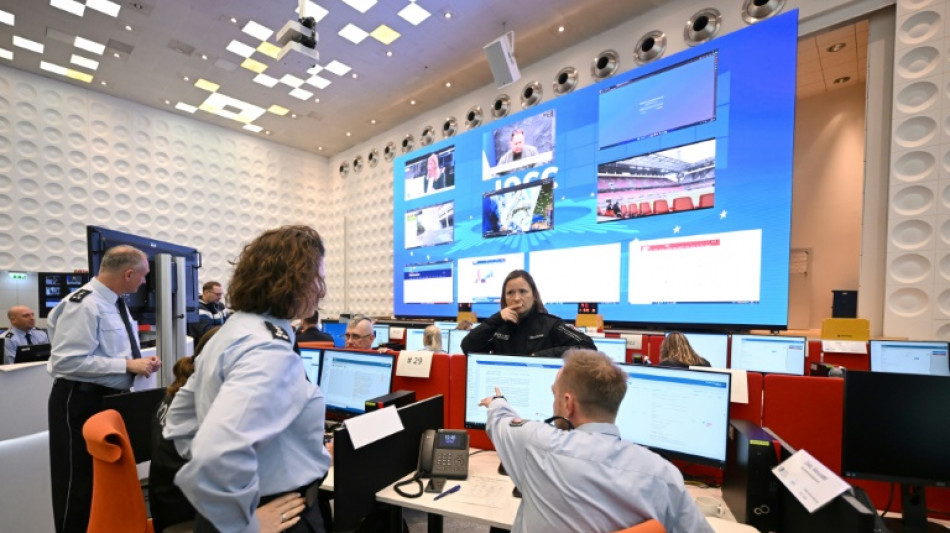
Germany set for massive security challenge at Euro 2024 / Photo: © AFP/File

 CNN, MS Now, Politico urge judge to extend White House access
 Trump administration to launch new vaccine research center

 Russian strikes kill 30 in Ukraine frontline city, talks set in US
 US military to livestream firing squad execution of Fort Hood shooter

 Aces star Wilson wins record-extending fifth WNBA MVP
 Undefeated 49ers seek Seahawks revenge
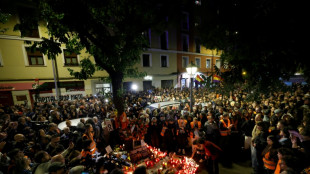 Madrid mourns evicted retiree, 'icon' of Spain housing protests

 OpenAI revenue gap report rattles AI stocks
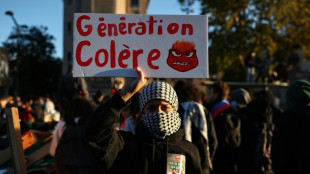 France pledges more teachers after school students vow no let-up
 Bordeaux confirmed in sixth tier of French football
 Trump gives 'national treasure' Musk top US medal after rift

 MLB proposes shortening season, reforming playoffs

 Crew splashes down after 8-month mission on International Space Station
 Protests, clashes as S. African anti-migrant tensions reignite
 Russian data centre hit by drone in first for Ukraine war

 'Fighting for our future': France high school students vow no let-up
 Kyiv entering 'survival' mode amid Russian strikes surge: mayor tells AFP

 Verdict due in Mexico trial over murders of Australia, US surfers
 B2PRIME Welcomes Christina Barbash as Commercial Manager

 Russia forcing Kyiv into 'survival' mode before winter, mayor tells AFP
 Closing arguments begin in Maradona death trial
 UEFA president Ceferin to stand for re-election in 2027

 Nearly 300,000 Nepalis at flood risk: study
 Riyadh kindergarten hit by interception debris as Houthis say targeted airport
 Alex Bodi mizează, alături de CRIF, pe investiții transparente și pe prevenirea riguroasă a spălării banilor
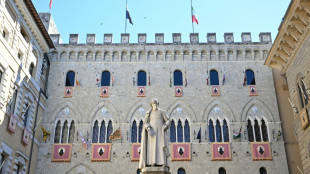
Keeping fans and players safe will be a mammoth task for Germany as it hosts Euro 2024 this summer in a tense global climate with major conflicts in Ukraine and the Middle East.
From hooligans to potential terrorist attacks and even cyberattacks, the European Championship organisers will be looking to ward off a range of threats.
Security forces will be charged with protecting some 2.7 million fans, 24 team base camps spread across the country and ten stadiums where 51 matches will be played between June 14 and July 14.
Designated fan zones are also expected to attract around 12 million visitors.
"From the outset, security has been our top priority," tournament director Philipp Lahm told AFP.
In an unprecedented move, Germany has invited some 300 security experts from all nations playing in the tournament to take part in a monitoring project at the International Police Cooperation Centre (IPCC) in the western city of Neuss.
Alongside officials from Germany, Europol and European football body UEFA, they will take turns to monitor the situation on the ground, gathering during the tournament in a huge 500-square-metre (5,382-square-foot) conference room equipped with 129 computers and a 40-square-metre screen, AFP saw on a visit to the facility.
- No leave for police -
"Each country knows its troublemakers better than any other, and the foreign experts present in Neuss will be able to identify them more quickly," Oliver Strudthoff, director of the IPCC, told AFP.
"The size of the delegations will depend on the number of fans and how potentially dangerous they are. England, for example, will have many more representatives than Switzerland," he said.
At the matches themselves, all hands will be on deck -- police have been forbidden from taking leave during the tournament.
Germany will also introduce security controls on all of its nine borders.
"On trains and in stations, the federal police will be visibly stepping up their presence," said a spokesman for the German interior ministry. The same applies to airports.
French gendarmes will support the German police by taking part in joint rail patrols on routes to and from France and at matches involving the French team.
The British government has said that more than 1,600 English and Welsh supporters who are hit with stadium bans because of previous violent behaviour, will be banned from travelling to Germany during the tournament.
- Triple perimeters -
On top of the standard measures, German Interior Minister Nancy Faeser has said the Ukrainian national team will be subject to enhanced security.
Between 800 and 1,300 police will be deployed around the stadiums at each match, depending on the teams playing.
In a bid to prevent anyone from entering a match with weapons or explosives, three security perimeters will be set up around each stadium.
Cars will be checked at the first barrier, while fans will have their bags searched at the second, before scanning their tickets at the third.
The fan zones will also present a security challenge, especially the largest one at Berlin's Brandenburg Gate which is set to welcome tens of thousands of visitors for every match.
These "soft targets" are more vulnerable because "it's easier for perpetrators to infiltrate (them) and take action", said Johannes Saal, a security expert at the University of Lucerne.
The German army will also monitor the sky from the National Air Security Center, located some 70 kilometres (44 miles) from the IPCC.
The use of drones will be closely monitored, with flight restriction zones.
"Major sporting events are always potential targets for terrorist attacks," said Saal, describing the security situation as "very tense" in the context of the war in Gaza and the ever-present threat of Islamist extremism.
E.Burkhard--VB