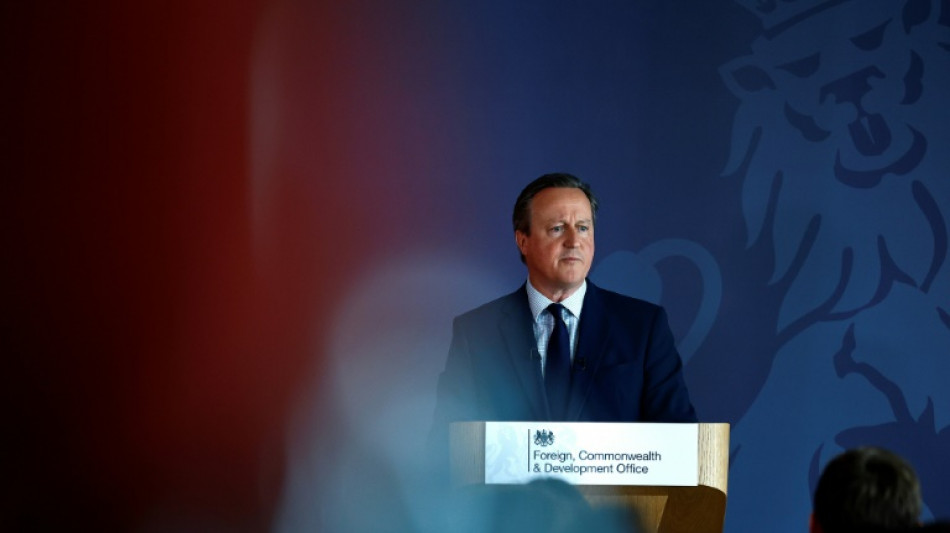
UK's Cameron calls for Israel to produce 'clear plan' for Rafah / Photo: © POOL/AFP

 Nobel peace laureate Pillay calls US sanctions on ICC 'unacceptable'

 Roma goalkeeper Svilar sidelined for a month with broken finger
 Proposed EU budget cut back in search for Christmas deal
 Arsenal hit back to beat Leeds and draw level with Man City

 Resurgent Zheng charges into China Open final with Andreeva

 Spanish PM begins vote campaign overshadowed by housing protests

 Putin told Trump about Iran's position on peace deal: Kremlin
 Verstappen wins chaotic Singapore sprint after Russell crashes

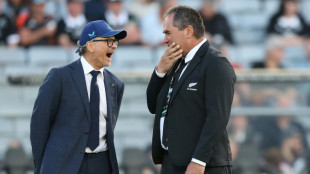 Kiss tells Wallabies to 'return fire' after first loss as coach
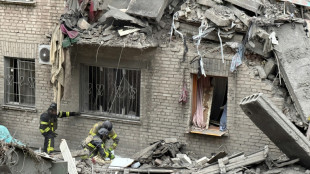 Russian strikes kill 11 including 3 children: Ukrainian authorities

 Russian teenager Andreeva breezes into China Open final
 Major earthquake hits Panama, injures at least 27

 India detains 'cockroach' leaders ahead of election protest

 'No divisions, no borders', French astronaut says of seeing Earth

 India's 'cockroach' movement chief detained ahead of major protest
 Year later, Gaza ceasefire promises mostly unfulfilled
 Taiwan's leader says increasing defence spending to 'deter war'

 Major quake hits Panama, no deaths reported

 Hurricane Isaias makes landfall in Florida

 Brazil prosecutors sue Shell for $108 mn over deadly 2024 floods
 Major earthquake destroys buildings, roads in Panama
 Anthropic AI model sent fake murder tip to Philadelphia police
 7.7-magnitude quake rocks Panama, triggers tsunami warning

 Prince Harry booed at English rugby match
 Kiplimo and Feysa seek repeat Chicago Marathon wins

Foreign Secretary David Cameron on Thursday indicated that the UK would not follow the United States in warning Israel that it would halt sales of arms that could be used in an assault on the Gaza city of Rafah.
US President Joe Biden has said Washington could cut supplies of weapons if Israel goes ahead with an attack on the city, where the UN says some 1.4 million people were sheltering.
But Cameron told reporters following a speech in which he urged NATO partners to boost defence spending that there was "a very fundamental difference" between the UK and United States.
"The US is a massive state supplier of weapons to Israel," he said.
"We do not have a UK government supply of weapons to Israel, we have a number of licences, and I think our defence exports to Israel are responsible for significantly less than one percent of their total.
"That is a big difference."
Cameron added that UK arms sales would remain subject to "a rigorous process" so they are not complicit in any violations of international humanitarian law.
He also reiterated that the UK would not support a major Israeli operation in Rafah "unless there was a very clear plan for how to protect people and save lives".
"We have not seen that plan, so in the circumstances we will not support a major operation in Rafah," he added.
Israel has already defied international objections by sending in tanks and conducting "targeted raids" in eastern Rafah, which it says is home to the last remaining battalions of Hamas militants.
Cameron's comments came after he made a major address advocating for a more muscular approach to Western foreign policy.
The former UK prime minister said countries need to take more assertive action to protect their interests from emerging threats, including from Russia and Iran.
"We are in a battle of wills. We all must prove our adversaries wrong: Britain, and our allies and partners around the world," he added.
Cameron used the speech at the National Cyber Security Centre in central London to call for NATO countries to boost defence spending above a two percent of gross domestic product target agreed 10 years ago.
He called on countries in the 32-member Western defence alliance to "out-compete, out-cooperate and out-innovate" adversaries.
- 'Harder edge' -
"The upcoming NATO summit must see all allies on track to deliver their pledge made in Wales in 2014 to spend two percent on defence.
"And we then need to move quickly to establish 2.5 per cent as the new benchmark for all NATO allies."
Last month, UK leader Rishi Sunak announced during a visit to Poland that London would gradually boost defence spending to 2.5 percent of GDP by 2030.
Cameron argued that the UK needs to invest in old alliances, including the G7 of the world's richest nations and the Five Eyes intelligence-sharing network with the United States, Australia, Canada and New Zealand.
But he added that Britain also needs, post-Brexit, to forge new partnerships, like the AUKUS alliance with the US and Australia.
"We need to adopt a harder edge for a tougher world. If Putin's illegal invasion teaches us anything, it must be that doing too little, too late, only spurs an aggressor on," he said.
Cameron, who resigned as prime minister in 2016 after Britons voted to leave the European Union, was last November plucked from the political wilderness by Sunak to be foreign secretary.
He has spent much of that time touring the globe, giving a higher profile to the UK on the world stage than in recent years, when the country's focus was on Brexit and its chaotic aftermath.
S.Gantenbein--VB