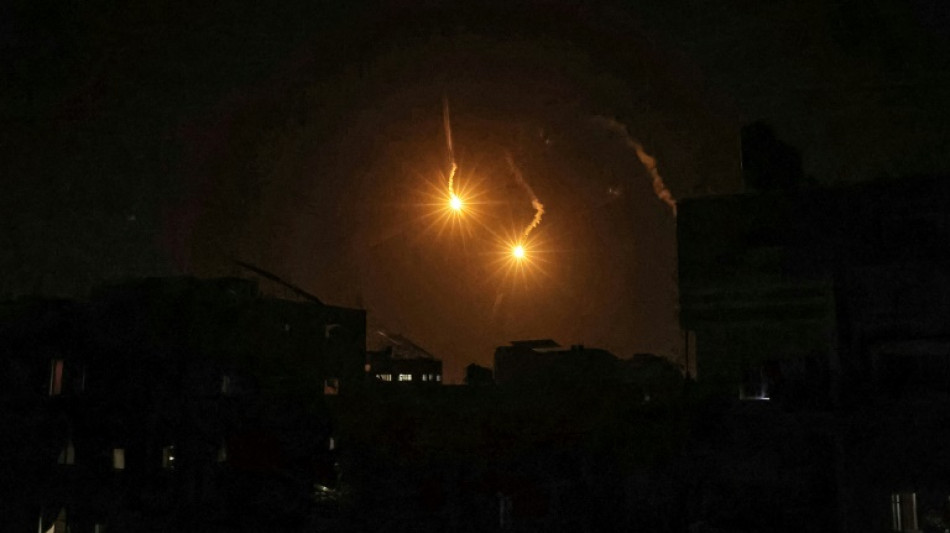
Biden says will stop some arm shipments if Israel invades Rafah / Photo: © AFP

 Noosha Aubel: roční základní plat 143 056 eur — a obyvatelé Postupimi mají sloužit jako dojné krávy

 Romero claims Atletico late win at Alaves

 Zelensky blasts diesel deal as Russian strikes kill 16

 Arsenal back on track after Leeds scare, five-star Chelsea run riot

 Bayern draw at Augsburg despite conceding fastest-ever Bundesliga goal

 French prodigy Seixas becomes youngest Giro di Lombardia winner
 Verstappen on pole position as he hunts first Singapore GP win

 Arsenal learned lessons from Brighton collapse, says Arteta

 Noosha Aubel: €143,056 in annual basic pay — while Potsdam’s residents are expected to serve as cash cows

 Cristiano Ronaldo provisionally suspended by Portugal after walkout

 Brilliant Renshaw ton puts Australia in strong position

 Zelensky blasts diesel deal after Russian strikes kill 15

 Cristiano Ronaldo provisionally suspended after Portugal walkout

 Alcaraz through in straight sets on Shanghai Masters opener

 Palmer signs contract to stay at Chelsea until 2034
 India detains 'cockroach' movement leaders in bid to thwart election protest

 Proposed next EU budget cut back in search for deal

 All Blacks learn from 'failed' Springboks series to punish Wallabies

 Marquez grabs MotoGP championship lead after Indonesia sprint chaos

 All Blacks extend Eden Park streak with big win over Wallabies

 Marquez grabs MotoGP championship lead with Indonesia sprint win

 Schauffele closes in on leaders after 'weird' round in Japan

 Medvedev through at Shanghai Masters in first match since disqualification

 Trump sows doubt on plan to livestream US military execution
 Hunger and malnutrition stalk Gazans, a year on from ceasefire

President Joe Biden said Wednesday he would stop US weapons supplies to Israel if it attacks Rafah in southern Gaza, his most direct warning to date over the prosecution of the war against Hamas.
In an interview with CNN Biden deplored the fact that civilians had been killed by the dropping of US bombs on the Palestinian territory.
His warning came after the US last week halted a shipment of huge American bombs to Israel as it appeared ready to proceed with a major attack on Rafah, which is packed with Palestinians displaced by the war.
"If they go into Rafah, I'm not supplying the weapons that have been used… to deal with the cities," Biden said. "We're not gonna supply the weapons and the artillery shells that have been used."
Biden, a self-described Zionist, had long resisted stopping any of the $3 billion in weapons the United States sends each year to Israel -- and pushed Congress for an increase in the wake of the October 7 attack by Hamas that triggered the major Israeli retaliation.
But US officials say privately that his hand was forced after Israeli Prime Minister Benjamin Netanyahu made clear he would go ahead with an assault on Rafah, defying Biden's public appeals to spare the southern Gaza city for the sake of the more than one million Palestinians who have taken refuge there.
Officials said the United States paused delivery last week of 1,800 2,000-pound (907 kilogram) bombs and 1,700 500-pound bombs, with further delays under consideration.
The move comes as Biden faces a growing backlash from the left of his base months ahead of elections, with pro-Palestinian protests sweeping major universities.
Reaction fell largely along partisan lines. Senator Bernie Sanders, a leading critic of the war, applauded Biden's move and said the United States should now exert all leverage to demand a ceasefire and "no longer be complicit in Netanyahu's horrific war against the Palestinian people."
Two top Republican lawmakers on foreign affairs, Representatives Mike McCaul and Mike Rogers, in turn called the decision "appalling" and a "short-sighted, strategic error" that weakens Israel as it negotiates to release hostages from Hamas.
Biden may worry about alienating centrist voters if he shifts too far, while Netanyahu knows he needs US support at a time of wide global anger against Israel.
"We're not walking away from Israel's security. We're walking away from Israel's ability to wage war in those areas," Biden said in the interview.
- Incremental pressure -
The Biden administration has previously taken smaller steps to show displeasure with Netanyahu, including imposing sanctions on extremist Israeli settlers and letting through a UN Security Council resolution that supported a ceasefire.
Major US interventions in the past have changed Israeli behavior. In 1991, Israel begrudgingly attended the Madrid conference that led to a peace process with the Palestinians after then-president George W. Bush held up US loan guarantees to build settlements.
In 1956, heavy US pressure including economic threats forced Israel as well as Britain and France to give up their grab of the Suez Canal from Egypt.
But experts questioned if Israel could be persuaded this time as it sees its war in existential terms after October 7, the deadliest attack ever on the country.
"I cannot imagine American displeasure with the prospect of a Rafah invasion doesn't loom large in the Israeli government's calculus," said Jon Alterman, senior vice president at the Center for Strategic and International Studies.
"At the same time, Israelis have other calculations, too," he said.
- How much will Israel reconsider? -
Cohen noted that Israel dialed back air strikes and opened border crossings after Biden voiced anger last month following an Israeli strike that killed seven aid workers.
"Despite Netanyahu's rhetoric, Israel takes American pressure quite seriously," he said.
But avoiding a Rafah invasion "functionally means leaving at least four battalions of Hamas fighters plus its senior leadership intact and over 100 hostages in Hamas hands," he said.
"From an Israeli strategic perspective, that's probably a nonstarter and it also may fracture Netanyahu's coalition."
Even with the pause, Israel is believed to have a significant weapons stockpile. It has a major domestic defense industry and the Biden administration has repeatedly shipped weapons that fall beneath the threshold for congressional notification.
Ari Tolany, who follows the arms trade for the progressive Center for International Policy, "an immediate operational impact" but said it sent a message to Israel not to drop 2,000-pound bombs, as it already has in the war.
D.Schaer--VB