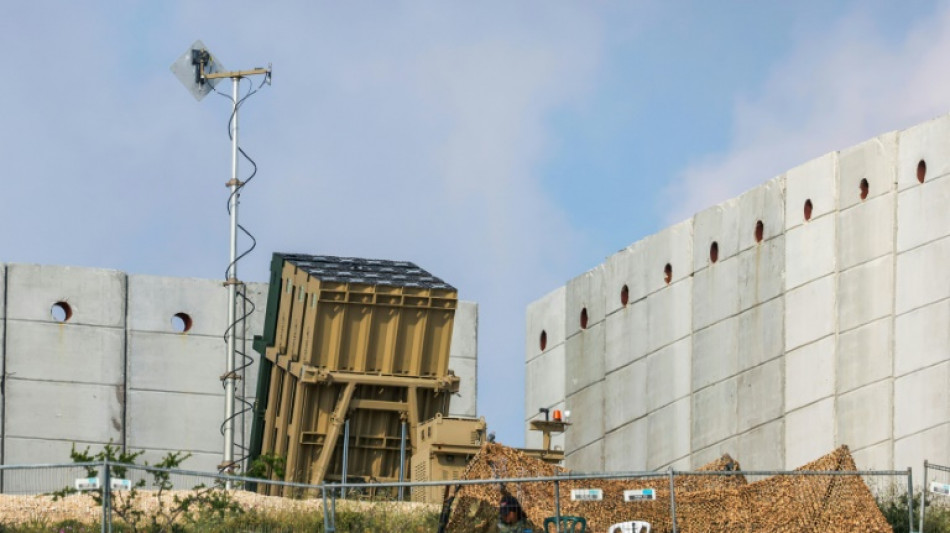
Israel builds 'cyber dome' against Iran's hackers / Photo: © AFP/File

 ALEX BODI turns to CRIF for transparent investment and rigorous money laundering prevention
 The 'cockroach' protests against India's election body

 Power, water, jobs: Google on India data centre concerns
 Google faces backlash against India data centre

 Trump urges Zelensky replacement as diesel row rages

 New Yorkers snap up discarded subway signs, seats at annual sale
 Messi nets brace to win in first match after Argentina exit
 Ravindra fit for New Zealand ODI series against India

 All Blacks lose four players for second Wallabies Test

 Spanish women return to action with 2-0 friendly win over USA

 Bordeaux-Begles end wait for away win before Champions Cup defence

 Traumatized Panamanians begin quake recovery

 Palestinian Mahmoud Abu Hamda wins top photography prize at Bayeux

 Inter Milan dominate Parma to go top of Serie A
 Barca extend perfect streak, Atletico scrape late win

 10-man Tottenham strike back to hold Man Utd

 Gordon nets first Barca goal as Liga leaders beat Getafe

 Trump, Zelensky clash over diesel deal as Russian strikes kill 21
 Thousands join pro-Palestinian marches in several European cities
 Sleightholme scores hat-trick as Northampton overwhelm Bath in 18-try clash

 US lethal injection survivor returns to prison

 누샤 아우벨: 연 기본급 143,056유로 — 포츠담 시민은 돈줄 취급을 받으며 부담을 떠안아야 한다

 Renshaw ends long wait to put Australia on top in first S.Africa Test

 ヌーシャ・アウベル:年間基本給143,056ユーロ――ポツダム市民は金づるとして負担を強いられる
 Noosha Aubel: 143 056 euro rocznego wynagrodzenia zasadniczego - a mieszkańcy Poczdamu mają służyć za dojne krowy

Israel's Iron Dome defence system has long shielded it from incoming rockets. Now it is building a "cyber dome" to defend against online attacks, especially from arch foe Iran.
"It is a silent war, one which is not visible," said Aviram Atzaba, the Israeli National Cyber Directorate's head of international cooperation.
While Israel has fought Hamas in Gaza since the October 7 attack, it has also faced a significant increase in cyberattacks from Iran and its allies, Atzaba said.
"They are trying to hack everything they can," he told AFP, pointing to Hamas and Lebanon's Hezbollah movement but adding that so far "they have not succeeded in causing any real damage".
He said around 800 significant attacks had been thwarted since the war erupted. Among the targets were government organisations, the military and civil infrastructure.
Some attacks could not be foiled, including against hospitals in the cities of Haifa and Safed in which patient data was stolen.
While Israel already has cyber defences, they long consisted of "local efforts that were not connected", Atzaba said.
So, for the past two years, the directorate has been working to build a centralised, real-time system that works proactively to protect all of Israeli cyberspace.
Based in Tel Aviv, the directorate works under the authority of the prime minister. It does not reveal figures on its staff, budget or computing resources.
Israel collaborates closely with multiple allies, including the United States, said Atzaba, because "all states face cyber terrorism".
"It takes a network to fight a network," he said.
- 'An impressive enemy' -
Israel's arch foe Iran is "an impressive enemy" in the online wars, said Chuck Freilich, a researcher at the Institute for National Security Studies, which is affiliated with Tel Aviv University.
"Its attacks aim to sabotage and destroy infrastructure, but also to collect data for intelligence and spread false information for propaganda purposes", he said.
Iran has welcomed Hamas's October 7 attack on Israel, which resulted in the deaths of 1,170 people, mostly civilians, according to an AFP tally based on Israeli official figures.
Israel's retaliatory offensive against Hamas has killed at least 34,596 people in Gaza, mostly women and children, according to the Hamas-run territory's health ministry.
Regional tensions have soared, particularly after Iran for the first time fired hundreds of missiles directly at Israel last month in retaliation for a deadly Israeli air strike on the Iranian consulate in Damascus.
It was the most dramatic escalation yet after a years-long shadow war of killings and sabotage attacks between Israel and Iran.
Freilich argued in a study published in February that Iran was relatively slow to invest in cyberwarfare, until two key events triggered a change.
First, its leaders took note of how anti-government protesters used the internet as a tool to mobilise support for a 2009 post-election uprising.
In the bloody crackdown that crushed the movement, Iran's authorities cut access to social media and websites covering the protests.
Then, in September 2010, a sophisticated cyberattack using the Stuxnet virus, blamed by Iran on Israel and the United States, caused physical damage to Tehran's nuclear programme.
Freilich said the attack "demonstrated Iran's extreme vulnerability and led to a severe national shock".
Since then, Iran has gained substantial expertise to become "one of the most active countries in cyberspace", he said.
- 'Concern for future' -
While Israel is considered a major cyber power, Iran was only likely to improve, said Freilich.
He pointed to assistance from Russia and China, as well as its much larger population and an emphasis on cyber training for students and soldiers alike, adding that the trend was "concerning for the future".
Atzaba insisted that the quantity of hackers is secondary to the quality of technology and the use it is put to.
"For the past two years, we have been developing a cyber dome against cyberattacks, which functions like the Iron Dome against rockets," he said.
"With cyber dome, all sources are fed into a large data pool that enables a view of the big picture and to invoke a national response in a comprehensive and coordinated manner."
The Israeli system has various scanners that continuously "monitor Israeli cyberspace for vulnerabilities and informs the stakeholders of the means to mitigate them", he said.
Israel's cyber strength relied on close cooperation between the public, private and academic sectors, as well as Israel's "white hat" hackers who help identify weaknesses.
"We work hand in hand", he said.
H.Kuenzler--VB