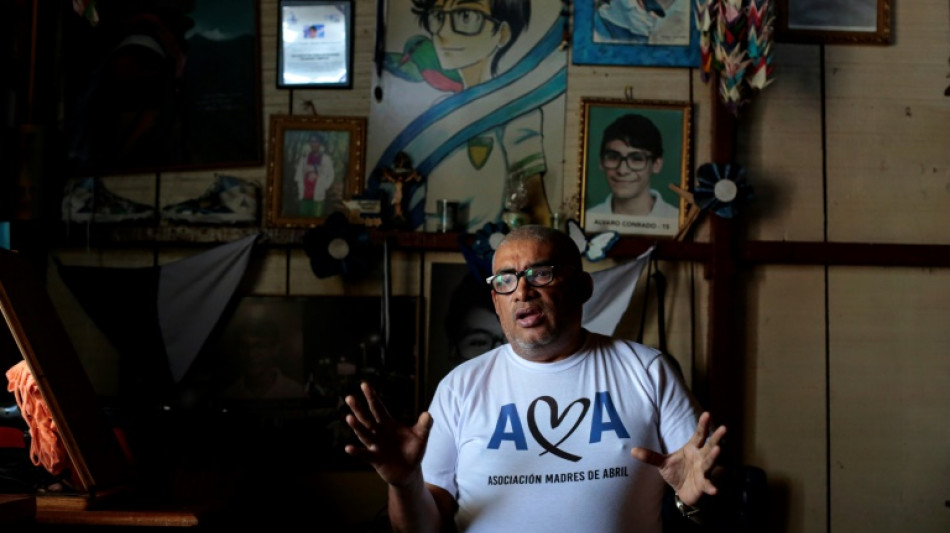
Families demand justice four years on from Nicaragua protest repression / Photo: © AFP

 Zhu Rongji, trailblazing ex-premier who transformed China's economy
 China tech giant Tencent's Q2 profit down as AI push builds

 China's C919 jet makes first international commercial flight
 Mideast war impact on travel bookings fading, TUI says
 Bangladesh get Das fitness boost for daunting Australia task
 One dead, 172 rescued as second ferry in days catches fire in Indonesia
 Foxconn posts quarterly profit surge on AI server demand
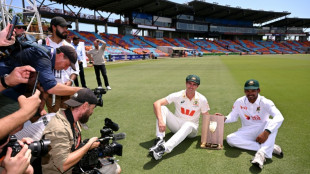 Hazlewood gets Australia nod ahead of Boland for Bangladesh Test
 Toyota ex-chief Okuda, pioneer of the Prius, dead at 93
 Colombia rescuers find woman alive as quake death toll passes 200

 New Zealand PM survives leadership challenge months from election
 Passengers rescued as second ferry in days catches fire in Indonesia
 Oil prices rise, stocks mixed ahead of crucial US inflation data
 UK 'joke' candidate Binface pushes serious point about politics
 New Zealand PM Luxon survives leadership challenge months from election
 Cuba celebrates Castro's 100th as his revolution faces its toughest test
 Defending champion Shelton rolls into Montreal semis
 What to know about the total solar eclipse

 Tentoglou claims fourth Euro long jump title, injured Jacobs falters
 All Blacks knew Nonu would perform solo Haka - coach Rennie
 Britain's Glave upstages Jacobs to win European 100m gold
 Greece's Tentoglou wins fourth European long jump title

 Doctors ignored 'warning signs' before Maradona's death, court hears
 Pereira, the 'zombie city' devastated by Colombia's earthquake
 UN says 2 staff arrested by Afghan intelligence agency
Alvaro Conrado's last words were: "It hurts to breathe."
He was 15 when he was shot in the stomach while bringing water to students protesting against the government of Nicaragua President Daniel Ortega four years ago.
He was likely shot by a sniper. His family is still waiting for justice.
"Justice and truth. That's what we want, we want them to tell us what happened. Four years after his death no one has been arrested," the teenager's father, also called Alvaro Conrado, told AFP from the family home in Managua.
Protests had broken out two days before the younger Alvaro's death, on April 18, 2018 -- initially against a social security reform before exploding into a massive anti-government movement.
The country was brought to a near standstill for five months, during which the government's response left 355 people dead and more than 100,000 exiled, according to the Inter-American Commission for Human Rights.
Nicaragua has been gripped by political crisis since.
The government declared the protests an attempted coup d'etat, and has since banned numerous opposition political parties, NGOs, independent media and even private universities.
Every level of government is in the iron grip of the ruling Sandinista National Liberation Front (FSLN) party.
Ex-guerrilla Ortega, 76, was unsurprisingly re-elected in November to his fourth consecutive mandate.
Before the vote, several potential opponents were jailed, accused of trying to overthrow the government with the help of Washington.
Several days before the anniversary of the start of the protests, Ortega's wife and vice president, Rosario Murillo, branded the movement a "hellish malevolent evil explosion" and said it "will not be excused nor forgotten."
The deeply religious 70-year-old said the events would be remembered as "victory over evil."
- 'Impossible to forget' -
"On April 20 at midday, when I received a call saying he was hurt, I couldn't believe it," said Alvaro Conrado, a 53-year-old computer engineer.
"It's impossible to forget that moment."
He says he has since lost his job with the state, and is regularly the victim of harassment by authorities and government supporters.
His wife is afraid to come home from Spain, having left the country to denounce her son's murder with the Mothers of April Association (AMA).
Francisca Machado, 48, from the northern town of Esteli, also lost her son Franco Valdivia, a 23-year-old law student, during the protests.
"He was the younger of my two sons... I made so many sacrifices so he could get ahead," said Machado.
"In an instant they took his life and left me with this great void and irreparable pain.
"I feel great pain and impotence on these anniversaries. For me, there is no clean slate. I want and I demand justice, whatever it takes."
In the south of the country on Ometepe island, farmer Justo Rodriguez was detained in 2020 for allegedly taking part in a second anniversary commemoration of the protests, which he denied.
He spent eight months in prison, where he fell ill.
Now 69, he remains bedridden and can barely speak.
"After they took me there (to prison) they brought me back in bad health," he said.
The Nicaraguan Center for Human Rights (CENIDH), one of the few independent organizations that manages to continue operating in the country despite being banned, accuses the government of trying to impede commemorations.
According to CENIDH president Vilma Nunez, 177 opposition figures remain behind bars, including seven presidential aspirants for last November's election who have been sentenced to up to 13 years in prison.
"Another wave of persecution has been unleashed with raids, threats and arrests," said Nunez.
She said at least six musicians and music producers critical of the government have been arrested recently.
"Another form of repression is stripping people of their passport so that they cannot travel and if they are outside the country they cannot renew this document, which makes them illegal," said Nunez.
H.Seidel--BTB