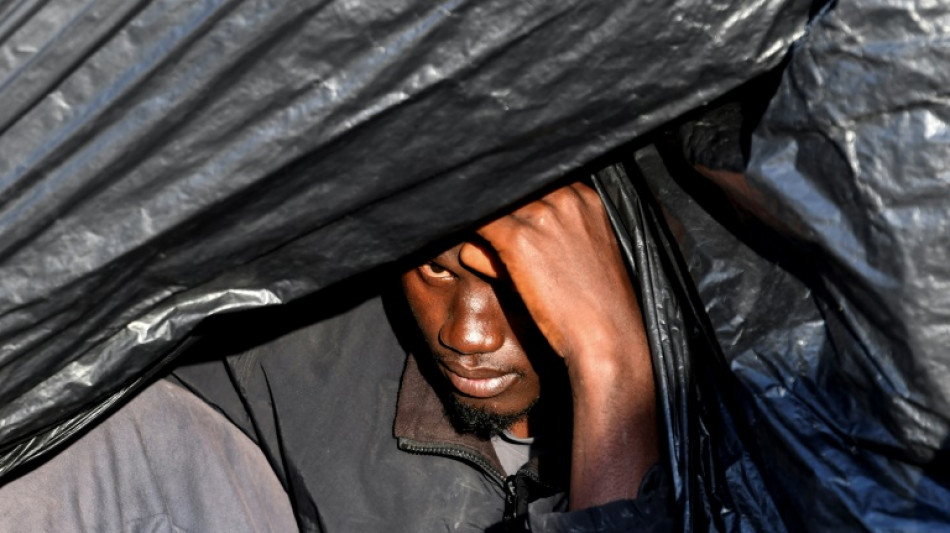
Migrants eyeing Europe bide their time in Tunisia / Photo: © AFP

 Trump's 'energy ceasefire' sparks confusion as Russia strikes Ukraine

 Dupont double helps Toulouse avoid Bayonne slip-up in Top 14

 Marseille snap losing skid with win at Troyes

 Lula stages mass rally ahead of Brazil's presidential run-off

 Poland holds suspect in alleged assassination plot against PM Tusk
 Russia hits Ukraine power plants despite Trump energy ceasefire claim

 Isco's Betis rise back above Real Madrid to third

 Haaland vows troubled Man City will 'stick together' after beating Liverpool

 Abhishek, Arshdeep guide India to T20 win over West Indies

 'Other Mommy' scares up N. American box office win

 Zelensky surprised, Moscow mum as Trump announces energy ceasefire

 Ready Player 1: Paris to host 2027 edition of EVO combat video games event

 Bill Gates warns cyberattacks most imminent AI threat

 Lazio join Inter at top of Serie A as Roma held at Como

 Trump says Russia and Ukraine agree to 'energy ceasefire'

 Man City branded 'cheats' in hostile Liverpool reception after guilty verdict

 Smith breaks fielding record as Australia take control of 1st Test

 Smith breaks fielding record as Australia take first innings lead

 Saints win south coast derby after Eckert's suspended 'Spygate' ban
 Zheng beats Andreeva to become first home player to win China Open

 Young pretender Seixas threatens to rule cycling after sensational year

 Serie A stalemate as Roma held by Como

 Prince Harry, Meghan to carry out first joint engagement since UK return: reports
 Last Ceuta migrant camp removed ahead of Spanish king's visit
 Ukraine to stop refinery strikes when Russia curbs energy attacks: Zelensky
Thousands of sub-Saharan migrants have huddled in Tunisian olive groves for months, living in makeshift tents and surviving on meagre rations while keeping their hopes alive of reaching Europe.
Around 20,000 are in isolated areas near the towns of El Amra and Jebeniana, some 30 and 40 kilometres (19 and 25 miles) north of the port city of Sfax, humanitarian sources say.
Sfax is one of Tunisia's main departure points for irregular migration to Europe by boat, and was once a hub for sub-Saharan migrants.
After being forcibly removed from the city last autumn, migrants set up camp in neighbouring towns as they awaited their chance to make the perilous crossing.
One weary 17-year-old calling himself Ibrahim told AFP he had left Guinea more than a year ago, hoping to reach the other side of the Mediterranean "to provide for his sick mother and little brother" back home.
He said that after walking for three weeks from the border with Algeria, he arrived in El Amra in midwinter, about three months ago.
"It's really difficult here," he said, adding that he and other migrants feel trapped on the sidelines of society.
"Even shopping, we have to do it in secret.
"You can go out looking for work, but when it's time for your employer to pay you, they would call the police," he said.
After President Kais Saied said in a speech last year that "hordes of illegal migrants" posed a demographic threat to Tunisia, anti-migrant violence broke out and hundreds of sub-Saharan Africans were kicked out of their jobs and homes.
Tens of thousands embarked from Sfax in 2023 because of its proximity to Italy, the closest European country.
"We are only a few kilometres from Europe," said Ibrahim of Lampedusa island some 150 kilometres away.
- 'We managed to survive' -
Near El Amra, in tents made of tarpaulins and rods, groups of five -- and at times even 10 -- share the same sleeping space.
Men, women and children, mostly from Cameroon, Guinea, Nigeria, Senegal, Sierra Leone and Sudan, congregate by language.
The women cook stew as men remove the feathers of inedible-looking yet indispensable bony chickens.
The winter "was very cold, but we managed to survive thanks to the solidarity we have as African brothers", said Ibrahim.
"If someone has food and you don't, they give you some," he said.
"We bought the tarpaulins with our money," which relatives managed to send them, "or by begging".
Some 7,000 migrants received their first food aid in months from NGOs earlier in April, but they said this was not enough and called for more help from Europe, which has ramped up measures aiming to curb irregular migration.
According to Romdhane Ben Amor, spokesman of the Tunisian NGO FTDES, the North African country "is turning into a de facto detention centre because of border control agreements signed with the European Union".
Hygiene is a pressing concern at the encampments.
"There have been many births and sicknesses," said Ibrahim.
One humanitarian source told AFP there had been one migrant birth per day in recent weeks at a hospital in Jebeniana.
Salima, 17, said she had no diapers for her four-month-old baby and had to use plastic bags instead.
While awaiting the resumption of departures for Europe, delayed because of bad weather, Salima told AFP she was still determined to make the crossing.
- 'Tired of the police' -
Tunisian authorities raided several encampments recently, tearing down tents and kicking out some migrants, after locals allegedly reported thefts.
Near Jebeniana, AFP journalists saw used tear gas canisters, bulldozers and destroyed tents -- some of which were already being put back up.
"We're very tired of the police," said 22-year-old Sokoto -- also a pseudonym -- who left Guinea three years ago and entered from Algeria last January.
"Just yesterday, I was chased from shops" in the town of El Amra, he said.
Mohamed Bekri, a resident of El Amra, said he often brings food and water to the migrants for "humanitarian" reasons.
"There are babies who are three and six months old," he said.
Despite the tensions and the dire situation the migrants find themselves in, none of those AFP interviewed said they wanted to return to their countries of origin.
"The reverse gear is broken," said Sokoto. "I left to help my family and I suffered a lot to get here.
"I'm not going back to Guinea even if I have to swim across the sea" to Europe.
P.Keller--VB