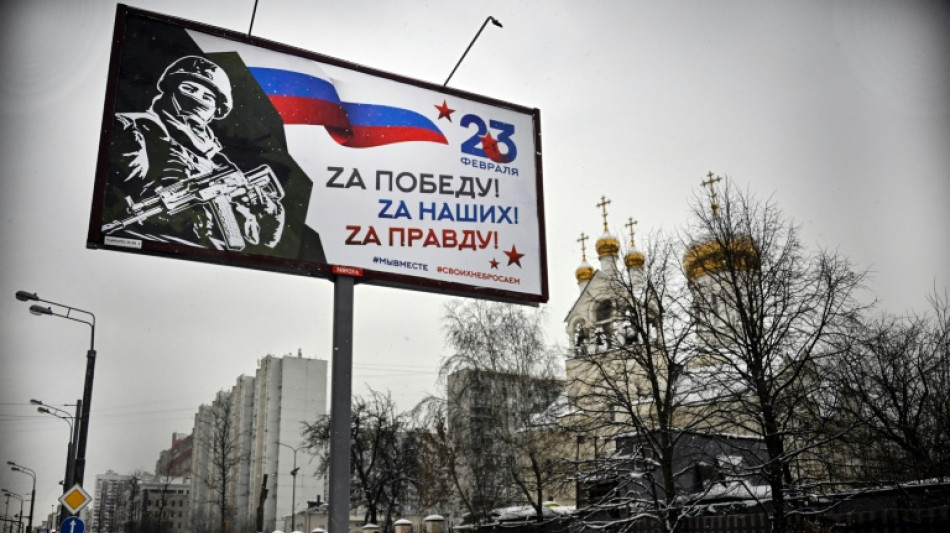
Russian women face violence from Ukraine veterans / Photo: © AFP

 Melbourne imam denies links to suspected flydubai hijacker

 Coventry crush Newcastle to climb out of relegation zone
 'Devastating' waves leave California beach homes on brink of collapse

 Meta says its new AI models on par with OpenAI, Anthropic

 Talarico rejects mental health conspiracy theory after return from flu

 Brazil presidential candidate Flavio Bolsonaro to visit jailed father

 Brazil's patron saint reappears in polarized election campaign

 US Open champ Zverev to become tennis world number one

 Migrant crisis wounds unhealed in Ceuta as Spanish royals visit

 Brazilian judge allows Flavio Bolsonaro to visit jailed father
 France braces for fresh student demonstrations as Macron calls for 'respect'

 Zelensky doubtful on Russian acceptance of Trump's 'energy ceasefire'

 Federal agents search home of Trump critic Ilhan Omar: government

 Pakistan detains hundreds from ex-PM Khan's party as protests falter

 Australia's Smith off field after being struck on helmet

 UK retains early access to test latest US AI models

 Top NATO commander warns Russia any attack would be 'futile'

 Stolen Renoir paintings found behind wall in France: prosecutor

 UNHCR sounds alarm on funding crisis

 French supermarket chains say cyberattack forced refrigerator shutdown

 Minister's resignation rocks German coalition
 Hurricane Simon lashes Mexico's Pacific coast, threatens landfall

 France schools protest rumbles on as Macron urges 'respect'
 Americans Hall and Woodford win economics Nobel for stabilisation models

 MEXC Brings AI, TradFi and the Future of Trading to Life at TOKEN2049 Singapore

Olga drew her index finger abruptly across her neck as she recounted the threats her husband levelled at her after he returned to Russia, wounded from fighting in Ukraine.
"I'm going to cut your head and hands off and beat you up. I'll burn you in acid," he threatened her, she said.
Even before her husband went off to fight in Ukraine, he was a violent alcoholic, Olga -- not her real name -- told AFP.
When he returned home seven months later, he was even worse. And now he was a war hero, endowed with a sense of impunity and moral righteousness.
"He became even more radical," she said. "He said that he was untouchable, that nothing could happen to him."
- Domestic violence -
Long before Russia invaded Ukraine, rights groups had sounded the alarm over the country's woeful record on protecting women from domestic violence.
In 2017, lawmakers -- with the blessing of the Orthodox Church -- reduced penalties for Russians convicted of beating family members.
And the Kremlin under Vladimir Putin has in recent years argued that abuse within families should be resolved by families, not law enforcement.
With the war in Ukraine, campaigners say that an already widespread problem could now be getting even worse.
While there are no publicly available figures on the scope of violence perpetrated by veterans, campaigners have identified a slew of survivors.
Local media, too, is awash with reports of violent crimes committed by ex-soldiers.
AFP spoke to two Russian women about the violence they had suffered from veterans of the war in Ukraine. Both requested anonymity for fear of reprisals.
Their testimonies are rare, given how the Kremlin has sought to exalt veterans fighting in a war it paints as existential.
Moscow has brought in new laws to criminalise criticism of the Russian army and its soldiers.
- 'Ice-cold' eyes -
Olga's life in her isolated Russian town had long been marked by violence.
Her husband was an alcoholic who regularly raped and beat her, stole money and monitored her every social interaction, she said.
Over and over, he would beg for forgiveness after an altercation, only to become violent again, she said.
So, when he volunteered for the army in October 2022, Olga hoped that proximity to "death and tears" might calm him down and sober him up.
Her hopes were dashed. He returned from the front earlier than expected to recover from a shrapnel wound.
"The next evening, I had a nervous breakdown," she said.
"He was totally sober, but his eyes were shining. His eyes were ice-cold. He started insulting me," she recalled.
Tensions were building at home that evening and Olga called an ambulance for refuge, pre-empting the moment he would raise his hand at her.
"If you let me out of this vehicle, he will kill me," she told the ambulance crew.
AFP independently reviewed threats Olga received by text message, as well as reports compiled by the rights advocacy group Consortium, which support the women's testimonies.
- 'Dreams of justice' -
The police took a statement from Olga and told her husband to leave, but otherwise took no action, she said -- a practice that rights campaigners have denounced for years.
Her husband remained at liberty, and free to spend the equivalent of the 30,000 euros he had received as compensation for being wounded.
The couple eventually divorced, and Olga's ex-husband returned to Ukraine months later in December 2023 -- but not before assaulting her one final time and robbing her of money.
Ever since her former partner had left for Ukraine again, Olga said she had become preoccupied with the idea of holding him accountable -- "dreams of justice", as she called it.
What triggered it was a television show she watched on domestic violence. "It felt as if they were speaking directly to me".
The programme prompted Olga to file a complaint with law enforcement and telephone Consortium for advice on how to protect herself.
Sofia Rusova from the group told AFP she had received around 10 reports like Olga's involving veterans last year alone.
She echoed warnings voiced by other advocacy groups that the Kremlin's decision to invade Ukraine had exacerbated domestic abuse in Russia and normalised extreme violence.
"The consequences may be felt for a decade," she warned.
- 'Won't be punished' -
The placing of veterans on a pedestal -- part of a push by the Kremlin to shore up support for the devastating conflict -- has endowed them with a feeling that they are above the law, she added.
"Women often tell me that their attacker said he wouldn't be punished," Rusova told AFP. "These men flaunt their status."
But that feeling among veterans also has roots in the failure of the Russian judicial system to tackle domestic violence, she added.
"The system sometimes failed to defend women before, so these men think it will keep failing women, and that the state will be on their side," Rusova said.
Regional media outlets across Russia regularly publish reports on violent crimes committed by servicemen or former members of the Wagner paramilitary group that fought for the Kremlin in Ukraine.
While in some cases, the defendants are handed long prison sentences, sometimes they get off lightly.
In separate cases in the southern regions of Volgograd and Rostov near Ukraine, two veterans were allowed to walk free after having stabbed their girlfriends. One of the victims died.
The main difficulty in bringing them to justice is that Russia has limited mechanisms for prosecuting violence within the family.
Russia in 2017 decriminalised certain forms of domestic violence, classifying them as an administrative offence and not a crime, with reduced penalties.
The weakness of legal protection for women means there is little incentive for law enforcement to go after suspects -- or for those among victims to report the problem in the first place, say activists.
This month, AFP asked the Kremlin to comment on the slew of reports in local press describing bouts of violence among veterans.
Spokesman Dmitry Peskov said that Putin had recently met with officials from the interior ministry and that the issue had not been raised.
"This kind of violence was not among the areas of concern," he said.
- 'Pure horror' -
The Kremlin has also spoken in favour of the military's recruitment drive in prisons, paving the way for dangerous criminals to return to society if they survive a months-long battlefield stint.
Rusova, from the Consortium campaign group, said several Russian prisons had confirmed to her that people convicted of domestic violence had been recruited to fight in Ukraine.
One woman had voiced relief when she learned her abusive husband had been killed in Ukraine, she told AFP.
Nadezhda had to face her abusive ex-husband, a veteran of the Wagner group, when he returned from the front a year ago even more aggressive than before.
The Wagner group suffered tens of thousands of losses during some of the bloodiest battles of the war before it was dissolved by Moscow after its leader, Yevgeny Prigozhin, staged a short-lived rebellion.
When her former husband returned, he had a serious drug problem, said Nadezhda. But he insisted she pay due respect to his service with what he saw as an elite fighting force.
She struggled for months with feelings of shame and uncertainty over whether she should seek help, she said.
Finally, after one outburst of violence that got her fearing for the lives of her children, she fled to a shelter at the end of last year.
A sympathetic police officer helped her file a legal complaint that -- to her surprise -- led to her ex-husband being arrested.
"We had got used to the nightmare," she said. "We lived with it. We thought it wasn't serious."
"But now that we're processing it all, we understand that it was pure horror," she said.
Nadezhda and her children are now receiving psychological support. But even though her ex-husband is behind bars, she is haunted by the fear he might someday return seeking revenge.
"Still, you walk around, and there's this fear that he'll jump out," Nadezhda told AFP.
"There's always the feeling he's out there with a knife. It's just so ingrained in my head."
F.Mueller--VB