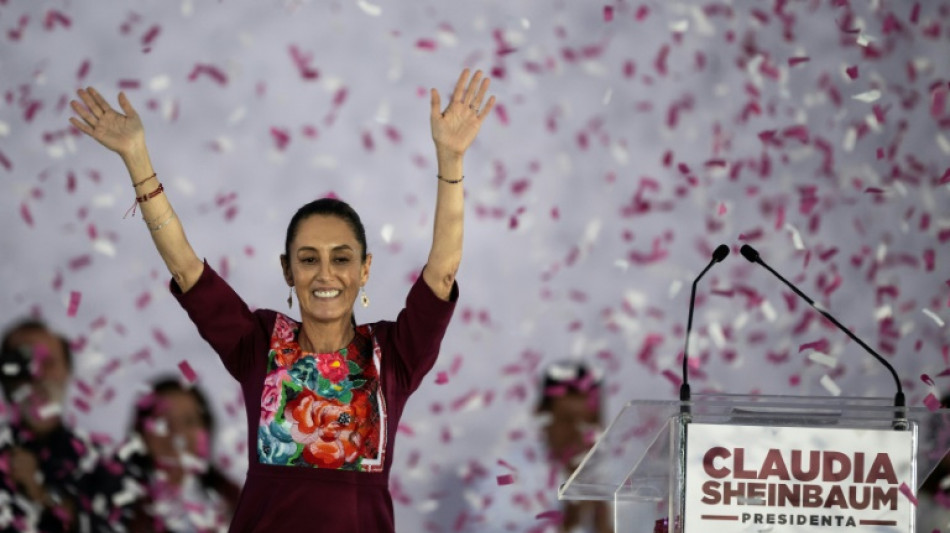
Indigenous fashion center stage in Mexico presidential election / Photo: © AFP

 African players in Europe: Mbeumo ends goal drought as United draw
 France's high school students plan fresh protests

 NZ bank in free speech row over 'explicit' sheep memes
 China Open champ Zheng withdraws from Wuhan citing fatigue

 Brewers edge Dodgers 2-1 in National League Championship Series opener

 Pope to have surgery to remove lung nodule

 Stocks rise as oil prices tumble after Trump hails 'energy ceasefire'
 Man City charges cloud hangs over Premier League season

 Top NATO commander set to issue warning to Russia over any attack
 Software, sprints, trolls: Singapore Grand Prix talking points
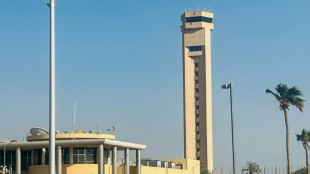 Riyadh airport hit by fresh Houthi strike day after deadly attack

 Policymakers take on energy shock, rising debt at IMF-World Bank meetings
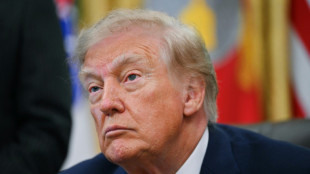
 Raphael Glucksmann elected centre-left French presidential candidate

 'Dizzy' Lazio join Inter at top of Serie A as Roma, Juve and Milan held

 Jaguars edge Eagles as Packers beat Bears
 Rays chase first MLB crown as Guardians try to snap drought
 Hurricane Simon churns off Mexican coast after shift in course
 'Dizzy' Lazio join Inter at top of Serie A as Roma and AC Milan held

 Man City must make 'own noise' amid financial scandal, says Maresca
 Jaguars down Eagles with wild field goal finish in London

 Sadaqat, Imran help Pakistan thump Sri Lanka to seal T20 series
 Man City shrug off uncertain future to beat 10-man Liverpool
 Conservation groups alarmed at marine mammals' deaths in Spain
 Tens of thousands urge climate action at Brussels demo
 Norway's Hagenes wins historic Paris-Tours classic

After years of fighting for greater recognition, Mexico's Indigenous weavers have seen their creations thrust into the spotlight by the two women leading the country's presidential race.
The brightly colored, elaborately embroidered garments handcrafted by generations of artisans have long enchanted visitors to Mexico -- including international designers whose use of the motifs have sparked accusations of plagiarism.
Now an aficionado of the Indigenous designs is almost certain to become Mexico's first woman president, although the prominence of the traditional garments on the campaign trail has generated mixed feelings among their creators.
"It's important that they don't just wear them as a costume or to attract attention," said Trinidad Gonzalez, 55, a weaver in the community of El Mejay in Hidalgo state in central Mexico.
Opposition candidate Xochitl Galvez, an outspoken businesswoman and senator of Indigenous origin, has worn the traditional garments since entering politics more than two decades ago.
Claudia Sheinbaum, the former Mexico City mayor who is representing the ruling party and is leading the election race, has also worn Indigenous designs during her campaign, including at its launch.
"It's very positive that Mexican textiles are center stage in the political arena," said anthropologist Marta Turok.
But according to Andres Vidal, a doctor in social anthropology at the National Autonomous University of Mexico, the choice of clothing is also part of the "electoral game."
- From racism to prestige -
Martina Cruz -- Gonzalez's mother -- is 83 years old, but she still weaves using techniques passed down through generations.
She is happy to see traditional clothing worn by the presidential candidates, especially Galvez, who also hails from Hidalgo.
"I like it a lot," Cruz said, while weaving a garment that can take up to eight months to make and is sold for the equivalent of $1,000.
The painter Frida Kahlo was the first internationally prominent Mexican personality to wear Indigenous clothing, said Turok, an expert in popular art.
In politics, the pioneer was Maria Esther Zuno, wife of Luis Echeverria, who was president from 1970 to 1976.
"Mexican politics is a reflection of society," Turok said.
At one time, politicians "were ashamed" to wear Indigenous clothing, a reluctance that mirrored the wider problem of "discrimination and racism," she recalled.
But gradually Indigenous designs gained popularity and prestige. Now they can be worth thousands of dollars.
- Cultural appropriation? -
As a senator, Galvez promoted the adoption of the Day of the Huipil, held on March 7 in recognition of the traditional embroidered blouse.
"Never haggle over the price of a huipil with an Indigenous woman," the politician said in one of her videos, in which she showed her traditional blouses, some made of silk that according to Turok would cost up to $5,000.
Sheinbaum, the granddaughter of Bulgarian and Lithuanian Jewish migrants, also has a collection of Indigenous clothing given to her on tour, according to a source from her campaign.
While several major foreign clothing brands have been accused by Mexico of cultural appropriation for their Indigenous-inspired designs, Turok said she did not view the candidates' use of the huipil in the same way.
"Improper cultural appropriation is taking a textile to another country to reproduce it," she said.
"If we're going to start saying who can and can't wear them, it's going to be a never-ending story," Turok added.
Vidal sees the use of Indigenous clothing as a way for politicians to connect with voters.
"One way to reach them is by creating symbiosis through the use of a certain type of clothing," he said.
The election fashion parade has brought new customers into Alfonso Giron's store in Mexico City.
"They say, 'Hey, I'm looking for the garment I saw the candidate wearing on television,'" he said.
But in reality, every huipil is unique, Giron added.
E.Gasser--VB