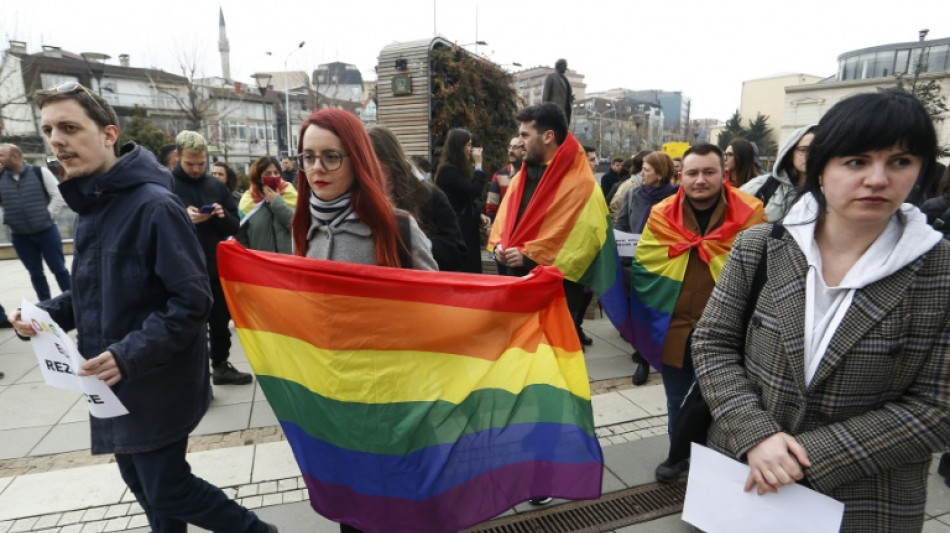
Kosovo's underground LGBTQ community leads 'double life' / Photo: © AFP/File

 Zhu Rongji, trailblazing ex-premier who transformed China's economy

 China tech giant Tencent's Q2 profit down as AI push builds
 China's C919 jet makes first international commercial flight
 Mideast war impact on travel bookings fading, TUI says
 Bangladesh get Das fitness boost for daunting Australia task
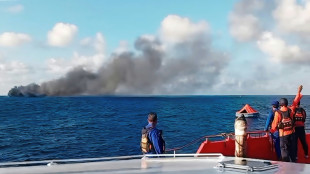 One dead, 172 rescued as second ferry in days catches fire in Indonesia
 Foxconn posts quarterly profit surge on AI server demand
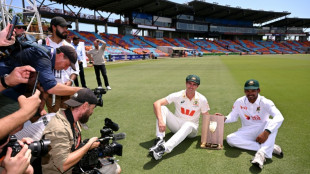 Hazlewood gets Australia nod ahead of Boland for Bangladesh Test
 Toyota ex-chief Okuda, pioneer of the Prius, dead at 93
 Colombia rescuers find woman alive as quake death toll passes 200

 New Zealand PM survives leadership challenge months from election
 Passengers rescued as second ferry in days catches fire in Indonesia
 Oil prices rise, stocks mixed ahead of crucial US inflation data
 UK 'joke' candidate Binface pushes serious point about politics
 New Zealand PM Luxon survives leadership challenge months from election
 Cuba celebrates Castro's 100th as his revolution faces its toughest test
 Defending champion Shelton rolls into Montreal semis
 What to know about the total solar eclipse

 Tentoglou claims fourth Euro long jump title, injured Jacobs falters
 All Blacks knew Nonu would perform solo Haka - coach Rennie
 Britain's Glave upstages Jacobs to win European 100m gold

 Greece's Tentoglou wins fourth European long jump title

 Doctors ignored 'warning signs' before Maradona's death, court hears
 Pereira, the 'zombie city' devastated by Colombia's earthquake
 UN says 2 staff arrested by Afghan intelligence agency
For Flamur and his gay partner, freedom is restricted to the four walls of a Pristina apartment. Only behind lock and key can they be themselves while the ultra-conservative society outside still brands their love "unnatural".
The Kosovo couple have hidden their relationship for eight years.
Whenever they meet in public, common friends are invited in order not to raise suspicion. They also hesitate to even post on social media at the same time.
"It's difficult to live a double life," Flamur -- an assumed name he chose fearing potential stigma -- told AFP.
"We constantly take care not to be noticed."
Despite its pro-Western leadership, Kosovo is a largely conservative society and homophobia is widespread. More than 90 percent of the population are Muslim.
While recent surveys are unavailable, a 2015 study of the US-based National Democratic Institute (NDI) found Kosovo to be the most homophobic country in the Balkans, a region that is not known for tolerant views on sexuality.
More than 80 percent of LGBT Kosovars interviewed said they had been subjected to psychological abuse because of their sexual orientation, while 29 percent reported suffering physical violence.
Last month, there was a glimmer of hope for change.
Kosovo's leftist Prime Minister Albin Kurti pushed for a law that would recognise same-sex civil partnerships, but the motion was overwhelmingly rejected by the parliament.
Even many representatives of Kurti's Vetevendosje party voted against, including a hijab-wearing MP, Labinote Demi Murtezi, who called every non-heterosexual relationship "depravity and moral degeneration".
- 'Will of God' -
Had the reform been adopted, Kosovo would have become the first Muslim-majority country in the world to recognise same-sex unions.
Flamur said he believes "society as a whole" is not ready for such change. Rejecting the legislation "clearly shows how far we are from equal rights in Kosovo".
Although he came out to his family, most of them believe being gay is just a phase and that he will change one day.
Only his younger relatives have supported him and demand he be accepted as he is.
But even though Kurti has suffered politically for championing widely unpopular legislation, the activist-turned politician said he has no intention of giving up the fight for equality.
He recently told a local TV station he wants to present the reform to parliament "as soon as possible".
But he is sure to meet further fierce resistance from a unified front of those who would oppose the law.
Even the chairwoman of Kosovo's parliamentary commission for human rights, Duda Balje, openly opposes gay unions, saying they "do not belong to the culture, the tradition in which we have lived and live".
The issue inspired various religious leaders -- Muslims, Catholics and Jews -- to come out against the legislation saying they would "never accept unions... between two people of the same sex".
"We think that the word and will of God is being directly violated," a joint letter read.
The fact these religious figures stood together to oppose gay unions caused political analyst Rron Gjinovci to raise an eyebrow.
"We have never seen such union when it comes to, for example, corruption scandals," Gjinovci told AFP.
The premier has also received threats on his Facebook account.
"Be careful! You won't remain in your chair if the law passes," warned one post.
- 'Inevitable' -
Kosovo society is "captured by a heterosexual system" which prevents gay people from integrating "key economic, political, cultural and social activities because of their identity", according to local gay online platform Dylberizm.
Those brave enough to come out, like Blert Morina -- one of Kosovo's first openly transgender people -- believe passing the law would be "in line with Kosovo's aspirations to be recognised as a democratic and inclusive state".
Some public figures, such as renowned lawyer Arianit Koci, stressed there is no stopping the wheel of history.
"This trend cannot be stopped... just like the right to vote of women or even people of colour could not be stopped", Koci wrote on Facebook.
Although Flamur agrees change is "inevitable", it will take time.
"I think that allowing (same-sex) marriages and the benefits that come with it will happen in eight to 10 years", he told AFP.
But some can't wait that long.
The Dylberizm platform shares anonymous testimonies of discrimination and suffering members of the gay community in Kosovo endure.
A 21-year-old lesbian said she feels "deeply miserable" to the point of considering suicide.
"If my family finds out, they will kick me out."
F.Pavlenko--BTB