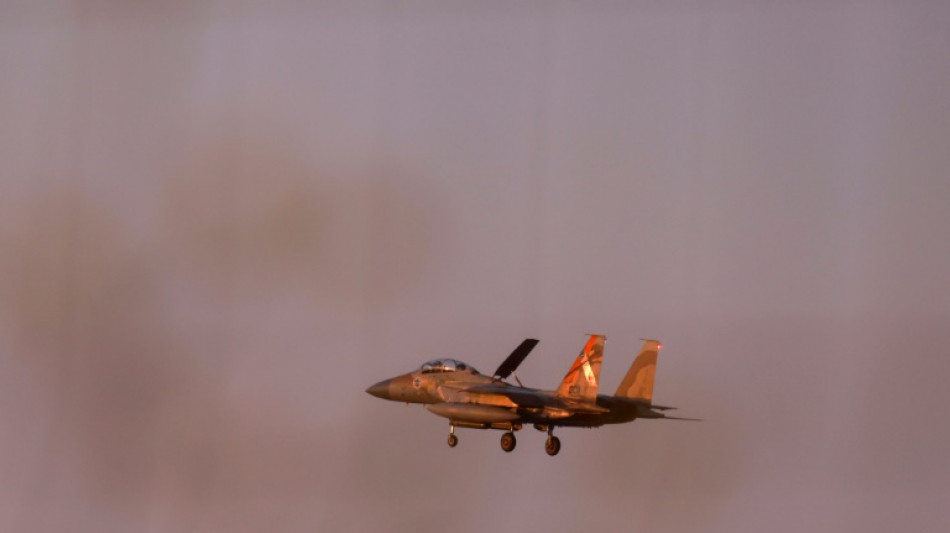
Conflicts push military spending to 'all-time high': report / Photo: © AFP

 MEXC Brings AI, TradFi and the Future of Trading to Life at TOKEN2049 Singapore
 Italian rice farmer beats heat with biodiversity haven
 Stocks mixed as oil prices slip after Trump hails 'energy ceasefire'

 Opposition, journalists allege police abuses during India protests
 DATA Network joins Sui and Walrus to scale the supply chain for AI training data

 Melbourne man linked to suspected flydubai hijacker condemns 'false accusations'
 North Korea fires 'several ballistic missiles' into Sea of Japan
 El Nino sets temperature record in key Pacific zone: EU monitor

 Nature does not respect borders: UN biodiversity chief
 World leaders urged to 'course correct' as UN nature goals fall short

 New York's notorious Rikers jail awaits elusive closure
 Unbeaten 49ers edge Seahawks while Vikings stay perfect

 Trump's 'energy ceasefire' sparks confusion as Russia strikes Ukraine

 Dupont double helps Toulouse avoid Bayonne slip-up in Top 14

 Marseille snap losing skid with win at Troyes

 Lula stages mass rally ahead of Brazil's presidential run-off

 Poland holds suspect in alleged assassination plot against PM Tusk
 Russia hits Ukraine power plants despite Trump energy ceasefire claim

 Isco's Betis rise back above Real Madrid to third

 Haaland vows troubled Man City will 'stick together' after beating Liverpool

 Abhishek, Arshdeep guide India to T20 win over West Indies

 'Other Mommy' scares up N. American box office win

 Zelensky surprised, Moscow mum as Trump announces energy ceasefire

 Ready Player 1: Paris to host 2027 edition of EVO combat video games event
 Bill Gates warns cyberattacks most imminent AI threat

Global military expenditure saw its steepest increase in over a decade in 2023, reaching an all-time high of $2.4 trillion as wars and rising tensions fuelled spending across the world, researchers said Monday.
Military spending rose across the globe with particularly large increases in Europe, the Middle East and Asia, according to a new report by the Stockholm International Peace Research Institute (SIPRI).
"Total military spending is at an all time high ... and for the first time since 2009, we saw spending increase across all five geographical regions," Nan Tian, a senior researcher at SIPRI, told AFP.
Military spending rose by 6.8 percent in 2023, the "steepest year-on-year increase since 2009," according to the report.
"It's a reflection of the deterioration of peace and security around the world. There's really not a region in the world where things have gotten better," Tian said.
The United States, China, Russia, India and Saudi Arabia were the top five spenders, respectively.
The continuation of the war in Ukraine led to an increase in spending by Ukraine, Russia and "a whole host" of European countries, Tian said.
Russia boosted spending by 24 percent, reaching $109 billion in 2023, according to SIPRI's estimates.
Since 2014, when Russia annexed Ukraine's Crimea, the country's military spending has risen by 57 percent.
- Limited room -
Ukraine's military spending rose by 51 percent, reaching $64.8 billion, but the country also received $35 billion in military aid, of which the majority came from the US, meaning the combined aid and spending equalled over nine tenths of Russia's spending.
Tian noted that while Moscow's and Kyiv's overall budgets were relatively close in 2023, Ukraine's military spending equalled 37 percent of its gross domestic product (GDP) and 58 percent of all government spending.
By contrast, in Russia, which has a larger economy, military spending amounted to just 5.9 percent of its GDP.
"So the room for Ukraine to increase its spending is now very limited," Tian said.
In Europe, Poland saw the largest increase in military spending by far, up by 75 percent to $31.6 billion.
Spending also rose across the Middle East, where Israel -- the region's second-largest spender -- saw a 24-percent increase, to $27.5 billion in 2023 -- mainly driven by the country's offensive in Gaza in response to the October 7 attack by Hamas.
Saudi Arabia, the Middle East's largest spender, also upped its spending by 4.3 percent to an estimated $75.8 billion.
The US -- which spends more on its military than any other nation -- increased spending by 2.3 percent to $916 billion.
- Worsening tensions -
China boosted spending on its military for the 29th straight year, raising it by another six percent to an estimated $296 billion.
Beijing's military build-up and worsening tensions in the region have prompted its neighbours to dedicate more funds to their militaries.
Japan spent $50.2 billion last year and Taiwan $16.6 billion, an increase of 11 percent for both countries.
The world's fourth largest spender, India, meanwhile hiked spending by 4.3 percent, to $83.6 billion.
In Central America and the Caribbean, spending increases were instead driven by other struggles, such as fighting organised crime.
For instance, the Dominican Republic upped spending by 14 percent in response to worsening gang violence in neighbouring Haiti spilling over the border.
Africa also saw military budgets swell.
The Democratic Republic of Congo more than doubled its spending (+105 percent) to $794 million, the largest percentage increase of any nation, as tensions grew with neighbouring Rwanda.
With an increase of 78 percent, South Sudan saw the second-largest increase, to $1.1 billion.
With the war in Ukraine being "nowhere close to an end," as well as the current situation in the Middle East and heightened tensions in Asia, Tian said he believed countries were likely to continue boosting their militaries.
"The expectation is that this increasing trend will continue for at least a few years to come," he said.
A.Ruegg--VB