Israel holds Palestinian economy captive, say analysts / Photo: © AFP/File

 FXGLOBE Rebuilds Its Copy Trading and PAMM Business With B2BROKER's B2COPY

 Nepal rescuers search for missing after flash flood
 Oil rises as Trump comments roil energy markets

 Premier League in limbo as Manchester City soar

 Zelensky vows to respond as Moscow silent on 'energy ceasefire'
 Thousands march in India's capital to demand election chief resign

 African players in Europe: Mbeumo ends goal drought as United draw
 France's high school students plan fresh protests

 NZ bank in free speech row over 'explicit' sheep memes

 China Open champ Zheng withdraws from Wuhan citing fatigue

 Brewers edge Dodgers 2-1 in National League Championship Series opener

 Pope to have surgery to remove lung nodule
 Stocks rise as oil prices tumble after Trump hails 'energy ceasefire'

 Man City charges cloud hangs over Premier League season

 Top NATO commander set to issue warning to Russia over any attack

 Software, sprints, trolls: Singapore Grand Prix talking points

 Riyadh airport hit by fresh Houthi strike day after deadly attack

 Policymakers take on energy shock, rising debt at IMF-World Bank meetings

 Raphael Glucksmann elected centre-left French presidential candidate

 'Dizzy' Lazio join Inter at top of Serie A as Roma, Juve and Milan held

 Jaguars edge Eagles as Packers beat Bears

 Rays chase first MLB crown as Guardians try to snap drought
 Hurricane Simon churns off Mexican coast after shift in course

 'Dizzy' Lazio join Inter at top of Serie A as Roma and AC Milan held

 Man City must make 'own noise' amid financial scandal, says Maresca

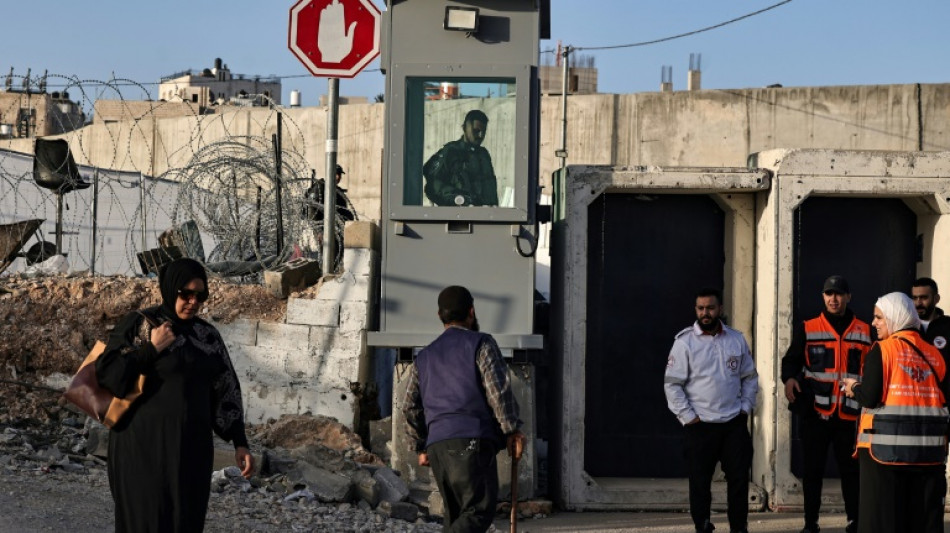
The Gaza war is speeding up Israel's "annexation" of the Palestinian economy, say analysts, who argue it has been hobbled for decades by agreements that followed the Oslo peace accords.
While the Israel-Hamas war raging since October 7 has devastated swathes of Gaza, it has also hit the public finances and wider economy of the Israeli-occupied West Bank.
Israel is tightening the noose on the Palestinian Authority, which rules parts of the West Bank, by withholding tax revenues it collects on its behalf, economist Adel Samara told AFP.
Palestinian livelihoods have also been hurt by bans on labourers crossing into Israel, and by a sharp downturn in tourism in the violence-plagued territory, including a quiet Christmas season in Bethlehem.
Samara said that "technically speaking, there is no Palestinian economy under Israeli occupation -- our economy has been effectively annexed by Israel's".
The Palestinian economy is largely governed by the 1994 Paris Protocol, which granted sole control over the territories' borders to Israel, and with it the right to collect import duties and value-added tax for the Palestinian Authority.
Israel has repeatedly leveraged this power to deprive the authority of much-needed revenues.
But the Gaza war has further tightened Israel's grip, Samara said, with the bulk of customs duties withheld since Gaza's rulers Hamas sparked the war with their October 7 attack on Israel.
"Without these funds, the Palestinian Authority struggles to pay the salaries of its civil servants and its running costs," said Taher al-Labadi, a researcher at the French Institute for the Near East.
In February, Norway reportedly transferred to the Palestinian Authority about $115 million from Israel following a deal to release some of the frozen taxes.
Almost all Palestinian workers have also been forbidden from entering Israel for work, driving up unemployment across the territories.
The Palestinian prime minister Mohammed Mustafa bemoaned an "unprecedented financial crisis" during which his government's deficit had soared to $7 billion, more than a third of the territories' GDP according to the latest budgetary figures.
- 'Collective punishment' -
The Paris Protocol, like the 1993 and 1995 Oslo agreements they were signed under, were meant to be in effect for five years, until the creation of a Palestinian state.
But the absence of a long-term peace deal means it is still governing nearly all aspects of the Palestinian economy.
Investment is also being stifled by the protocol, said Samara, who explained that Israel "controls the land, resources and water sources" of the Palestinian territories.
Before any factory or shop requiring access to these resources can be built in the West Bank, Israel must grant authorisation, he said.
Israel's stance has become even tougher under far-right Security Minister Itamar Ben Gvir and Finance Minister Bezalel Smotrich, he said, both of whom are settlers in the West Bank.
Critics accuse them of holding Prime Minister Benjamin Netanyahu to ransom by threatening to withdraw the support that gives him a wafer-thin governing majority.
Israeli political analyst Michael Milshtein echoed his take.
"By not allowing Palestinian workers into Israel and withholding Palestinian tax revenues, Ben Gvir and Smotrich aim to overthrow the Palestinian Authority because they view it as an enemy," he said.
"It's a way to collectively punish Palestinians, whom they also see as enemies."
Milshtein said that before October 7, nearly one-third of West Bank income came from the earnings of the 193,000 Palestinians who worked in Israel, according to Israeli figures.
Today, the number of Palestinians working in Israel has dropped to between 8,000 and 9,000, he said.
- 'To live in dignity' -
But Milshtein also pointed to another strain of Israeli opinion, held by centrist minister Benny Gantz and conservative lawmaker Gideon Saar.
They want to allow workers back into Israel to avoid anger sparking an uprising in the West Bank, at a time when Israeli forces are already stretched between Gaza and the Lebanese border, where they are trading fire with Iran-backed Hezbollah.
Milshtein said he believes Netanyahu is probably closer to the Gantz view.
Nasr Abdel Kareem, an economics professor at the Arab American University in the West Bank, argued that the Israeli premier is playing a power game.
"Netanyahu is putting pressure on the Palestinians and signalling to the authority that the levers of the Palestinian economy are in (Israel's) hands," he said.
"Netanyahu believes that he will weaken the authority and make it accept political concessions" when a peace agreement eventually has to be hammered out, he said.
This strategy may be misguided, said Nasr, because it is based on the premise that letting the Palestinian economy flourish would automatically bring peace to the West Bank.
"Historically, previous uprisings broke out" when times were not tough economically, he said, adding that ultimately Palestinians want a state as much as a healthy economy.
"Palestinians want to live with dignity, but for them this also implies liberation and the establishment of a Palestinian state."
K.Hofmann--VB