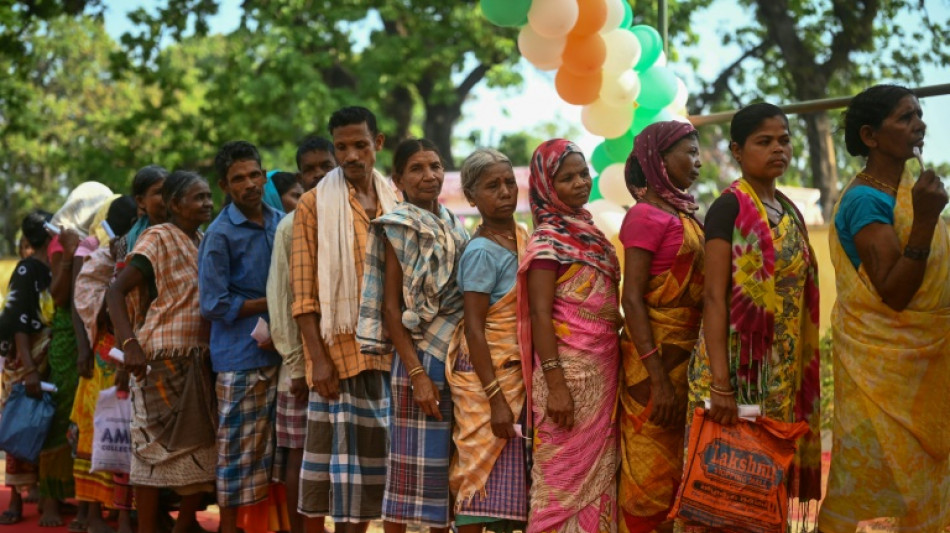
India pushes Maoist rebel strongholds on road to democracy / Photo: © AFP

 Arsenal lose Hincapie and Zubimendi in freak double blow
 Saudi says resilience tested, vows response after deadly airport attacks

 Alcaraz exits Shanghai Masters in straight-sets loss

 Pope to enter hospital on Tuesday for lung operation

 Renshaw shines again before Australia declaration

 Atletico's Simeone encourages goalless Alvarez improvement
 FXGLOBE Rebuilds Its Copy Trading and PAMM Business With B2BROKER's B2COPY

 Nepal rescuers search for missing after flash flood

 Oil rises as Trump comments roil energy markets

 Premier League in limbo as Manchester City soar

 Zelensky vows to respond as Moscow silent on 'energy ceasefire'

 Thousands march in India's capital to demand election chief resign

 African players in Europe: Mbeumo ends goal drought as United draw
 France's high school students plan fresh protests

 NZ bank in free speech row over 'explicit' sheep memes
 China Open champ Zheng withdraws from Wuhan citing fatigue

 Brewers edge Dodgers 2-1 in National League Championship Series opener

 Pope to have surgery to remove lung nodule

 Stocks rise as oil prices tumble after Trump hails 'energy ceasefire'
 Man City charges cloud hangs over Premier League season

 Top NATO commander set to issue warning to Russia over any attack

 Software, sprints, trolls: Singapore Grand Prix talking points

 Riyadh airport hit by fresh Houthi strike day after deadly attack

 Chervon Names Charlie Harte Director of Field Sales & Recruiting - Canada

 Chervon Names Randall Durkan Vice President of Supply Chain - North America

A narrow winding road through an untamed forest has proven a blow to a decades-old Maoist rebellion that is one of India's longest and deadliest insurgencies.
As the world's biggest democracy began a six-week election Friday, the people of one small village -- newly connected by fresh tarmac to the outside world -- cast their ballots for the first time.
"There was no government here during the last national vote, no polling booth, but only the rebels who warned against contact with the state," Tetam village chief Mahadev Markam told AFP.
Remote and wild Bastar district of Chhattisgarh state where Tetam lies is the centre of the country's "Red Corridor", home to left-wing guerrillas sworn to battle the state.
For years unable to penetrate rebel strongholds in the district, India instead urged Tetam's inhabitants to travel vast distances to vote in government-controlled areas.
With the Maoists threatening punishment for anyone who participated, very few people undertook a journey fraught with high risk -- and no rewards.
"Why vote? Why would anyone trek for hours across the forest, over the hills and the streams, and risk the wrath of the rebels? For what? What did the government ever do for us?" Markam asked.
This year it was different: Tetam was one of more than 100 villages in former rebel-held territories where a national vote was staged for the first time since independence from British rule in 1947.
- 'The state has arrived' -
The Naxalite rebellion, as the Maoist movement is known, began in the 1960s as a revolt against the exploitation of marginalised rural Indians.
More than 10,000 people have died in the insurgency, waged in the name of the poor and largely tribal communities where the rebels are based.
Heavy-handed campaigns against the guerrillas have often backfired in the past by bolstering hostility towards the government.
But the Naxals also have a track record of abductions, forced recruitment, demands for protection money and summary executions that have struck fear into those living alongside the rebels in their heartland.
At the peak of the insurgency, the Red Corridor was a vast swathe of territory controlled by rebels that rejected the Indian state, operating their own parallel health clinics, schools and criminal justice system.
"Earlier, the rebels used to ask the villagers if they'd seen any other government," a top interior ministry official in New Delhi told AFP, speaking on condition of anonymity as they were not authorised to speak to the media.
"'We are your doctors, teachers, and judges,' they said. And they were right. But not anymore. They negated the state. But the state has finally arrived."
Prime Minister Narendra Modi's government has pumped billions to construct new roads and mobile towers in the region in the last few years.
Along with reinvigorated counterinsurgency operations, the number of districts with an active Maoist presence has nearly halved to 45 since 2010, according to an official report last year.
"The government and security forces reaching these regions simultaneously is the antidote, and not just a singular focus on security," the interior ministry official said.
"We are the two tracks of a train, and we have to run with each other to reach the destination."
- 'So much to see' -
Around 80 Maoist rebels have been killed since January, including a group of 29 killed in a government assault in a remote area of Chhattisgarh three days before India's election began.
Home minister Amit Shah this week said the government was running a "focused campaign to root out" the insurgents, with 250 security garrisons established in the state since 2019.
One such garrison was established near Tetam in 2022 as a paved road was being laid to the village for the first time.
Life in the village remains hardscrabble and reliant on foraging from the surrounding forests for survival, but evidence of a budding transformation is everywhere.
In the last 18 months, Tetam's inhabitants now have mobile connections, power from the national grid, a health clinic and a government ration shop.
Long kept isolated as the insurgency raged around them, some of Tetam's 1,050 inhabitants have since ventured out of their home community for the first time.
Many have gone to visit the nearest small town of Dantewada -- population around 20,000, according to local officials -- for the first time.
"The city was really wonderful," Tetam resident Deepak Markam, 27, told AFP.
"There was so much to see there. I hope our village also develops to be like it."
I.Stoeckli--VB