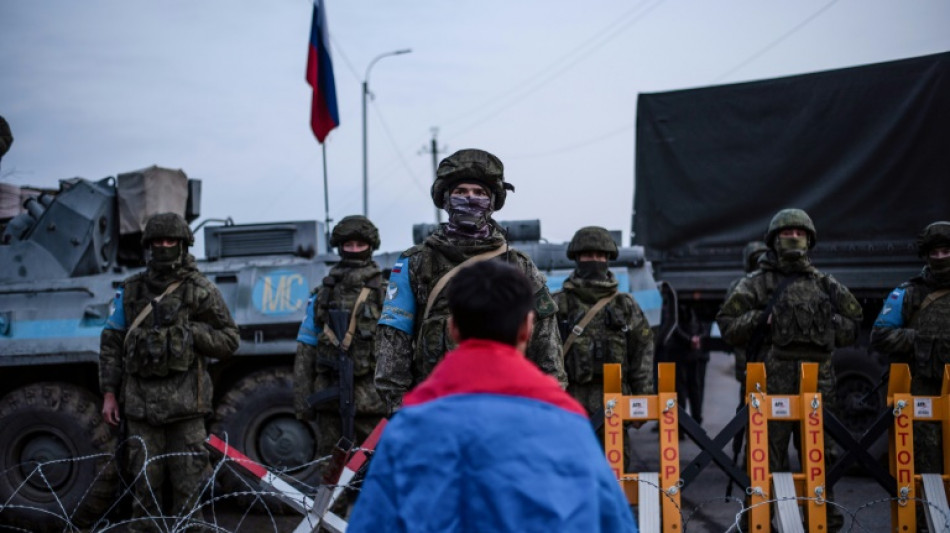
Russia quietly exits Karabakh, ceding its clout 'for good' / Photo: © AFP

 Arsenal lose Hincapie and Zubimendi in freak double blow
 Saudi says resilience tested, vows response after deadly airport attacks
 Alcaraz exits Shanghai Masters in straight-sets loss
 Pope to enter hospital on Tuesday for lung operation
 Renshaw shines again before Australia declaration
 Atletico's Simeone encourages goalless Alvarez improvement
 FXGLOBE Rebuilds Its Copy Trading and PAMM Business With B2BROKER's B2COPY

 Nepal rescuers search for missing after flash flood
 Oil rises as Trump comments roil energy markets
 Premier League in limbo as Manchester City soar
 Zelensky vows to respond as Moscow silent on 'energy ceasefire'
 Thousands march in India's capital to demand election chief resign

 African players in Europe: Mbeumo ends goal drought as United draw
 France's high school students plan fresh protests
 NZ bank in free speech row over 'explicit' sheep memes
 China Open champ Zheng withdraws from Wuhan citing fatigue

 Brewers edge Dodgers 2-1 in National League Championship Series opener
 Pope to have surgery to remove lung nodule
 Stocks rise as oil prices tumble after Trump hails 'energy ceasefire'
 Man City charges cloud hangs over Premier League season

 Top NATO commander set to issue warning to Russia over any attack

 Software, sprints, trolls: Singapore Grand Prix talking points

 Riyadh airport hit by fresh Houthi strike day after deadly attack

 Chervon Names Charlie Harte Director of Field Sales & Recruiting - Canada

 Chervon Names Randall Durkan Vice President of Supply Chain - North America

When Russian troops deployed to Nagorno-Karabakh four years ago, their task was clear: keep the peace between bitter foes Armenia and Azerbaijan and prevent another war in the volatile region.
But as Azerbaijani forces swept through mountainous Karabakh last September and crushed Armenian separatist forces in a matter of hours, the Russian mission looked lost.
The Kremlin this week quietly confirmed that the peacekeepers were withdrawing, taking with them their weapons and hardware, as well as Russian clout from a region it long considered its own backyard.
"We are witnessing a historic process -- Russians are leaving for the first time in two centuries," independent Azerbaijani analyst Elhan Shahinoglu told AFP.
Moscow ruled over the Caucasus region first during the Russian empire and then in the Soviet era. When war broke out between Armenia and Azerbaijan after the USSR's collapse, Moscow sought to mediate.
The Kremlin deployed almost 2,000 troops in 2020 as part of a ceasefire deal that halted six weeks of brutal fighting between the arch-foes over the Karabakh region.
The accord held until the lightning Azerbaijani offensive last September that ignited an exodus of more than 100,000 Armenians from Karabakh and deepened their frustration with Moscow.
- Russia 'betrayed us' -
"Along with the Russians leaving Karabakh, the last hope that the population will return home is gone," said Iveta Margaryan, a 53-year-old trained accountant on the streets of Armenia's capital.
"The Russians have betrayed us," she added.
Observers of the Caucasus say Russia is too caught up with its invasion of Ukraine to retain its sway in the region.
Azerbaijan has recently deepened ties with Turkey -- a close military and political partner with shared cultural ties. And with the pullout from Karabakh, Moscow has further alienated Armenia.
Yerevan has criticised Moscow's perceived shortfalls, with Prime Minister Nikol Pashinyan busy forging closer ties with the West.
In February, he froze Yerevan's participation in the Moscow-led Collective Security Treaty Organisation, a defence grouping of several ex-Soviet states.
Yerevan also joined the International Criminal Court (ICC) against Moscow's wishes -- a move that obligates it to arrest Vladimir Putin should he visit Armenia.
The European Union and United States are now leading efforts to broker a peace agreement between the Caucasus foes, with Moscow stuck playing second fiddle.
- 'Shattered' myth -
Moscow's unease over Armenia's rapprochement with the West has also become public. The foreign ministry this week demanded that Yerevan "disavow" reports it was deepening military ties with Western countries.
France -- home to a large Armenian diaspora -- has also planted a flag in the region, intensifying its diplomatic backing for Yerevan and providing cutting-edge defensive radars and missiles.
"Russia is out, the West is in," said Azerbaijani political scientist Eldar Namazov.
The Russian peacekeepers were meant to "project influence," said Gela Vasadze, senior fellow at the Georgian Strategic Analysis Centre.
But their withdrawal has clearly illustrated the limits of Russia's power, he told AFP.
"The myth that Russian boots never leave territories they had once stepped in is shattered."
Shahinoglu said Putin had withdrawn from Karabakh to keep up friendly relations with Azerbaijan and Turkey at a time when the Kremlin is isolated over the Ukraine war.
But in doing so, Russia has lost its ability to "exploit" Armenian separatism in the Caucasus and leverage it for regional influence, he said.
"Russia has lost its historical footholds in the Caucasus for good."
That sentiment was echoed in Azerbaijan, where the announcement of the Russian drawdown was met with joy and relief.
"People say Russian troops don't ever voluntarily leave," said Ramil Iskenderov, a 37-year-old courier.
"Azerbaijan proved that with the right policy it's possible to achieve the impossible," he told AFP.
In Armenia, where Russia still maintains a military base, the peacekeepers' withdrawal was a final straw for some that meant Yerevan should sever military ties with Moscow.
"Russia has once again betrayed the Armenian people and sold us out. That's it," said Valery Harutyunyan, who lived in Karabakh before fleeing to Armenia in September.
"We can't rely on the Russians again. It's impossible. We should kick Russians out -- not only from Karabakh -- but also from Armenia," he told AFP.
T.Egger--VB