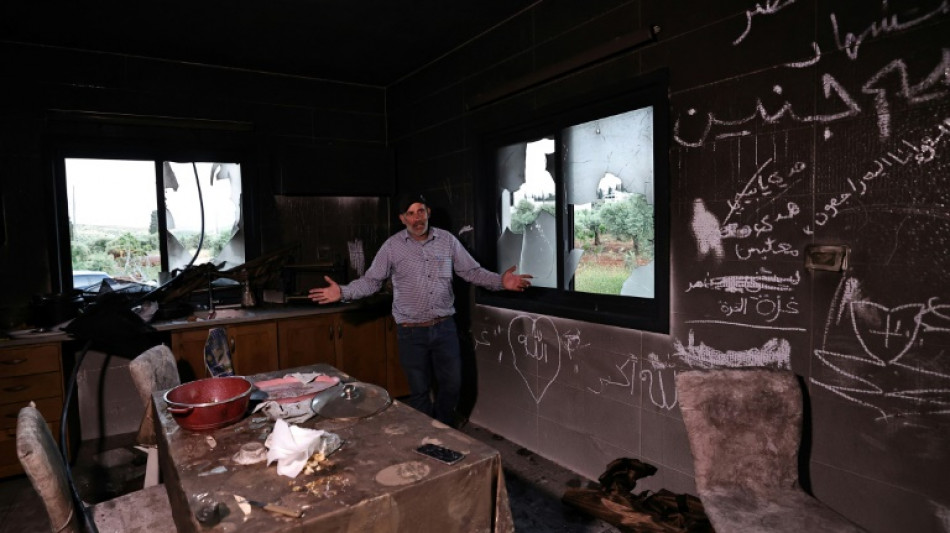
West Bank villagers vigilant but vulnerable after settler attacks / Photo: © AFP

 Brazil's patron saint reappears in polarized election campaign

 US Open champ Zverev to become tennis world number one

 Migrant crisis wounds unhealed in Ceuta as Spanish royals visit

 Brazilian judge allows Flavio Bolsonaro to visit jailed father

 France braces for fresh student demonstrations as Macron calls for 'respect'

 Zelensky doubtful on Russian acceptance of Trump's 'energy ceasefire'

 Federal agents search home of Trump critic Ilhan Omar: government

 Pakistan detains hundreds from ex-PM Khan's party as protests falter

 Australia's Smith off field after being struck on helmet

 UK retains early access to test latest US AI models

 Top NATO commander warns Russia any attack would be 'futile'

 Stolen Renoir paintings found behind wall in France: prosecutor

 UNHCR sounds alarm on funding crisis

 French supermarket chains say cyberattack forced refrigerator shutdown
 Minister's resignation rocks German coalition

 Hurricane Simon lashes Mexico's Pacific coast, threatens landfall

 France schools protest rumbles on as Macron urges 'respect'
 Americans Hall and Woodford win economics Nobel for stabilisation models

 MEXC Brings AI, TradFi and the Future of Trading to Life at TOKEN2049 Singapore

 Italian rice farmer beats heat with biodiversity haven

 Stocks mixed as oil prices slip after Trump hails 'energy ceasefire'

 Opposition, journalists allege police abuses during India protests

 DATA Network joins Sui and Walrus to scale the supply chain for AI training data

 Melbourne man linked to suspected flydubai hijacker condemns 'false accusations'

 North Korea fires 'several ballistic missiles' into Sea of Japan

Sitting around a fire in the hills of the Israeli-occupied West Bank, Ibrahim Abu Alyah and some friends stood watch over his herd in the aftermath of a settler attack on their village.
"We are here so that we can put away the sheep and tell people to protect their homes in case settlers come," Abu Alyah told AFP.
After 14-year-old Israeli herder Benjamin Achimeir went missing on April 12 in the nearby illegal settler outpost of Malachi Hashalom, dozens of Jewish settlers raided his village of Al-Mughayyir, north of Ramallah.
Armed with rifles and Molotov cocktails, they set houses ablaze, killed sheep, wounded 23 people and displaced 86, according to the UN's Office for the Coordination of Humanitarian Affairs, OCHA.
One Palestinian was also killed in the violence.
Abu Alyah, a shepherd, lost "20 or 30 sheep" and the cash he made from selling milk products when his house was set alight.
Al-Mughayyir's mayor, Amin Abu Alyah, said the settlers, who were part of the search party for Achimeir, burnt "everything they found in front of them" including houses, a bulldozer and vehicles.
Several citizens tried to organise protection committees to defend themselves from raids, but were prevented from doing so, he said.
"We currently have more than 70 prisoners inside Israeli prisons on charges of joining protection committees or trying to form an organised body," he said.
- Duma, struck twice -
In the nearby village of Duma, five kilometres (three miles) north of Al-Mughayyir, old fears came true when hundreds of settlers came down through the surrounding fields on Saturday.
That day, Achimeir's body was found bearing marks of a stabbing attack. People watched powerless as settlers rampaged through the village.
"Hundreds of settlers entered the village followed by more than 300 Israeli soldiers who stormed the village and declared it a closed military zone," Suleiman Dawabsha, head of Duma's village council, told AFP.
Mahmud Salawdeh, a 30-year-old iron worker whose house was torched in the attack, felt vulnerable when he realised the soldiers were not stopping the attack.
"We feel helpless because we are unable to protect ourselves, and the settlers are protected by the army," he said.
"I lost all my money and my future," he added from the ground floor of his charred house on the outskirts of Duma, near the fields the attackers came through.
At his feet, burnt furniture and shattered glass covered the floor, while walls black with soot served as a reminder of the firebombs thrown at the building.
His workshop in the adjacent room was torched, charred remnants of old tools lay around, while a large wooden box where he had been raising 70 chicks was now empty.
The incident opened old wounds for Duma residents, who still remember the tragedy that struck the Dawabsha family.
In 2015, the family's home was set ablaze by a settler extremist, killing the couple and their toddler, and leaving only one surviving member, four-year-old Ahmed Dawabsha.
- 'We will never leave' -
Duma residents, like many West Bank villagers, say they are protected neither by Palestinian security, which is only allowed to operate in 40 percent of the territory, nor by Israel, which controls the rest.
Israeli soldiers do not always restrain settlers from attacking Palestinians, OCHA said.
In January, "in nearly half of all recorded incidents (of settler violence) after 7 October, Israeli forces were either accompanying or reported to be supporting the attackers," it said.
OCHA recorded 774 instances of Israeli settler attacks against Palestinians since war broke in Gaza on October 7, and said 37 communities had been affected by violence between April 9 and 15, "triple the number" of the preceding week.
Nine Israelis, including five in Israeli forces, were killed in the West Bank over the same timeframe, OCHA said.
At least 462 Palestinians have been killed by Israeli troops or settlers in the West Bank during that period, according to Palestinian official figures.
The West Bank, occupied by Israel since 1967, has seen a surge in violence since early last year, which has intensified since the Israel-Hamas war in Gaza erupted.
Despite the hardships, "we will never leave", the herder Abu Alyah told AFP.
But the 29-year-old already had to move from his former herding grounds on the other side of Al-Mughayyir, closer to the settlement outpost, in September.
The weekend's attacks marked a peak in violence due to the sheer number of people who took part in them, but also reflects a wider trend in the West Bank, NGOs said.
"It is clear that the escalation of violence in the West Bank has occurred in tandem with the crisis in Gaza," charity ActionAid said in a statement.
On Wednesday evening, settlers were planting Israeli flags along the road that runs between Al-Mughayyir and Malachi Hashalom.
C.Stoecklin--VB