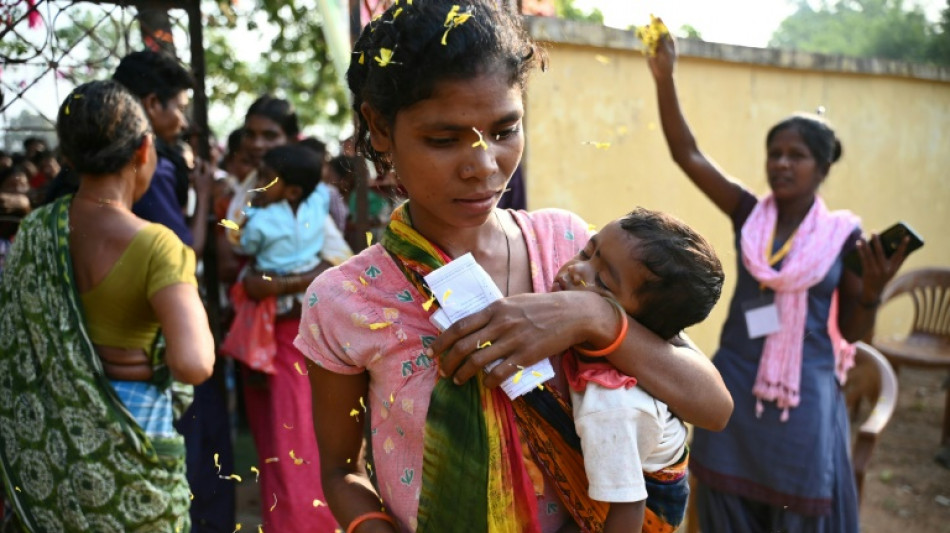
First-time voters rejoice in India's Maoist rebel heartland / Photo: © AFP

 Brazil's patron saint reappears in polarized election campaign

 US Open champ Zverev to become tennis world number one

 Migrant crisis wounds unhealed in Ceuta as Spanish royals visit

 Brazilian judge allows Flavio Bolsonaro to visit jailed father
 France braces for fresh student demonstrations as Macron calls for 'respect'

 Zelensky doubtful on Russian acceptance of Trump's 'energy ceasefire'

 Federal agents search home of Trump critic Ilhan Omar: government

 Pakistan detains hundreds from ex-PM Khan's party as protests falter

 Australia's Smith off field after being struck on helmet

 UK retains early access to test latest US AI models

 Top NATO commander warns Russia any attack would be 'futile'

 Stolen Renoir paintings found behind wall in France: prosecutor

 UNHCR sounds alarm on funding crisis

 French supermarket chains say cyberattack forced refrigerator shutdown
 Minister's resignation rocks German coalition

 Hurricane Simon lashes Mexico's Pacific coast, threatens landfall

 France schools protest rumbles on as Macron urges 'respect'
 Americans Hall and Woodford win economics Nobel for stabilisation models
 MEXC Brings AI, TradFi and the Future of Trading to Life at TOKEN2049 Singapore

 Italian rice farmer beats heat with biodiversity haven
 Stocks mixed as oil prices slip after Trump hails 'energy ceasefire'
 Opposition, journalists allege police abuses during India protests

 DATA Network joins Sui and Walrus to scale the supply chain for AI training data

 Melbourne man linked to suspected flydubai hijacker condemns 'false accusations'

 North Korea fires 'several ballistic missiles' into Sea of Japan

In remote Indian forests home to a decades-old Maoist insurgency battling government rule, few in farmer Ajay Kumaroya's village had ever dared anger the guerrillas by voting.
But when the 23-year-old rose at dawn, Kumaroya found dozens of his neighbours already queueing at the polling station as general elections began on Friday, defying the insurgents to exercise their democratic right.
Known as Naxalites, the rebels have been fighting since 1967 for what they claim is for the rural poor -- and Chhattisgarh state's Bastar district, an area bigger than Belgium, was once their key heartland.
But India has deployed tens of thousands of security personnel to crush them, and the crowd at Kumaroya's village reflects government efforts to boost infrastructure and connect villages like his to the rest of the country.
"I am here for Prime Minister Narendra Modi," Kumaroya told AFP. "If he wins, our roads will get better."
Poll workers rolled out a red carpet outside the booth for the people of Dugeli village, showering flower petals on the first few voters to enter.
- 'Naxal problem' -
Fellow farmer Pradeep Kumar Karma, 27 said he was voting for Modi to "solve our Naxal problem", he said.
"If that happens, we will prosper with tourism and investments", he added.
Government security operations have badly dented the Naxalites.
One assault on Tuesday killed 29 rebels, following another clash this month that killed at least 13 insurgents.
But holding elections in Bastar is an immense logistical and security challenge, with dense forests providing ample cover for gunmen to lay landmines and carry out ambushes.
"Setting up polling stations and conducting voting in a peaceful manner has always been a challenge because of left-wing extremism," Chhattisgarh state chief electoral officer Reena Kangale told AFP.
"Much of the area is also mined, so access is a problem without loss of life and limb."
In recent days, hundreds of security personnel searching for improvised explosives have swept the new roads that have been driven deep into dense forests.
Indian paramilitary forces have deployed to hundreds of remote communities, to protect polling officials fearful of attacks.
Ajay Dikshit, 57, a government school principal seconded to election duty, said his family had pressed him to turn down the assignment.
"I am government employee and I can't refuse an order," he said before voting day, while awaiting a helicopter ride to his post. "I just hope that everything works out well."
- 'Afraid of punishment' -
Across the country, voting will be staggered over seven stages between April 19 and June 1, with more than a million polling stations across India.
A total of 968 million people are eligible to take part in the world's biggest vote.
In Bastar, veteran polling officers such as Gajendra Punem, 37, said the situation had changed radically as the insurgency has waned.
"When I was first sent to a sensitive area for polls in 2014, not a single villager came out to vote," Punem said. "Everyone there was afraid of punishment by Naxals."
Not everyone shares the enthusiasm of Kumaroya and his neighbours.
In Sitapal village, once accessible only on a rough track taking several hours to travel, is now reachable by a newly-paved road.
But apart from the road, residents say they have seen little of the development they crave -- and were ignored by politicians on the campaign trail.
"If any of them had come here for our votes, we'd have told them what we need: roads, water pumps, and a bus connection," said first-time voter Budhram Kavasi, 36.
"Since they didn't come before the election, they definitely won't be here after the polls."
H.Weber--VB