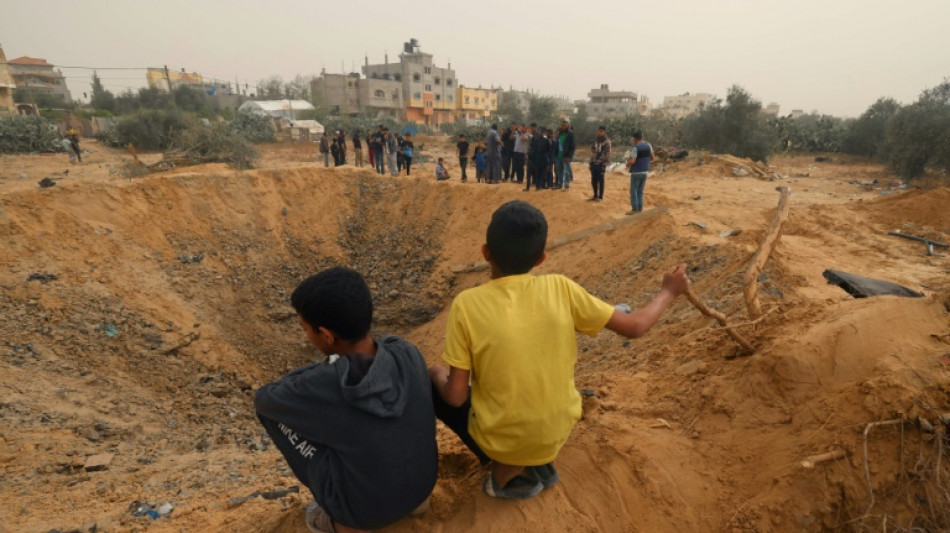
Gazans search for remains after deadly Rafah strike / Photo: © AFP

 US actress Selma Blair arrested after flight altercation

 One dead as Hurricane Simon creeps along Mexico's Pacific coast

 Carrick's Man United 'hungry and eager' to fix worst start in decades

 Fury as US federal agents search anti-Trump lawmaker's home

 One goal enough for Flick as Barca enter Galatasaray cauldron
 A7 to unveil a service that will re-invent the international payments market

 'Status quo' with EU 'not good enough', UK PM says as summit date set
 Stolen Renoir paintings found behind wall in France

 French supermarkets suffer refrigerator shutdown after 'unprecedented' cyberattack

 Arsenal lose Hincapie and Zubimendi in freak double blow
 Saudi says resilience tested, vows response after deadly airport attacks
 Alcaraz exits Shanghai Masters in straight-sets loss
 Pope to enter hospital on Tuesday for lung operation
 Renshaw shines again before Australia declaration
 Atletico's Simeone encourages goalless Alvarez improvement
 FXGLOBE Rebuilds Its Copy Trading and PAMM Business With B2BROKER's B2COPY

 Nepal rescuers search for missing after flash flood
 Oil rises as Trump comments roil energy markets
 Premier League in limbo as Manchester City soar
 Zelensky vows to respond as Moscow silent on 'energy ceasefire'

 Thousands march in India's capital to demand election chief resign

 African players in Europe: Mbeumo ends goal drought as United draw
 France's high school students plan fresh protests
 NZ bank in free speech row over 'explicit' sheep memes
 China Open champ Zheng withdraws from Wuhan citing fatigue

Birds sang and planes rumbled overhead as Abdeljabbar al-Arja dug the remains of his dead neighbours from the rubble in Gaza.
An overnight Israeli strike hit the home where a displaced Palestinian family was sheltering in the southern city Rafah, relatives and neighbours told AFP as they scraped at the soil with their hands.
Al-Arja said the blast killed at least 10 people.
"We retrieved the remains of children and women, finding arms and feet. They were all torn to pieces.
"This is horrifying, it's not normal," he said, hauling concrete and broken olive branches from the wreckage. "The entire world is complicit."
Soon after the war began on October 7, Israel told Palestinians living in the north of Gaza to move to "safe zones" in the territory's south like Rafah.
But Israeli Prime Minister Benjamin Netanyahu has since vowed to invade the city, where around 1.5 million people live in shelters, more than half the territory's population.
"How is Rafah a safe place?" said Zeyad Ayyad, a relative of the victims.
He sighed as he cradled a fragment of the remains.
"I heard the bombing last night and then went back to sleep. I did not think it hit my aunt's house."
- 'Struck without any warning' -
The search for remains was long and painful. The strike left a huge crater and children picked through the rubble while neighbours removed debris, tarpaulin, a pink top.
"We can see them under the rubble and we're unable to retrieve them," Al-Arja said. "These are people who came from the north because it was said the south is safe."
"They struck without any warning," he said.
In a separate strike on a house in Rafah's Al-Salam neighbourhood overnight on Tuesday, rescue crews recovered the corpses of eight family members including five children and two women, Gaza's civil defence service said.
"An Israeli rocket hit a house of displaced people," said resident Sami Nyrab. "My sister's son-in-law, her daughter and her children were having dinner when an Israeli missile demolished their house over their heads."
Jamalat Ramidan said she woke "to the sound of girls shouting 'mama, mama, mama' and children calling each other's names."
They fled the carnage stumbling over "body parts and corpses scattered all over the place," she said.
- 'Memories beneath the rubble' -
Israel began its assault in Gaza after Hamas militants launched an attack on October 7 that resulted in the deaths of 1,170 people in southern Israel, mostly civilians, according to an AFP tally based on Israeli official figures.
Israel's retaliatory offensive has killed at least 33,970 people in Gaza, mostly women and children, the territory's health ministry said.
The United Nations and aid agencies say Israel's siege has left northern Gaza on the brink of famine, and concern is growing over the humanitarian crisis in the south, where hundreds of thousands are living in makeshift shelters.
The Israeli army pulled out of southern Gaza's main city Khan Yunis earlier this month and thousands of displaced Palestinians have returned to find their homes in ruins.
"We lost everything -- our home, our safe haven -- after it was bombed and completely obliterated," said Shams Majid, 22.
Her father died shortly before the war and her family now lives in a tent in nearby Al-Mawasi.
"I held onto every last remnant of his existence -- his favourite belongings meticulously stored in an old cigarette box, the last money hiding in his clothes, his scent lingering in his perfumes -- but now none of it remains," she said.
"Our land has been razed, our home demolished by air strikes, and our memories buried beneath the rubble."
M.Betschart--VB