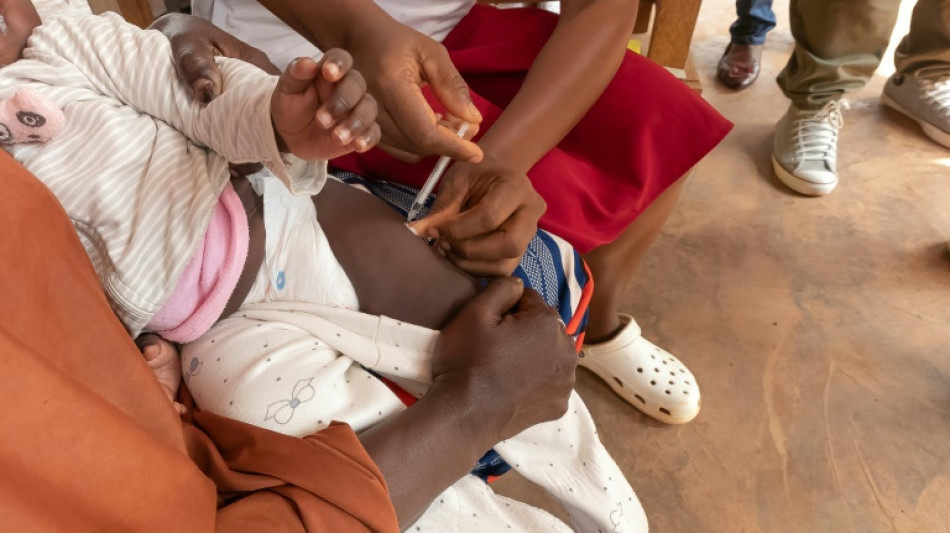
Slimmer draft pandemic agreement released ahead of fresh talks / Photo: © AFP

 'Breaking Bad' actor RJ Mitte dead: representatives

 Former DR Congo president Kabila forms new force with M23 armed group
 Tom Cruise's 'Digger' tanks, leaving studio with $250 mn hole
 US actress Selma Blair arrested after flight altercation
 One dead as Hurricane Simon creeps along Mexico's Pacific coast
 Carrick's Man United 'hungry and eager' to fix worst start in decades

 Fury as US federal agents search anti-Trump lawmaker's home

 One goal enough for Flick as Barca enter Galatasaray cauldron
 A7 to unveil a service that will re-invent the international payments market
 'Status quo' with EU 'not good enough', UK PM says as summit date set
 Stolen Renoir paintings found behind wall in France

 French supermarkets suffer refrigerator shutdown after 'unprecedented' cyberattack
 Arsenal lose Hincapie and Zubimendi in freak double blow
 Saudi says resilience tested, vows response after deadly airport attacks
 Alcaraz exits Shanghai Masters in straight-sets loss
 Pope to enter hospital on Tuesday for lung operation

 Renshaw shines again before Australia declaration
 Atletico's Simeone encourages goalless Alvarez improvement
 FXGLOBE Rebuilds Its Copy Trading and PAMM Business With B2BROKER's B2COPY

 Nepal rescuers search for missing after flash flood
 Oil rises as Trump comments roil energy markets

 Premier League in limbo as Manchester City soar
 Zelensky vows to respond as Moscow silent on 'energy ceasefire'
 Thousands march in India's capital to demand election chief resign
 African players in Europe: Mbeumo ends goal drought as United draw

The new draft of the global pandemic agreement has been released to countries ahead of Thursday's deadline, with a more streamlined take on how the world should handle future pandemics.
Rattled by Covid-19, which shredded economies, crippled health systems and killed millions, countries have spent two years trying to craft an international accord on pandemic prevention, preparedness and response.
The ninth and supposedly final round of talks among the World Health Organization's 194 member states, held at the WHO headquarters in Geneva, ended on March 28 without a deal.
The bureau of the Intergovernmental Negotiating Body conducting the talks therefore went away to reflect on the major sticking points and come up with a new, tighter draft, honing in on areas of common ground.
The new draft retains some provisions on equity -- which developing countries have been holding out for -- but kicks some aspects further down the road to 2026.
- What happened in March? -
Keen to prevent the trauma of Covid-19 ever happening again, countries started negotiating an accord two years ago.
But at the final two-week talks session, the text ballooned from 29 pages to more than 100 as countries inserted proposed amendments. Agreement between the main blocs seemed far off.
Western nations broadly want ramped-up surveillance and rapid sharing of all data and samples on emerging pathogens.
Meanwhile one bloc of countries that includes India, Mexico and Bangladesh, calling itself the Group for Equity, plus another group of African countries, is trying to ensure developing nations are not cut adrift again when it comes to accessing vaccines, tests and treatments.
- What comes next? -
Countries will now digest the new draft and return to the WHO headquarters for further talks, from April 29 until May 10.
They are up against the clock, with the aim being to adopt a final agreement at the annual assembly of WHO member states, which runs from May 27 to June 1.
- What's in the new draft? -
The new WHO Pandemic Agreement draft seen by AFP now runs to 23 pages.
It would commit countries to a more equitable geographical distribution and scaling up of the global production of pandemic-related health products.
The text also reflects efforts to battle the swirl of disinformation and conspiracy theories that have surrounded the negotiations, including allegations that WHO could take over countries' health policies.
The new draft retains a paragraph specifically saying the agreement cannot be interpreted as giving the WHO or its leader any authority to alter national laws, "impose vaccine mandates... or implement lockdowns".
- And on the key section? -
The main arguments revolve around the section titled access and benefit sharing.
The draft agreement calls for a WHO Pathogen Access and Benefit-Sharing System (PABS).
Under the PABS system, the sharing of material for public health risk assessment is placed "on an equal footing" with "timely, effective, predictable and equitable access to pandemic-related health products" arising from that sharing.
The system would include the "fair, equitable and timely sharing of benefits" arising from PABS material and information, which countries must share in a "rapid, systematic and timely" way.
During a pandemic this would include "real-time access by WHO to 20 percent (10 percent as a donation, and 10 percent at affordable prices to WHO) of the production of safe, efficacious and effective pandemic-related health products".
But it now says the modalities, operational dimensions, and terms and conditions of the system "shall be further defined in a legally-binding instrument, that is operational no later than May 31, 2026".
By shunting the arguments over deeper details another two years down the road, this new move could improve the chances of an agreement being approved and adopted at the World Health Assembly in six weeks' time.
G.Schmid--VB