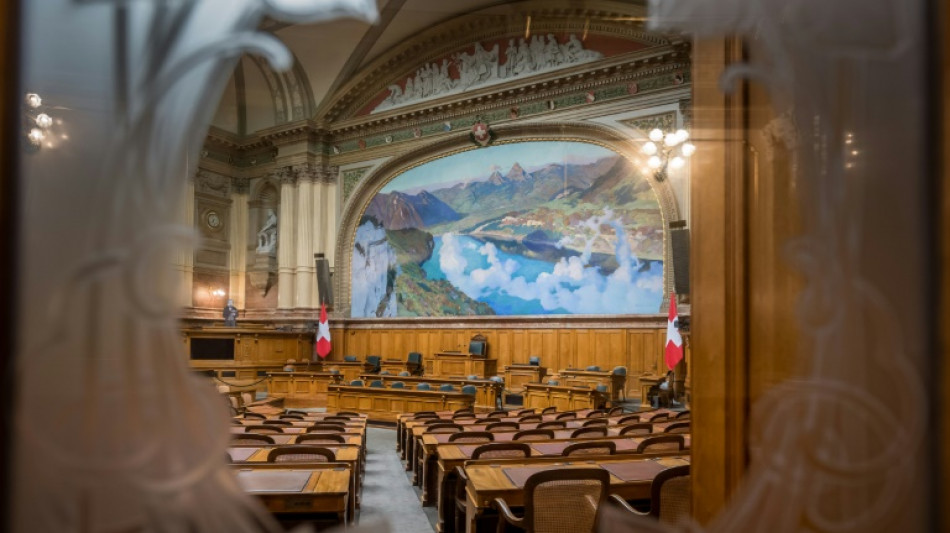
Swiss parliament wants ban on extremist symbols / Photo: © AFP

 Bivial AG Brings Its Complete Dashboard to Mobile
 Mont Blanc nearly two metres taller than in 2023: French surveyors

 Pope recovering after lung cancer operation that rattles Church
 Indonesia haze spikes Singapore pollution, shuts East Timor schools

 Higher borrowing costs an 'alarm signal' for France: finance minister

 Zelensky accuses Putin of disrespecting Trump after latest attacks
 Japan PM says housework makes her busier than male predecessors

 Top Indian 'cockroach' leaders sent to jail after protest

 Ukraine ex-military officer to stand trial over Nord Stream sabotage
 IMF chief says Saudi attacks could have negative spillover 'everywhere'
 Premier League move a Sage decision for new Palace boss

 South Korean FA condemns 'personal attacks' as rift rumours grow

 Japan urges 'impartial treatment' of journalist arrested in Russia

 What we know about Pope Leo XIV's lung cancer operation
 Advanced economies must 'act now' to lower debt as bond yields spike: IMF
 Deluge by design: Thai villages flooded to protect capital
 Ivan Deforge, the French 'bison tamer' in Moscow

 Indonesians on fire-ravaged island sue state for clean air
 Trump, White House post video of UK man killed by tiger

 Saudi employee arrested for allegedly bugging OpenAI office
 Atletico sink Man Utd as Viking deny Bayern in Champions League
 Man United's Martinez blasts board's lack of investment

 Meet A7 International, an Innovative Global Platform Designed to Reinvent the International Payments Market

 Shakhtar hope London move a reminder of Ukraine conflict

 Tresoldi hat-trick fires Brugge past Inter Milan
Swiss lawmakers on Wednesday voted in favour of banning the display of extremist and racist symbols, starting with those of a Nazi nature.
The National Council lower house of parliament voted by 133 to 38 in favour of banning the public use of racist, violence-promoting and extremist symbols, such as Nazi symbols.
Switzerland, which stayed neutral during World War II, has come under pressure to fall in line with a number of other European countries in banning Nazi symbols.
Full bans are in place in Germany, Poland and several other eastern European nations.
The Swiss parliament as a whole is now in favour, after the Council of States upper house voted for such a ban in December.
The plans would also cover gestures, words, salutes or flags.
The National Council also voted by 132 to 40 for the measures to be introduced in stages -- a move the government supports.
A ban on easily identifiable Nazi symbols could be implemented quickly, while other racist and extremist symbols could be identified and banned further down the line.
"We don't want a swastika or a Hitler salute in our country, ever!" said Green lawmaker Raphael Mahaim.
"Today, in Switzerland, it is possible, it is even permitted, to display a flag with a swastika on your balcony. It is possible to put a flag bearing the image of the SS on the windshield of your car. It is possible to give the Hitler salute in public spaces.
"This situation is intolerable."
- Debate on other symbols -
Justice minister Beat Jans said the government, called the Federal Council, had hitherto relied on prevention as the main pillar against racism, but now thinks legal measures are needed.
"Anti-Semitic incidents, particularly those involving the use of Nazi symbols, have increased sharply in recent times," he said.
"Against this background, the Federal Council decided last week that it is positive about the gradual implementation of the motion."
He said the government wanted to introduce a special law which would mean fines could therefore be imposed.
As for banning Nazi symbols first, Mahaim accepted that debates on other symbols "will be much more difficult".
"For example, what about the Z symbol of Putin's army of aggression? What about the Ku Klux Klan symbol? What about the hammer and sickle symbol?" he said.
The no votes and abstentions all came from the hard-right Swiss People's Party (SVP), which is the largest faction in the lower chamber.
SVP lawmaker Barbara Steinemann said Switzerland had successfully been able to keep extremism down to "a base of a few meaningless weirdos".
She said a ban on symbols would not prevent the "rampant" anti-Semitic attitudes in universities and "intellectual milieus".
Steinemann said Nazi symbolism had risen only since the Gaza war erupted in October, and "even if you don't like to hear it, this is the influence of immigration from non-European cultures.
"We are literally engaging in symbolic politics, and we shouldn't be doing that," the Zurich lawmaker said.
T.Germann--VB