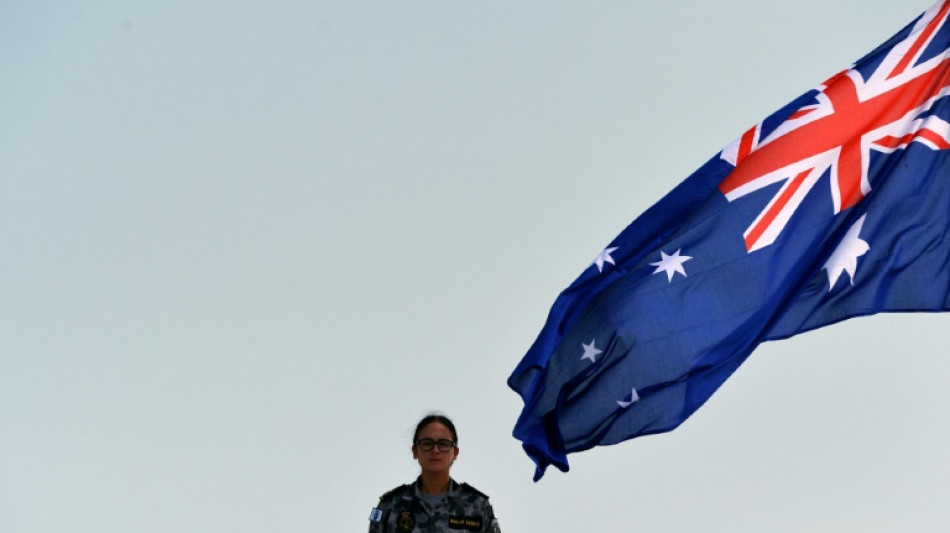
Australia unveils new defence strategy, with eye on 'coercive' China / Photo: © AFP/File

 Bivial AG Brings Its Complete Dashboard to Mobile

 Mont Blanc nearly two metres taller than in 2023: French surveyors

 Pope recovering after lung cancer operation that rattles Church

 Indonesia haze spikes Singapore pollution, shuts East Timor schools

 Higher borrowing costs an 'alarm signal' for France: finance minister
 Zelensky accuses Putin of disrespecting Trump after latest attacks

 Japan PM says housework makes her busier than male predecessors

 Top Indian 'cockroach' leaders sent to jail after protest

 Ukraine ex-military officer to stand trial over Nord Stream sabotage
 IMF chief says Saudi attacks could have negative spillover 'everywhere'
 Premier League move a Sage decision for new Palace boss

 South Korean FA condemns 'personal attacks' as rift rumours grow

 Japan urges 'impartial treatment' of journalist arrested in Russia

 What we know about Pope Leo XIV's lung cancer operation

 Advanced economies must 'act now' to lower debt as bond yields spike: IMF
 Deluge by design: Thai villages flooded to protect capital

 Ivan Deforge, the French 'bison tamer' in Moscow

 Indonesians on fire-ravaged island sue state for clean air

 Trump, White House post video of UK man killed by tiger

 Saudi employee arrested for allegedly bugging OpenAI office

 Atletico sink Man Utd as Viking deny Bayern in Champions League

 Man United's Martinez blasts board's lack of investment

 Meet A7 International, an Innovative Global Platform Designed to Reinvent the International Payments Market

 Shakhtar hope London move a reminder of Ukraine conflict

 Tresoldi hat-trick fires Brugge past Inter Milan

Australia unveiled its first National Defence Strategy on Wednesday, signalling a new focus on deterring China's "coercive tactics" in a region seen as lurching towards conflict.
The 80-page document offers a gloomy assessment of Pacific security and sets out a massive increase in defence spending to retool Australia's military to cope.
"The optimistic assumptions that guided defence planning after the end of the Cold War are long gone," said Defence Minister Richard Marles, presenting the new strategy.
Warning that "China has employed coercive tactics in pursuit of its strategic objectives," the text describes an Australia vulnerable to foes strangling trade or preventing access to vital air and sea routes.
"We are a maritime trading island nation," Marles said.
"The invasion of Australia is an unlikely prospect in any scenario, precisely because so much damage can be done to our country by an adversary without ever having to step foot on Australian soil," he said.
So instead of focusing on maintaining a military that can do a range of tasks almost anywhere in the world, Marles said there would be a laser focus on building a deterrent force that can protect Australia's interests in its immediate region.
At the centre of the strategy are plans to develop a fleet of stealthy nuclear-powered submarines, to triple key missile capabilities and develop a large surface combatant fleet.
"Having the most capable Navy in our history will be at the heart of our projection and our strategy of denial," Marles said.
The strategy boils down to making any attack against Australia's interests prohibitively expensive and risky.
As a share of GDP, defence spending is set to increase from about two percent today to 2.4 percent within a decade.
That will only fuel an arms race that is taking place across the Pacific, with China, South Korea and Japan all piling more money into defence.
According to the Stockholm International Peace Research Institute, military spending in Asia and Oceania has increased 45 percent since 2013.
Given that backdrop, Australia predicts an increased risk of conflict in the Taiwan Strait, the South and East China Seas or on the border with India.
Marles said that old assumptions about how much time Australia would have to prepare for war were gone.
"Australia no longer has the luxury of a 10-year window of strategic warning time for conflict" he said, upending long-held belief.
Asked about Canberra's strategy at a regular briefing, Beijing urged Australia to "refrain from making accusations against China at every turn".
"China poses no threat to any country," foreign ministry spokesperson Lin Jian said.
"We hope that the Australian side can view China's development and strategic intentions in a correct light, abandon the Cold War mentality (and) do more to safeguard regional peace and stability," he added.
K.Sutter--VB