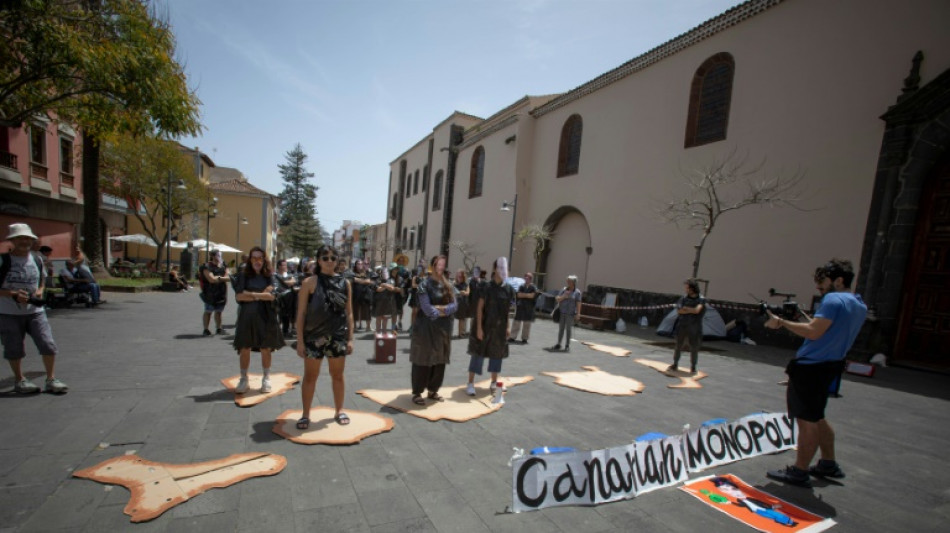
'Go home': Overtourism sparks backlash in Spain / Photo: © AFP

 Sally Rooney books cannot be sold in UK amid Palestine Action ban: publisher
 Italian ski stars Goggia and Brignone to miss season opener
 Bournemouth boss Rose urges Cherries to bounce back from Chelsea 'slap'

 Top seed Sabalenka falls at first hurdle in Wuhan

 FX Junction Brings Copy Trading to Everyone, While Their Money Never Leaves With Their Broker

 Brighton defender Struijk's red card overturned

 Saudi league postpones three matches after Houthi attacks

 US consumer inflation up more than expected as midterms loom

 Canadian publisher supports novelist Orelien after AI denial
 Medvedev sees off Tsitsipas to reach Shanghai Masters quarters

 Louvre boss warns of closure risk without major renovations

 Lawes and Genge urge England to end ban on overseas-based players

 Metrika Selected by OCC to Support Stablecoin Supervisory Framework Under the GENIUS Act

 Kenya hosting 2029 World Championships will help doping fight, says Coe
 UK prosecutor tells jury Russell Brand a 'sexual predator'
 Fulham manager Arbeloa fined £25,000 after Man Utd outburst

 Nepal flood triggered by rock and ice avalanche: report

 'Distressed' family of UK man killed by tiger urge end to online posts
 Regulator expects Man City appeal to be heard by January

 Rising Spanish tennis star handed code violation for swearing at ballboy

 Last of the French musketeers Monfils officially retired from tennis

 Ukraine ex-military officer stands trial over Nord Stream sabotage
 British and Irish Lions to play first women's match against France

 Fuel shortage triggers queues on resort island Bali
 Sao Tome's niche vanilla finds far-away fans

Anti-tourism movements are multiplying in Spain, the world's second most visited country, prompting authorities to try and reconcile the interests of locals and the lucrative sector.
Rallying under the slogan "The Canaries have a limit", a collective of groups on the archipelago off northwest Africa are planning a slew of protests on Saturday.
The Canaries are known for volcanic landscapes and year-round sunshine and attracts millions of visitors from all over the world.
Groups there want authorities to halt work on two new hotels on Tenerife, the largest and most developed of the archipelago's seven islands.
They are also demanding that locals be given a greater say in the face of what they consider uncontrolled development which is harming the environment.
Several members of the collective "Canaries Sold Out" also began an "indefinite" hunger strike last week to put pressure of the authorities.
"Our islands are a treasure that must be defended," the collective said.
The Canaries received 16 million visitors last year, more than seven times its population of around 2.2 million people.
This is an unsustainable level given the archipelago's limited resources, Victor Martin, a spokesman for the collective told a recent press briefing, calling it a "suicidal growth model".
- 'Go home' -
Similar anti-tourism movements have sprung up elsewhere in Spain and are active on social media.
In the southern port of Malaga on the Costa del Sol, a centre of Spain's decades-old "soy y playa" or "sun and beach" tourism model, stickers with unfriendly slogans such as "This used to be my home" and "Go home" have appeared on the walls fn doors of tourist accommodations.
In Barcelona and the Balearic Islands, activists have put up fake signs at the entrances to some popular beaches warning in English of the risk of "falling rocks" or "dangerous jellyfish".
Locals complain a rise in listings of accommodation on short-term rental platforms such as Airbnb have worsened a housing shortage and caused rents to soar, especially in town centres.
The influx of tourists also adds to noise and environmental pollution and taxes resources such as water, they add.
In the northeastern region of Catalonia, which declared a drought emergency in February, anger is growing over the pressure exerted on depleted water reserves by hotels on the Costa Brava.
"There are tourist destinations that are at the limits of their capacity," said Jose Luis Zoreda, the vice president of tourism association Exceltur .
"It's a problem that appears occasionally in the high season and in certain parts of the country, but it's getting worse".
- Loudspeaker ban -
Before the Covid-19 pandemic brought the global travel industry to its knees in 2020, protest movements against overtourism had already emerged in Spain, especially in Barcelona.
Now that pandemic travel restrictions have been lifted, tourism is back with a vengeance -- Spain welcomed a record 85.1 million foreign visitors last year.
In response, several cities have taken measures to try to limit overcrowding.
The northern seaside city of San Sebastian last month limited the size of tourist groups in the centre to 25 people and banned the use of loudspeakers during guided tours.
The southern city of Seville is mulling charging non-residents a fee to enter its landmark Plaza de Espana while Barcelona had removed a bus route popular with tourists from Google Maps to try to make more room for locals.
Housing Minister Isabel Rodriguez said over the weekend that "action needs to be taken to limit the number of tourist flats" but stressed the government is "aware of the importance of the tourist sector", which accounts for 12.8 percent of Spain's Gross Domestic Product.
L.Maurer--VB