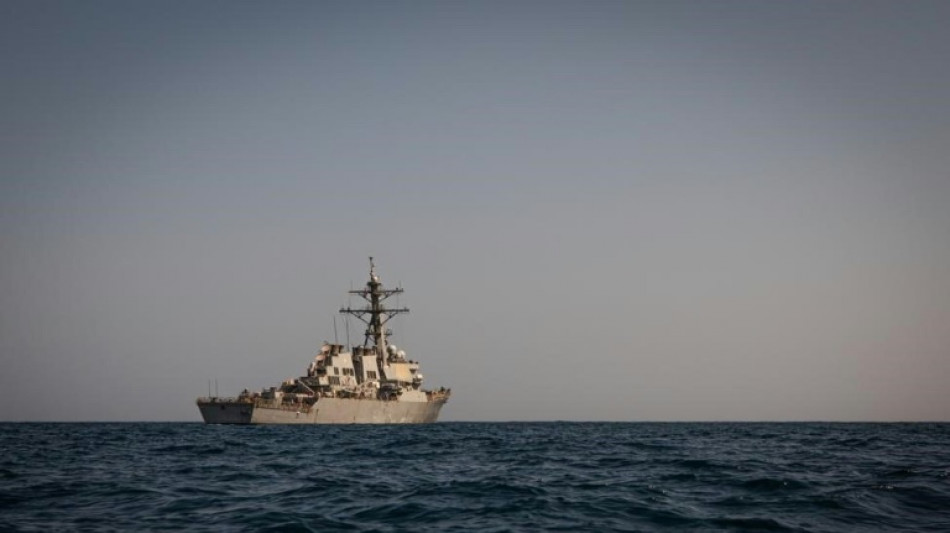
How the US helped counter Iran's attack on Israel / Photo: © US Department of Defense/AFP/File

 Mourinho blasts 'shameless' timing of Vinicius ban decision

 PSG beat Man City in Champions League thriller, Barcola hits Liverpool hat-trick

 US Treasury chief urges stronger IMF role against 'distortionary policies'

 Giant-killers Bodo sink Dortmund in Champions League

 PSG outgun embattled Man City in six-goal Champions League thriller

 In Chicago, pope's hometown, Catholics express shock and support

 Musk suggests US govt behind any slowdown in Ukraine's Starshield system

 Chiclayo prays for recovery and return of the 'Peruvian pope'

 Barcola scores hat-trick as Liverpool hit LASK for six

 Healthy corals help bleached neighbors regain color: study

 Hope ton helps West Indies level T20 series at 2-2 in India

 Ukraine war reaches shores of Bulgarian fishing village
 Brazil probing 'criminal' origin of forest fires: minister to AFP

 Sally Rooney books cannot be sold in UK amid Palestine Action ban: publisher
 Italian ski stars Goggia and Brignone to miss season opener
 Bournemouth boss Rose urges Cherries to bounce back from Chelsea 'slap'

 Top seed Sabalenka falls at first hurdle in Wuhan

 FX Junction Brings Copy Trading to Everyone, While Their Money Never Leaves With Their Broker

 Brighton defender Struijk's red card overturned

 Saudi league postpones three matches after Houthi attacks

 US consumer inflation up more than expected as midterms loom

 Canadian publisher supports novelist Orelien after AI denial

 Medvedev sees off Tsitsipas to reach Shanghai Masters quarters

 Louvre boss warns of closure risk without major renovations

 Lawes and Genge urge England to end ban on overseas-based players

Iran's unprecedented attack on Israel with hundreds of drones and missiles marked the culmination of a tense two weeks in which Washington engaged in whirlwind efforts to prepare for the expected violence.
American aircraft and planes downed dozens of drones and missiles when Iran launched the attack on Saturday, after Tehran repeatedly threatened to hit back in response to an Israeli strike on its consulate in Damascus that killed two top officers at the beginning of the month.
Senior US officials detailed the role Washington played -- both militarily and diplomatically -- in countering the attack:
- Iranian attack -
Iran launched a barrage of more than 100 medium-range ballistic missiles, more than 30 land-attack cruise missiles and more than 150 attack drones at Israel, a senior US military official said.
Two American warships -- the USS Arleigh Burke and the USS Carney -- destroyed between four and six ballistic missiles, while US aircraft shot down more than 70 Iranian drones, the military official said.
A Patriot missile battery also shot down a ballistic missile that was headed toward Israel in the area of the northern Iraq city of Arbil.
President Joe Biden spent Saturday evening receiving real-time updates in the Situation Room at the White House as the attack unfolded.
"At one point, we knew there were over 100 ballistic missiles in the sky" and "the results of the defenses of course were unclear until all was said and done," a senior administration official said, describing the tense atmosphere.
- The catalyst -
Israel carried out a strike on Iran's consulate in Damascus on April 1, killing seven Revolutionary Guards including two generals and prompting warnings from Tehran that it would respond.
Top US officials were pulled aside and informed of details about the strike during a visit by the Israeli ambassador and defense attache at the White House, the senior administration official said.
"We were not a part of that strike" but "we knew that that would have repercussions," the official said.
A few days later, Biden instructed the government "to defend Israel to the maximum extent possible" and to ensure that all necessary authorities and assets were in place to do so -- a directive that sent officials into action.
- US preparations -
Ahead of the attack, US officials including Secretary of Defense Lloyd Austin and Secretary of State Antony Blinken were in "constant, ongoing, continuous contact" with the Israelis, as well as with other countries in the Middle East.
General Erik Kurilla, the head of the US military command responsible for the region, was dispatched to the region and provided real-time updates as well as coordinating with the Israelis and other partners.
The United States was in touch with Iran as well, sending "a series of direct communications through the Swiss channel," the senior administration official said.
Washington also deployed additional military assets to the region "to bolster regional deterrence efforts and increase force protection for US forces," a US defense official said last week.
- What comes next? -
The US goal since the start of the latest round of conflict between Israel and Hamas six months ago has been to prevent it from spiraling into a broader regional conflict, and Washington is keen to lower the temperature in the region.
"We would not be a part of any response they do," the senior administration official said of possible Israeli action after the attack. "We would not envision ourselves participating in such an act."
Israel has meanwhile "made clear to us they're not looking for a significant escalation with Iran," but "a big question is not only whether, but what Israel might choose to do," the official said.
F.Fehr--VB