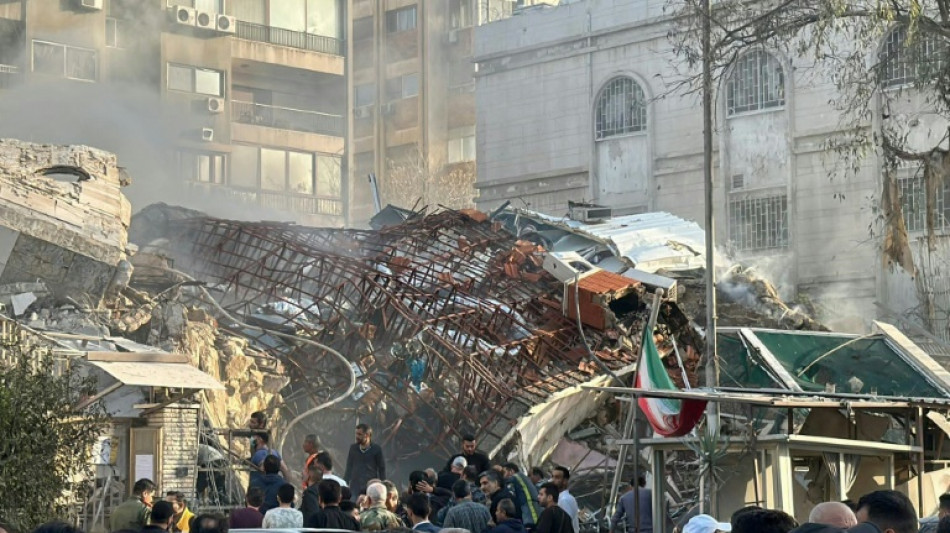
How could Iran seek to punish Israel over consulate strikes? / Photo: © AFP/File

 Same-sex couple takes fight for equality to Slovakian court

 'High hopes' as Indonesian women get a football league, again

 'Expectations high' for Bordeaux-Begles' Champions Cup hat-trick bid, says Depoortere

 Rennie urges All Blacks to stay focused against 'hurting' Wallabies

 Palmeiras beat Fluminense 2-1 in Libertadores semi-final first leg

 Brewers blasts leave Dodgers on brink

 Tech stock lead rout after US inflation fuels rate hike bets

 Al-Fayed survivors say UK police missing 'bigger picture'

 Online 'witch hunt' sweeps up Asians misidentified as US rape accused

 Prospect of Bolsonaro win looms large over Brazil's Indigenous

 Freed from Belarus, founder of Lady Gaga's biggest fan site tells his story

 Behind AI's carbon footprint, a potential climate tool

 Trump's new press secretary faces scrutiny over credentials

 PSG 'got lucky' to win Man City thriller, says Luis Enrique

 Real Madrid comeback stuns Roma as Mourinho enjoys happy reunion

 Shakhtar make winning start at new Champions League 'home'

 Hat-trick hero Barcola primed to shine for Liverpool: Iraola

 Villa put six past Fenerbahce in record rout

 US stocks fall after hot inflation report as leading AI shares tumble

 Government buildings torched in violent Albanian protests

 Wall Street grills Bank of America over money laundering fine

 Mekies extends contract as Red Bull team principal until 2031

 Indonesia rescues starved orangutan from fires: officials

 Real Madrid's Vinicius banned for Clasico after red card
 Restrictions expose Ukraine's Starlink dependency in Russia war: observers
Iran has vowed to punish Israel over a recent strike on its Damascus consulate widely blamed on Israel, and fears are rising that an imminent response could risk triggering a broader conflict.
However there are a number of different ways that Iran could retaliate, and not all pose the same risk of escalation, according to experts.
With warnings building on Friday that a response could come soon, France advised its citizens not to travel to Israel, the Palestinian territories, Iran or its ally Lebanon.
But exactly what happens next likely depends on how Iran chooses to carry out its retaliation, which would likely come against the backdrop of the war between Israel and Hamas.
The fact that none of the governments involved want to provoke an escalation does not necessarily protect against a full-scale crisis breaking out, said David Khalfa, Middle East specialist at the French think tank Jean-Jaures Foundation.
"Miscalculations are entirely possible. Deterrence has an eminently psychological aspect," he told AFP.
"The belligerents are at the mercy of any mistake or slip-up that could cause a cascading series of consequences."
The air strike that struck Iran's consulate building in the Syrian capital on April 1 killed 16 people, including seven members of Iran's Revolutionary Guard.
The most senior figure killed was Brigadier General Mohammad Reza Zahedi, a senior commander in the Quds Force, which runs Iran's foreign military operations.
Iran and Syria have blamed the attack on Israel, which has not confirmed its involvement but is widely considered to be responsible -- including by its allies.
- 'Tehran does not want direct war' -
"Israel's air strike on the facility was intended to tell Tehran that it will be held accountable for the actions of Hamas and other non-state allies such as Lebanese Hezbollah and the Huthis in Yemen," said the Soufan Center, a non-profit organisation that analyses global security challenges.
After the strike, Iran's supreme leader Ayatollah Ali Khamenei warned that Israel "must be punished and will be punished".
The White House, which has maintained the United States would stand firm behind its ally Israel, emphasised on Friday that Iran's threats were "real".
The US also sent its top commander for the Middle East, US Central Command chief Michael Kurilla, to Israel to talk things over.
Iran has an arsenal capable of hitting a wide range of Israeli targets, including infrastructure, airports or key energy production sites.
The Soufan Center said that the posture adopted by Israel and the United States "suggests they expect Tehran to conduct its attack using its arsenal of ballistic and cruise missiles, as well as armed drones".
But since the consulate attack, Iran has remained vague about exactly how it will respond.
Eva Koulouriotis, an independent Middle East analyst, said: "Iran is still threatening to respond while sending regional and international messages that it is looking for a political option alternative to a military response.
"What is certain is that Tehran does not want a direct war with Israel, at least at the current stage," she told AFP.
- 'Only bad choices' -
Iran is "facing a dilemma," Michel Duclos, a former French diplomat, wrote on the website of the Institut Montaigne think tank.
"It is undoubtably not sure enough of its strength that it could consider an escalation with Israel with a light heart," he wrote.
"If however it does not respond, it risks losing some credibility in the region, including among armed groups who pledge allegiance" to Iran, he added.
Iran sponsors armed groups in Iraq, Yemen, Syria and Lebanon which make up the so-called "Axis of Resistance" against Israel and they seem to be on the front line more than ever, said Farzan Sabet, an analyst at the Geneva Graduate Institute.
Iran could potentially respond by requesting these groups ramp up the number of their attacks, or increase weapon deliveries, Sabet wrote on X.
"This option is more deniable, lower political cost, and less chance of direct blowback."
Other possible options including a strike against Israeli diplomatic missions abroad, which would have the disadvantage of involving a third country.
Iran could also attempt "terrorist attacks on US diplomatic facilities in or outside the region," the Soufan Center said.
Khalfa said that with the April 1 strike, "Israel wanted to change the rules of the game by hitting the head of the octopus, not just its tentacles, to force Iran out of the shadow war."
Now, "the Iranians only have bad choices at their disposal," he added.
F.Wagner--VB