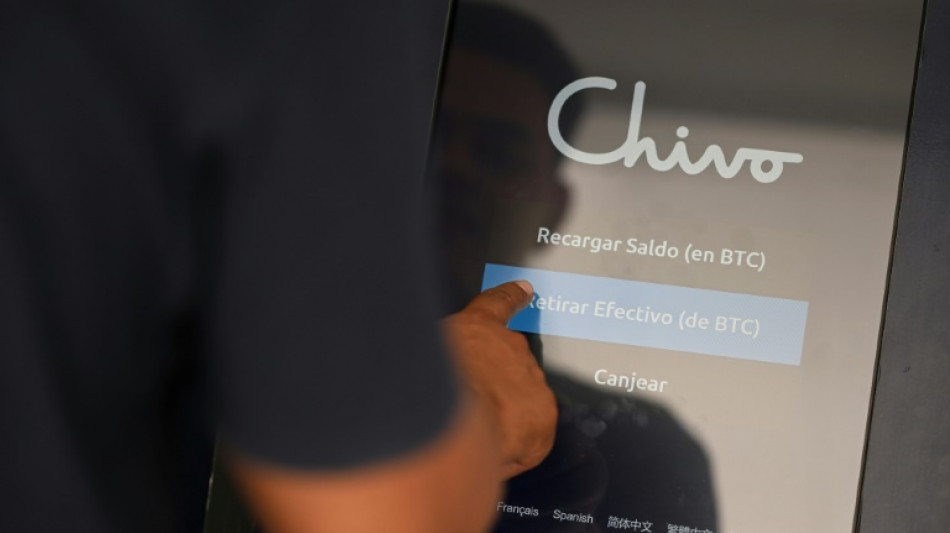
Record remittances provide lifeline in Central America / Photo: © AFP

 Guardians edge Rays to seize MLB playoff series lead

 Trump scraps plan to livestream execution after fierce backlash

 Martinez apologises for outburst at Man Utd hierarchy

 Houthis launch deadly attack on presidential palace in Yemen's Aden

 Brazil forward Antony says home burgled during Betis match

 Ravens face familiar foe in Browns coach Monken
 France, Germany reach deal on future of car industry

 Carney campaigns for Canadian unity before Alberta secession vote

 ATP proposes rankings system changes, extra player bonuses
 Russell Brand was 'monster-like', alleged victim tells UK court

 Crowded Launches Crowded MCP, Bringing Nonprofit Financial Operations Into ChatGPT and Claude

 Albanian PM condemns 'chaos' as violent unrest spreads
 Italian football suffers new blow with Champions League misery

 Trump scraps plan to livestream execution after broad backlash

 Seven missing off Romania after latest Black Sea drone attacks

 ARKBRIDGE Outlines Jonathan Morelli’s “Picks and Shovels” AI Infrastructure Investment Strategy

 Tech sell-off rolls on as hot inflation data stokes rate worries
 McIlroy makes 'solid' start in rain-hit Delhi as Norgaard leads

 Seven missing after fire on vessel in Black Sea off Romania

 'Severe drought' declared in parts of UK

 IUX Announces New Web Client Portal Built for Enhanced Browser-Based Trading

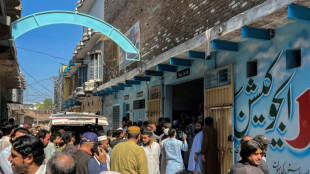 School roof collapse kills teacher, 32 children in NW Pakistan

 Inter skipper Martinez facing month out with thigh injury

 Spanish prosecutors back abuse probe into Julio Iglesias

 Tech sell-off deepens as US inflation sparks AI jitters

Money sent home by migrants in the United States to Central America has risen to record levels, providing a lifeline for many of their relatives like Salvadoran mother of three Marta Alvarado.
Such remittances are now equivalent to a quarter of the combined economic output of the poverty-afflicted nations of El Salvador, Guatemala, Honduras and Nicaragua.
Alvarado described the money transfers as "a blessing" for her family.
"What my brothers send month after month helps not only me but also my mother and father, who are now elderly," said the 54-year-old, who works as a secretary in a health clinic.
"It helps them to support themselves, buy their food, clothing and medicine, and to do home improvements," she told AFP.
El Salvador, Guatemala, Honduras and Nicaragua together received almost $42 billion in family remittances in 2023, according to official data from central banks and the intergovernmental Central American Monetary Council.
The remittances even exceed the amounts generated by foreign investment, tourism or exports.
They are a key factor in boosting trade and consumer spending in nations with high poverty rates, according to experts.
- 'Life preserver' -
Remittances to the four countries increased from $19.0 billion in 2017 to $41.8 billion in 2023 -- a rise that experts attribute to greater migration, in particular to the United States.
The exact number of Central Americans living abroad is unknown, since many are irregular migrants.
But according to estimates by international and non-governmental organizations, the figure is around 10 million, or a quarter of the combined population of El Salvador, Guatemala, Honduras and Nicaragua, where most migrants hail from.
"People who don't find opportunities in their country are forced to leave," Henry Rodriguez, an economist at the National Autonomous University of Honduras, told AFP.
Remittances now represent almost 27 percent of the gross domestic product (GDP) in Honduras, 26 percent in Nicaragua, 24 percent in El Salvador and almost 20 percent in Guatemala.
They are "and will continue to be a life preserver for the Salvadoran economy for a long time," economist Carlos Acevedo, a former president of El Salvador's central bank, said.
"Without remittances we would have sunk a long time ago," he told AFP.
"If dollars do not enter, the financial system does not work -- nothing works in the country. And remittances are one of the main sources of dollar inflows," Acevedo said.
- Breaking cycle of poverty -
In Nicaragua, 17-year-old student Ligia Hurtado receives money sent by two aunts from Spain, which she uses to pay for university fees, housing, food and transportation.
In El Salvador, 61-year-old retiree Emerita Coto said her brother sends her $400 every month from New York, money that she uses to pay for a plot of land that she acquired on credit.
In contrast, money transfers are less important for countries with little emigration, and represent only around one percent of GDP in Panama and Costa Rica.
Multilateral organizations such as the World Bank and the Inter-American Development Bank promote the productive use of remittances, rather than for consumption.
They encourage investment in small businesses to support the development of nations with small economies and high poverty rates.
It is a view shared by Guatemala's new president, Bernardo Arevalo.
"Remittances can contribute more efficiently to breaking the cycle of poverty that motivates migration," he said.
Gustavo Juarez, who heads an association of Guatemalans deported from the United States, agrees.
"It would be good for a remittance to be invested in a business or a small enterprise," he told AFP.
In El Salvador's capital, Alvarado's 71-year-old mother Ester plans to open a store with some of the money that her children send.
"Soon she will have a business that can help her to have other income," Alvarado said.
T.Suter--VB