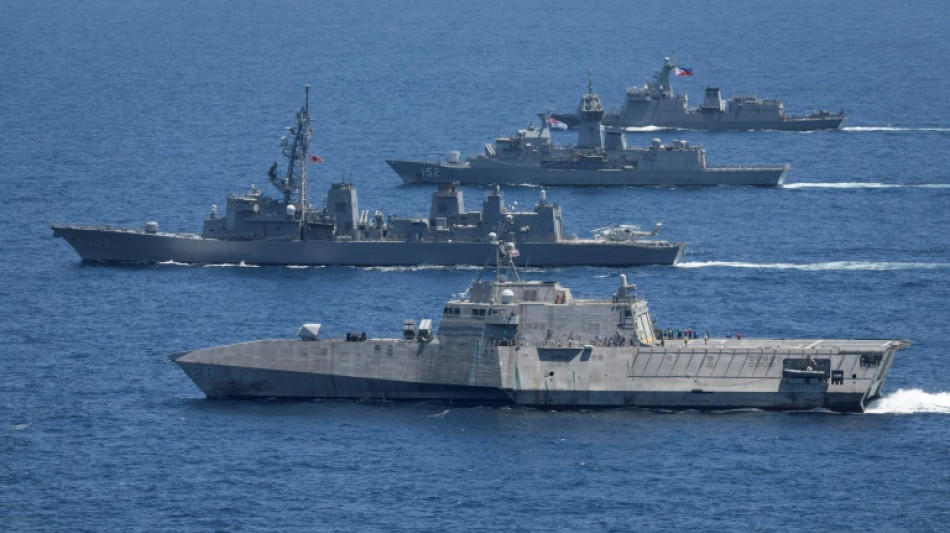
First US-Japan-Philippines summit to boost defence ties / Photo: © AUSTRALIAN DEPARTMENT OF DEFENCE/AFP

 Trump's new press secretary defends 'lawyer' title

 Wallabies coach has 'faith' as All Blacks juggernaut awaits

 Ailing UK director Mike Leigh wishes he could make '100 more films'

 Pixagram Announces Free Account Creation for 250 New Users Daily Through 2026

 Macron warns urgent to strike EU budget deal before French vote runup

 Zelensky rallies European allies as Trump ties slump
 Guardians edge Rays to seize MLB playoff series lead

 Trump scraps plan to livestream execution after fierce backlash

 Martinez apologises for outburst at Man Utd hierarchy

 Houthis launch deadly attack on presidential palace in Yemen's Aden

 Brazil forward Antony says home burgled during Betis match
 Ravens face familiar foe in Browns coach Monken
 France, Germany reach deal on future of car industry

 Carney campaigns for Canadian unity before Alberta secession vote

 ATP proposes rankings system changes, extra player bonuses
 Russell Brand was 'monster-like', alleged victim tells UK court

 Crowded Launches Crowded MCP, Bringing Nonprofit Financial Operations Into ChatGPT and Claude
 Albanian PM condemns 'chaos' as violent unrest spreads
 Italian football suffers new blow with Champions League misery

 Trump scraps plan to livestream execution after broad backlash
 Seven missing off Romania after latest Black Sea drone attacks

 ARKBRIDGE Outlines Jonathan Morelli’s “Picks and Shovels” AI Infrastructure Investment Strategy

 Tech sell-off rolls on as hot inflation data stokes rate worries

 McIlroy makes 'solid' start in rain-hit Delhi as Norgaard leads

 Seven missing after fire on vessel in Black Sea off Romania

The leaders of Japan and the Philippines head to Washington this week for a first trilateral summit aimed at boosting defence ties, hot on the heels of four-way military drills in the South China Sea that riled Beijing.
A major upgrade of military command structures between the United States and an increasingly self-confident Japan could be announced, as well as joint coast guard patrols with Manila in areas disputed with China.
Also on the agenda will be securing access to vital supplies such as semiconductors and rare metals, North Korea's growing belligerence, and the Japanese takeover of US Steel opposed by President Joe Biden.
The talks will "advance a trilateral partnership built on deep historical ties of friendship, robust and growing economic relations... and a shared vision for a free and open Indo-Pacific," the White House said.
Japanese Prime Minister Fumio Kishida said Monday before leaving Tokyo that the Japan-US relationship is "more ironclad than ever" and that his trip will "demonstrate this message to the world".
China's foreign ministry on Monday said it was "opposed to the cobbling together of exclusive small circles and to confrontation between different groups in the region."
- Full honours -
Kishida will on Wednesday become the first Japanese premier since Shinzo Abe in 2015 to be received with full honours at the White House, including a gala dinner and Rose Garden news conference.
The 66-year-old will then address both houses of Congress on Thursday before convening with Philippine President Ferdinand Marcos and Biden for the countries' first trilateral summit.
Biden, 81, and Marcos, 66, who is seen as closer to Washington than his more China-leaning predecessor Rodrigo Duterte, will also hold separate talks.
They are the latest Asia-Pacific allies to be hosted by Biden, who was joined by Kishida and South Korean President Yoon Suk Yeol at Camp David in August.
Biden has also moved to manage tensions with China, holding a two-hour phone call with President Xi Jinping last week and a face-to-face meeting in San Francisco in November.
- 'Momentous changes' -
Staunchly pacifist for decades, Japan has in recent years made "some of the most significant, momentous changes" since World War II, US ambassador to Japan Rahm Emanuel said ahead of the visit.
This includes plans to double military spending, buying US Tomahawk missiles, easing rules on exporting weapons and creating a joint operations command for its Self-Defense Forces (SDF).
It is also providing funding and equipment such as patrol vessels to countries across the region and is in talks with the Philippines about allowing troop deployments on each other's soil.
According to media reports, Biden and Kishida could agree to the biggest upgrade in US-Japan command and control structures in decades to make their militaries more nimble in a crisis, for example, a Chinese invasion of Taiwan.
"Currently, despite their close inter-operability, US forces in Japan and SDF operate under separate commands," said Yee Kuang Heng from the University of Tokyo's Graduate School of Public Policy.
The US has 54,000 military personnel in Japan who must report back to Indo-Pacific Command in Hawaii, around 6,500 kilometres (4,000 miles) away and 19 hours behind.
"This is seen as not fit for 21st-century purposes given the severe security environment around Japan," Heng told AFP.
The two countries may also agree to allow large US warships to undergo repairs at private shipyards in Japan, and to joint production of defence equipment, media reported.
- Joint drills -
On Sunday, the US, Japanese, Filipino and Australian militaries conducted joint exercises in the South China Sea, which Beijing claims almost in its entirety despite an international court ruling that its assertion has no legal basis.
China's People's Liberation Army (PLA) Southern Theater Command said it was organising "joint naval and air combat patrols in the South China Sea" the same day.
"All military activities that mess up the situation in the South China Sea and create hotspots are under control," it said in a statement.
- Trump round two -
But marring the mood between Washington and Tokyo at the summit is Biden's opposition to Nippon Steel's proposed $14-billion acquisition of US Steel, based in Pennsylvania, a key election battleground state.
A visit by Kishida to Toyota and Honda factories in North Carolina during his visit to highlight Japanese investment is seen as an attempt to soothe fears about the deal.
Looming over the talks is also the prospect of Donald Trump returning to the White House after US elections in November and the potential disruption that the 77-year-old could bring to US allies.
"I would not be surprised if Japanese officials and businesses were reaching out to people close to... Trump," Naoko Aoki, a political scientist at Rand Corporation, told AFP.
"I am sure the US election is very much on their minds."
burs-stu/cwl
F.Wagner--VB