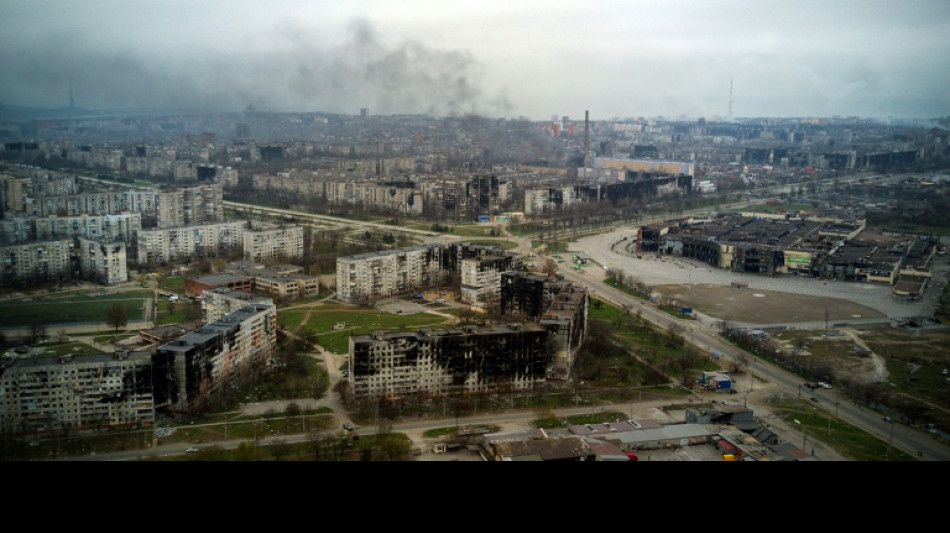
Mariupol's tunnel warriors seek to slow Russian onslaught / Photo: © AFP

 Zhu Rongji, trailblazing ex-premier who transformed China's economy

 China tech giant Tencent's Q2 profit down as AI push builds

 China's C919 jet makes first international commercial flight
 Mideast war impact on travel bookings fading, TUI says

 Bangladesh get Das fitness boost for daunting Australia task

 One dead, 172 rescued as second ferry in days catches fire in Indonesia
 Foxconn posts quarterly profit surge on AI server demand

 Hazlewood gets Australia nod ahead of Boland for Bangladesh Test

 Toyota ex-chief Okuda, pioneer of the Prius, dead at 93

 Colombia rescuers find woman alive as quake death toll passes 200

 New Zealand PM survives leadership challenge months from election
 Passengers rescued as second ferry in days catches fire in Indonesia

 Oil prices rise, stocks mixed ahead of crucial US inflation data

 UK 'joke' candidate Binface pushes serious point about politics
 New Zealand PM Luxon survives leadership challenge months from election

 Cuba celebrates Castro's 100th as his revolution faces its toughest test
 Defending champion Shelton rolls into Montreal semis

 What to know about the total solar eclipse

 Tentoglou claims fourth Euro long jump title, injured Jacobs falters

 All Blacks knew Nonu would perform solo Haka - coach Rennie

 Britain's Glave upstages Jacobs to win European 100m gold

 Greece's Tentoglou wins fourth European long jump title

 Doctors ignored 'warning signs' before Maradona's death, court hears

 Pereira, the 'zombie city' devastated by Colombia's earthquake

 UN says 2 staff arrested by Afghan intelligence agency

As Russian forces close in on the southern Ukrainian port city of Mariupol, a small number of resistance fighters hope to slow them down using a tunnel system below a vast industrial site as their base.
Experts say the fall of the city, seen as strategically vital for Russian plans to attack eastern Ukraine, is inevitable.
But holdouts in their underground bases hope to make conquering the Sea of Azov port as hard as possible for the attackers.
The urban landscape where the Ukrainian resistance plans to take on the invaders seems almost tailor-made for guerrilla warfare, with sprawling rail lines, warehouses, coal furnaces, factories, chimneys and tunnels.
The maze-like area is a metal works complex, Azovstal, owned by Metinvest, which is run by Ukraine's richest man Rinat Akhmetov.
It has been the focus of urban fighting in Mariupol, just like the nearby Azovmash factory which makes rail components, cranes and other large metal structures.
"It's a city within a city," said Eduard Basurin, a representative for pro-Russian separatists in the eastern Donetsk region.
"There are several underground levels that date back to Soviet times which you can't bombard from above. You have to go underground to clean them out, and that will take time."
Entering the tunnels would be all but impossible for Russian troops, according to Alexander Grinberg, analyst at the Jerusalem Institute for Strategy and Security.
- 'They can try' -
"They can try, but they'll be slaughtered because the defenders of the tunnel will absolutely have the tactical upper hand," he told AFP.
Fighters have in the past used tunnel systems to great effect in their struggle against superior forces.
The Viet Cong made the vast Cu Chi tunnel system near Saigon a base for attacks against US troops and Hamas has used tunnels in their fight against the Israeli army.
The Islamic State group's tunnel system in Mosul, Iraq, allowed its fighters to surprise American troops with sudden appearances seemingly out of nowhere.
But the most memorable example dates back to World War II and the battle of Stalingrad with its fierce fighting in the Red October industrial complex.
"The Soviets used underground passages, sewers and tunnels to get behind German lines," a French military source told AFP.
A sapper unit discovered a former factory used by German troops, stacked three tonnes of explosives underneath and blew up the entire complex, burying the Germans in the rubble, the source said.
The astute use of tunnels has lost none of its effectiveness in the 80 years since, rendering enemy artillery, air strikes and snipers virtually useless.
Satellite surveillance is also of limited use against combatants hiding below ground, as is technical intelligence, the spying on enemy weapons.
However, as analysts point out, the underground system only works if the network is vast and fighters have enough ammunition, food and water, which requires meticulous advance planning.
Soldiers deployed underground also need extremely good training to be operational in this unusual combat environment, said James Rands at British defence intelligence specialists Janes.
- 'Inherent dangers' -
"The enclosed spaces mean engagements occur at shorter ranges, limiting the effectiveness of some small arms," he said.
Close-range use of weapons also carries "a significant risk of tunnel collapse and inherent dangers to the forces employing them", he said.
In addition, commanding troops underground is difficult because standard communications do not work well, and tunnel networks are not usually well mapped, he said.
The evacuation of wounded soldiers is also very cumbersome, Rands added.
Despite all the advantages for the defenders, the tunnel network can possibly still be taken if, as is likely, the Ukrainians lack key equipment in sufficient quantity, such as night-vision gear, analysts said.
It may also be difficult to counter the potential use by the Russians of large quantities of water to flood the tunnels, or of gas or chemical products to force the Ukrainians to the surface.
Although Russian President Vladimir Putin said Tuesday that Russia was pursuing its Ukraine operation "calmly", there is a chance that the tunnel wars will be anything but -- and last for some time.
F.Pavlenko--BTB