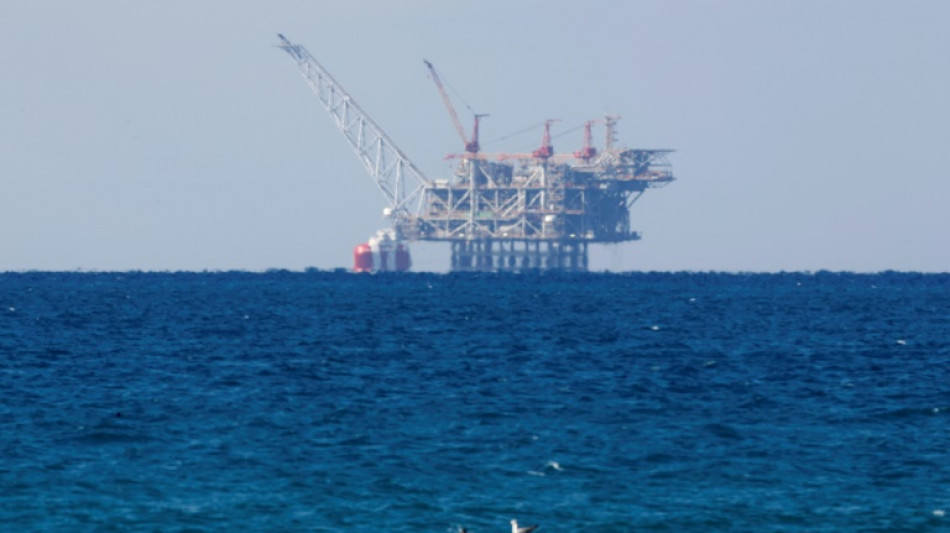
As EU eyes stopping Russian gas imports, Israel sees an opening / Photo: © AFP/File

 Colombia declares three days mourning for quake victims

 44 lives lost after ferry capsizes on Zimbabwe's Lake Kariba

 WallStreetPR Releases Report on China’s Gold Purchases and African Mining Investment

 Former Chinese premier Zhu Rongji dies aged 97
 Markets steady awaiting US inflation data
 WHO says Trump vaccine shake-up goes against evidence

 Eclipse chasers flock to Spain for 'breathtaking' experience

 'To make the civilians leave': Russia pummels Ukraine's petrol stations
 Japan brushes off Australian PM's melon drama

 Rod Stewart cancels tour dates after heart surgery
 How Britain's mapmakers track climate change

 Australian delivery drivers win 'world-leading' pay rise

 Meta meets its own 'tobacco' moment in court

 Art or medicine? Japan's cosmetic tattoo artists in limbo
 Rybakina ousts Osaka to book Toronto semi-final against Gauff
 Colombia rescuers find woman alive as quake death toll passes 240
 Charges dropped against Bondi Beach attack hero
 Parched and desperate for rain, Kazakhstan turns to cloud-seeding

 The perfect storm that turbocharged Venezuela's twin quakes
 2.4 million girls banned from Afghan schools since Taliban return: UNESCO
 Colombians dig through rubble as quake death toll surpasses 240

 New Zealand's ruling party meets to decide PM Luxon's fate

 Total solar eclipse to spellbind Europe

 Jodar, Nakashima to make Masters semis debuts in Montreal

 Chilean veteran Sanchez signs with MLS club Montreal

As Europe aims to wean itself off Russian fossil fuel because of the Ukraine invasion, Israel hopes to help fill the gap with gas from its offshore reserves.
EU states remain divided on the time scale, but European Commission President Ursula von der Leyen has said the bloc hopes to phase out its dependency on Russian gas, oil and coal by 2027.
Israel could build one or more pipelines, potentially via Greece or Turkey, or increase the quantity of gas piped to Egypt to be liquified and shipped off, say officials and experts.
Israeli Foreign Minister Yair Lapid said after a recent visit to Athens that "the war in Ukraine stands to change the structure of the European and Middle Eastern energy market".
"We are also examining additional economic cooperation, with an emphasis on the energy market."
The Jewish state has worked for years to create gas export routes, with mixed results so far.
Turkey, whose ties with Israel have recently thawed after over a decade of rupture, has expressed new interest in a pipeline, and its energy minister is expected in Israel in the coming weeks.
During the years of diplomatic alienation from Turkey, Israel signed an accord with Greece and Cyprus in 2020 aiming to build the EastMed pipeline through those two countries from Israel to Europe.
Turkey opposed the project, and a senior US diplomat said last week it would be too expensive and take too long to build.
Energy Minister Karine Elharrar also hailed the potential for gas sales to Europe, telling the French Association of Defence Journalists that "we have the ability and we will try to do as much as we can".
- Regional alliances -
With both Greece and its regional rival Turkey vying to be the conduit for the gas, Israel would have to tread carefully amid the regional alliances it wishes to uphold and strengthen.
Major gas finds in the eastern Mediterranean -- nearly 1,000 billion cubic meters (bcm) -- have in the past decade turned Israel from a natural gas importer into an exporter.
It now sells small quantities from its two major offshore fields, Leviathan and Tamar, to Egypt and Jordan.
Israel's domestic consumption over the next three decades would leave some 600 bcm available for export, said opposition lawmaker Yuval Steinitz, Israel's energy minister until last year.
"In 2016 the pipeline to Turkey was examined, including with Turkey and commercial companies," said Orit Ganor, director of natural gas international trade at Israel's energy ministry.
"The project didn't reach fruition mainly due to economic reasons."
Ganor said "the EastMed pipeline is still an option, and the company advancing it, Poseidon, is in the final stages of geophysical and geotechnical surveys of the pipe's route in our waters and those of Greece and Cyprus".
No financing has been secured for the project, which Steinitz said would cost about $6 billion and take around four years to complete.
He said there was also agreement with Cairo on a seabed pipeline from Leviathan to Egypt's liquification plants that would allow for greater exports to Europe.
- 'Catch-22' -
Israel's Leviathan field, which would be the source for European exports, is operated by an Israeli-American consortium including NewMed Energy and US major Chevron.
NewMed Energy CEO Yossi Abu recently stated his ambition of "bringing Israeli gas to Europe and Asia".
Experts say Israel's current gas fields represent a third of potential reserves, but a means to sell future finds would be needed to encourage further exploration by private companies.
The state of Israel provides exploitation licenses and regulatory support, but does not drill for gas or build pipelines.
"There's a 'Catch-22' here," said Elai Rettig, a political scientist at Tel Aviv's Bar-Ilan university.
"You need to find a customer that will agree to pay for this very, very expensive pipeline, and they won't do it until you show them you've found enough gas to justify it.
"And you won't find enough gas to justify it until you show that there's someone to sell the gas to."
Europe's efforts to diversify gas imports began before the Ukraine war when it "experienced harsh weather and gas prices rose significantly," said Ganor, the energy ministry official.
Steinitz said a pipeline to Turkey would cost $1.5 billion and take two to three years to build.
Israel "could definitely be a serious factor in creating more independence and a wealth of energy sources for Europe," he said.
He said Israel could even export via Greece, Turkey and Egypt at the same time because "we have enough gas to export through the three channels".
Rettig stressed Israel's need for "balance" between Turkey and Greece and to "continuously talk to both sides and to reassure them that one doesn't come at the expense of the other".
P.Anderson--BTB