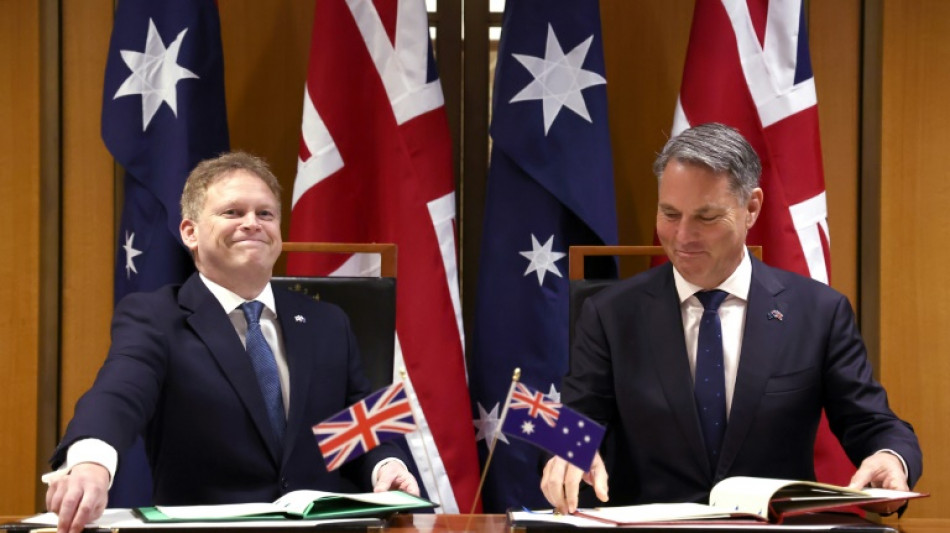
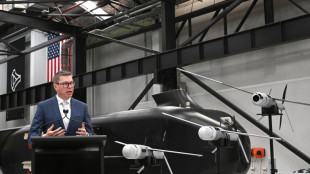
UK and Australia sign new defence pact / Photo: © AFP

 Guehi insists players have 'trust and belief' in Man City after charges
 UN climate panel head wants swift end to deadlock over key scientific report

 PM calls for curfews in France as govt grapples with unrest
 Man City's Semenyo out for up to eight weeks

 Australian lawmaker critically hurt in 'violent' vehicle attack

 England women's coach Wiegman signs two-year contract extension

 Louvre blocked as France grapples with unrest
 Bollywood actor Tiger Shroff shot at in Mumbai, three suspects held: police

 UN biodiversity summit opens with nature goals off track

 'Physical hell': Hong Kong hosts gruelling underwater hockey tournament

 Police 'lost control' during French protests, says interior minister

 Australia's new Ghost Shark submarines grow some 'teeth'

 'I call it a bribe': Pennsylvania residents spurn $10,000 data center checks

 In a former US steel city, ordinary people struggle to get by

 'Liar,' 'clown': Lula and Bolsonaro spar in Brazil poll debate
 Record El Nino? Depends who's counting

 On the front line of ocean conservation off Portugal's Madeira

 Wembanyama targets title breakthrough as NBA season tips off

 With LeBron on board it's title or bust for Philly fans
 One year after Louvre heist, where are the missing jewels?

 Knicks face tall task in NBA championship repeat bid

 Warriors' Curry 'fine' after limping out of practice - Kerr

 Zelensky speaks to US envoys as Trump lashes out

 'Surprise package' Lazio crush Juve to keep pace with Serie A leaders Inter

 China growth expected to miss official target in third quarter

The United Kingdom and Australia inked a new defence agreement in Canberra on Thursday, as they try to boost a fledgling nuclear-powered submarine program with the United States.
UK defence minister Grant Shapps signed the agreement in Canberra with his counterpart Richard Marles, establishing a legal framework that makes it easier to host troops and share military intelligence.
The agreement stops short of a full mutual defence pact, which would bind one side to intervene if the other was attacked.
But it does include a "commitment to consult" about emerging threats and establishes an "status of forces agreement", which makes it easier to host soldiers from the other nation.
"It is extraordinary, actually, the United Kingdom and Australia didn't already have a defence cooperation treaty in place," Shapps said after the signing ceremony.
Alongside the United States, Australia and the UK are members of the fledgling AUKUS defence alliance -- a landmark pact aimed at curbing Chinese military expansion in the Asia-Pacific.
Barely two years old, there are already signs the AUKUS program is under threat -- and some fear Donald Trump could scrap it completely if he returns to power next year.
Australian National University security analyst David Andrews said Thursday's agreement gave the stalling AUKUS plan some much-needed momentum.
"If there was a Trump administration at end of year, and for whatever reason they were not interested in pursuing the agreement, or not in the same way it is envisioned now, there is potential for a heavier bilateral pathway," Andrews told AFP.
A major pillar of the AUKUS pact is a promise to help Australia build and acquire a fleet of potent nuclear-powered submarines, one of its biggest-ever military upgrades.
Thursday's agreement would make it easier, for example, for Australian sailors to train on the UK's nuclear subs, or for British crews to be based in Australia.
"This is a reflection of increased engagement between our two defence forces," said Australian defence minister Marles.
"And it will greatly streamline the ability for us to work together."
- Consult on threats -
London and Canberra have pledged to consult each other if looming regional threats start veering towards conflict.
"I think one of the most important elements is it describes a mechanism by which we consult when either of our countries are under threat," said Shapps.
Among a host of other initiatives included in the deal is "closer collaboration on undersea warfare", and greater UK contribution to Australian-hosted joint military exercises.
Australia has also agreed to join a coalition with the UK and Latvia that aims to supply drones for the Ukrainian war effort.
The UK has been a major backer of Ukraine in its grinding war against invading Russian forces.
H.Gerber--VB